Mo Rocca spotlights George M. Cohan, Broadway's original king
Mo Rocca turns to George M. Cohan, the Broadway showman who helped script American patriotism into popular culture. His songs still echo in civic rituals, campaign language and musical theater.
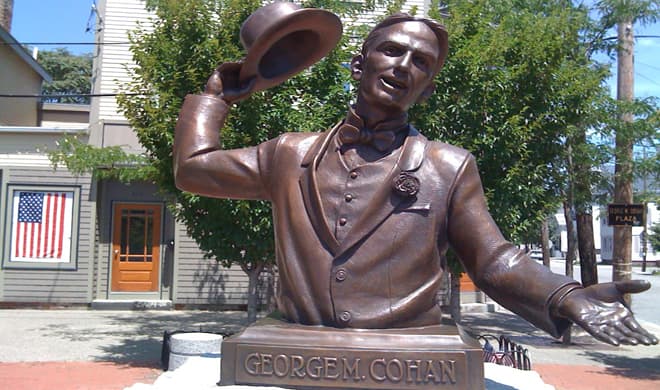
Mo Rocca’s latest Sunday Morning segment looks at George M. Cohan as more than a show-business legend. It treats him as one of the architects of American patriotism in popular culture, a performer whose songs, characters and swagger helped define what “all-American” sounded like on stage. That influence outlasted Broadway’s early era, surfacing in public rituals, political rhetoric and the DNA of musical theater itself.
The Broadway pioneer who made patriotism catchy
Cohan was born George Michael Cohan on July 3, 1878, in Providence, Rhode Island, and grew up inside performance. He began as a child in his family’s vaudeville act, The Four Cohans, learning the rhythms of song, dance and comic timing before he became one of Broadway’s defining early figures. By the time he died in New York City on November 5, 1942, he had become the industry’s original self-styled king, known widely as “the Yankee Doodle Dandy” and, in the early 20th century, as “the man who owned Broadway.”
His output was enormous even by the standards of commercial theater. Beginning with *Little Johnny Jones* in 1904, he wrote, composed, produced and appeared in more than three dozen Broadway musicals. Over his lifetime he wrote more than 50 shows and published more than 300 songs, a catalog that gave the American stage a new kind of tempo: brisk, brassy, patriotic and unmistakably urban.
How Cohan built an American sound
Cohan’s greatest strength was not just melody but identity. Songs such as “Give My Regards to Broadway,” “The Yankee Doodle Boy,” “Over There” and “You’re a Grand Old Flag” made him a national figure because they translated patriotism into performance. Instead of solemn civic music, he offered sharp, memorable tunes that could travel easily from theater to parade ground to public ceremony.
That mattered because early 20th-century America was still making up its mass culture. Cohan’s songs helped give audiences a shared language for nationhood, one built around optimism, motion and a broad confidence in the American project. His stage persona, part song-and-dance man and part producer-entrepreneur, reinforced the idea that patriotism could be entertaining, popular and distinctly modern.
Why World War I made Cohan even more important
Cohan’s legacy deepened during World War I, when patriotic songs became tools of morale as well as entertainment. “Over There” in particular became tied to the wartime mood, and the wider Cohan repertoire gave Americans music that fit rallies, performances and public sentiment during a period of national mobilization. The songs did more than reflect the moment. They helped shape it.
That contribution was formally recognized in 1940, when President Franklin D. Roosevelt awarded Cohan the Congressional Gold Medal for boosting morale through patriotic songs. The honor underscored something that theater audiences had known for decades: Cohan’s work had moved beyond Broadway and into the civic bloodstream. He had become a cultural supplier of confidence at a time when the country needed it.
What Rocca is spotlighting now
The CBS News Sunday Morning segment featuring Mo Rocca airs on June 7, 2026, and frames Cohan through Rocca’s long-running role as a correspondent who often draws larger historical meaning from American culture. Here, the focus is not simply on nostalgia for old Broadway. It is on how one writer-performer helped build a usable national myth, one that could be sung, repeated and absorbed by generations who never saw his original shows.
That framing matters because Cohan’s reputation can easily be reduced to one-liners about Broadway glamour or old-fashioned patriotism. Rocca’s spotlight instead places him in a longer civic story. Cohan’s music helped turn national identity into something catchy enough for theatergoers and durable enough for public life.
Why his legacy still surfaces in public life
Cohan’s influence persists because his songs sit at the intersection of entertainment and ceremony. “You’re a Grand Old Flag” and “Over There” are not just period pieces. They are examples of how popular music can become embedded in civic rituals, from holiday programs to commemorations that rely on familiar patriotic cues. His work also shaped the tone of campaign rhetoric, where upbeat, flag-waving language often echoes the cheerful certainty Cohan made central to his stage persona.
Theater itself still carries his imprint. Cohan helped define the New York musical comedy stage as a place where pace, personality and audience appeal mattered as much as plot. PBS has described him as a vaudeville song-and-dance man, playwright, manager, director, producer, comic actor and songwriter central to that world, and that range explains why his influence lasted. He did not just write songs. He modeled a type of American entertainer who could write, produce, perform and brand a national mood.
A foundation built from numbers and staying power
The scale of Cohan’s career helps explain why his name endures. More than 50 shows, more than 300 songs and more than three dozen Broadway musicals would be remarkable for any era. In Cohan’s case, those numbers came paired with a recognizable public identity that made him instantly legible to audiences: a fast-talking, patriotic, theatrical American original.
That combination is why he remains useful to historians, performers and viewers more than eight decades after his death. Cohan’s success was not just commercial, though Broadway success was central to it. It was cultural. He helped create a version of American patriotism that could be staged, sold and remembered, and that version still shapes how the country performs itself in song, in theater and in public ritual.
By revisiting Cohan now, Rocca is pointing to something larger than nostalgia. He is showing how one man’s songs helped teach America how to sing about itself, and how that song still echoes whenever the nation reaches for a familiar patriotic refrain.
This article was produced by Prism’s automated news system from verified source data, official records, and press releases, then run through automated quality and moderation checks before publishing. The system is built and supervised by the people who set the standards it runs under. Read our full AI policy.
Did this article answer your question?