Monaco Grand Prix through the decades, from 1950 to 2026
Monaco’s glamour never disappeared, but Formula 1 turned it into a far bigger commercial and technical showcase, with the circuit still punishing even the best cars.

The race that started as a street spectacle
The Monaco Grand Prix began as a local ambition with global consequences. Its first running took place on April 14, 1929, under the honorary presidency of Prince Louis II, with Antony Noghès of the Automobile Club de Monaco and Monégasque driver Louis Chiron helping push the event into existence. The inaugural race featured 16 competitors, 100 laps, and, according to Monaco’s own history, an average speed of 80.194 km/h by winner William Grover-Williams.
That origin matters because Monaco was already doing something the rest of motorsport was still learning to value: turning a city into a theatre. The narrow harbor, the hillside streets, and the sheer density of spectators made it unlike a purpose-built circuit from the start. Long before Formula 1 became a worldwide business, Monaco had the ingredients that would later make it indispensable, prestige, spectacle, and risk compressed into a few square kilometers.
1950: Monaco joins Formula 1 and immediately defines the championship
Monaco entered the Formula 1 World Championship in 1950, and its first championship race was held on May 21, 1950. Juan Manuel Fangio won for Alfa Romeo, with Alberto Ascari second and Louis Chiron third. That podium already said a great deal about the race’s place in the sport: Monaco was not a sideshow, but a true proving ground where the best drivers of the era had to combine precision, nerve, and restraint.
The 1950 event also came during Formula 1’s first championship season, when the world title was still a new organizing framework for the sport. Monaco’s immediate inclusion gave the series a dose of aristocratic glamour and urban drama that no other venue could match. The race’s status was reinforced by the fact that it became a permanent fixture from 1955 onward and has stayed on the calendar continuously since then.

A circuit that shaped the sport as much as the sport shaped it
The modern Circuit de Monaco is 3.337 km long, and the Grand Prix covers 78 laps for a total distance of 260.286 km. Those numbers help explain why Monaco remains such a singular challenge: the lap is short, the margins are tiny, and there is no room for error. Formula 1 describes the track as narrow, spectacular, and technically demanding, with overtaking extremely difficult.
That difficulty is central to the race’s identity. In many venues, modern F1 has come to reward downforce, tire management, and strategic flexibility; Monaco adds a fourth requirement, absolute precision within the tightest possible street setting. The track’s character has not been softened by time. If anything, the contrast between 1929’s 100-lap endurance spectacle and today’s shorter, faster championship event makes Monaco’s evolution clearer: the city race has adapted to Formula 1’s technical escalation while preserving the same basic visual grammar.
From glamour to global commercial machine
A photo roundup of Monaco through the decades works best when it is read as a record of transformation, not nostalgia. The early images capture a race that was intimate, almost improvisational, where the barrier between elite society and competition was porous. Later decades show how Monaco became the sport’s annual statement of luxury, celebrity access, and commercial power, a place where Formula 1 sells not only speed but status.
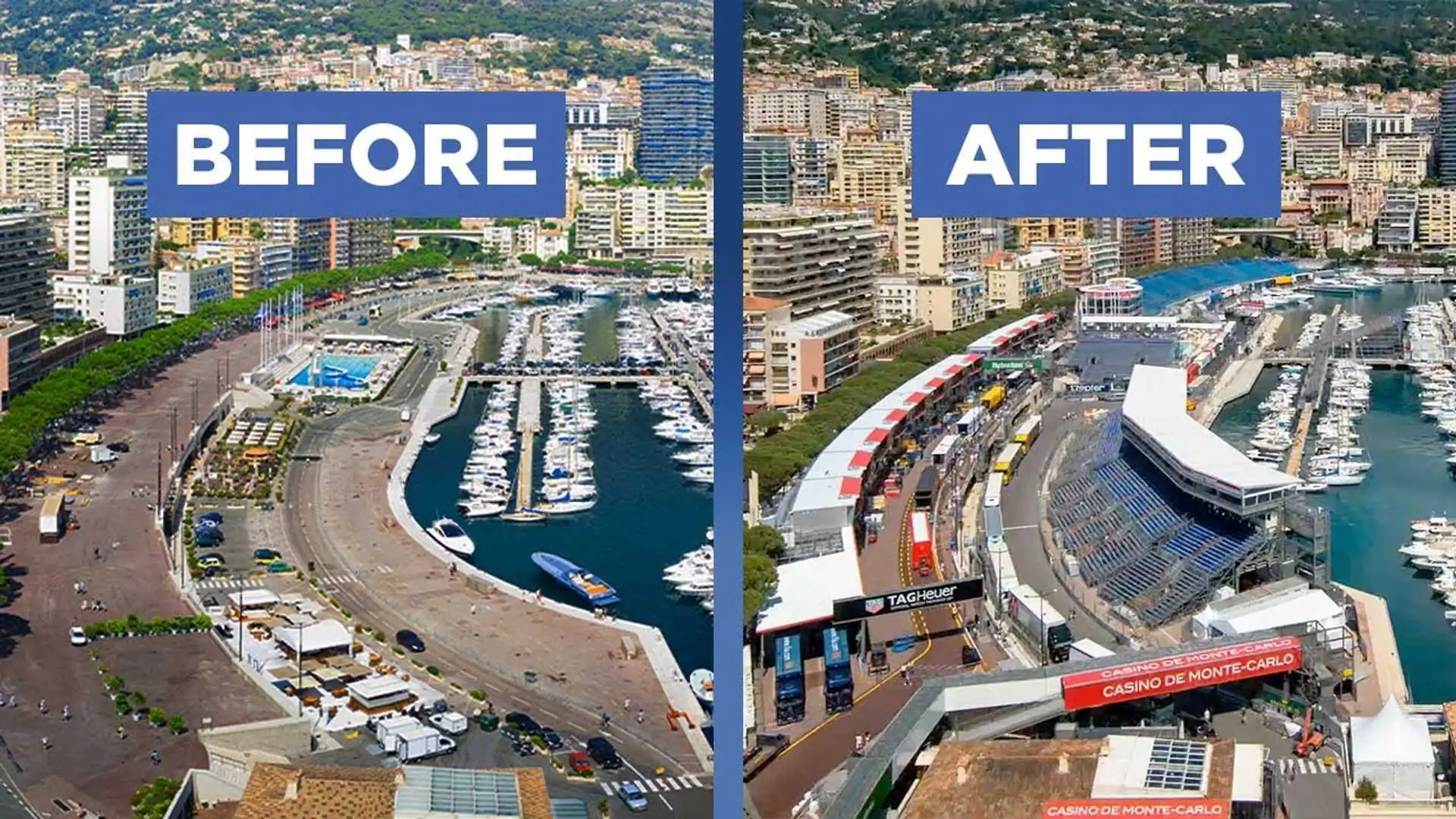
That transformation is visible in more than who appears on the grid. It is also visible in the scale of the event itself. What began as a local race under princely patronage has become a cornerstone of a global championship, one that now arrives in the Principality as a major broadcast product and a marketing showcase. Monaco’s appeal has always been prestige, but in the Formula 1 era, prestige became a commercial asset.
Safety, speed, and the changing shape of the cars
One of the clearest ways to read Monaco across the decades is through car design and safety. The earliest races were contested at speeds and with machinery that reflected a very different era of risk, and Monaco’s own account of the 1929 race, with its 80.194 km/h average, captures that slower, more exposed age. Modern Formula 1 cars are vastly faster, wider, and more aerodynamically complex, yet Monaco still forces them into a street environment that leaves little margin for error.
That tension between progress and constraint is what makes the track so revealing. The photos of later eras do not simply show faster cars; they show a sport that has had to build much more protection around drivers while still preserving Monaco’s old layout. The circuit remains unforgiving even as safety standards, chassis design, and track engineering have advanced dramatically since the first races.
Celebrity culture and the race’s lasting aura
Monaco’s reputation has always extended beyond motorsport because the setting itself is part of the attraction. The Principality’s harbor, terraces, and tightly packed streets made the Grand Prix a magnet for elite spectators long before Formula 1 became a global entertainment industry. Over time, that social dimension became inseparable from the sporting one, and the race developed into a place where the presence of celebrities, royalty, and major business figures became almost as expected as the front-row grid.

The key point is that Monaco did not become famous because it was glamorous. It became glamorous because the race made the city into an annual stage for the sport’s most visible names. That is why the photo archive matters: the images show not only the machines and the champions, but also the shifting culture around them, from an early motoring elite to a modern global audience.
Why 2026 matters
The 2026 Monaco Grand Prix is scheduled for June 4 to 7, 2026, in the Principality of Monaco, and it will be the 83rd edition. Formula 1 also lists it as the first European round of the 2026 season, a reminder that Monaco still occupies a privileged position in the championship calendar. Its timing and placement underline what the race has become: a fixed point in the Formula 1 year, not just a prestigious stop but a defining one.
The continued presence of Monaco on the calendar since 1955 says as much about Formula 1’s business model as about the race itself. The championship has expanded globally, commercial stakes have risen, and the cars have changed beyond recognition. Yet Monaco remains essential because it condenses the sport’s contradictions into one weekend: old-world glamour, modern engineering, elite exclusivity, and the constant threat that the smallest mistake will matter most.
In that sense, Monaco is not merely a historic venue. It is Formula 1’s most durable symbol of how a niche spectacle became a global commercial machine without losing the sense of danger and display that made it magnetic in the first place.
This article was produced by Prism’s automated news system from verified source data, official records, and press releases, then run through automated quality and moderation checks before publishing. The system is built and supervised by the people who set the standards it runs under. Read our full AI policy.
Did this article answer your question?
.jpg&w=1920&q=75)