Most Businesses Cannot Survive Three Days of Downtime, Study Finds
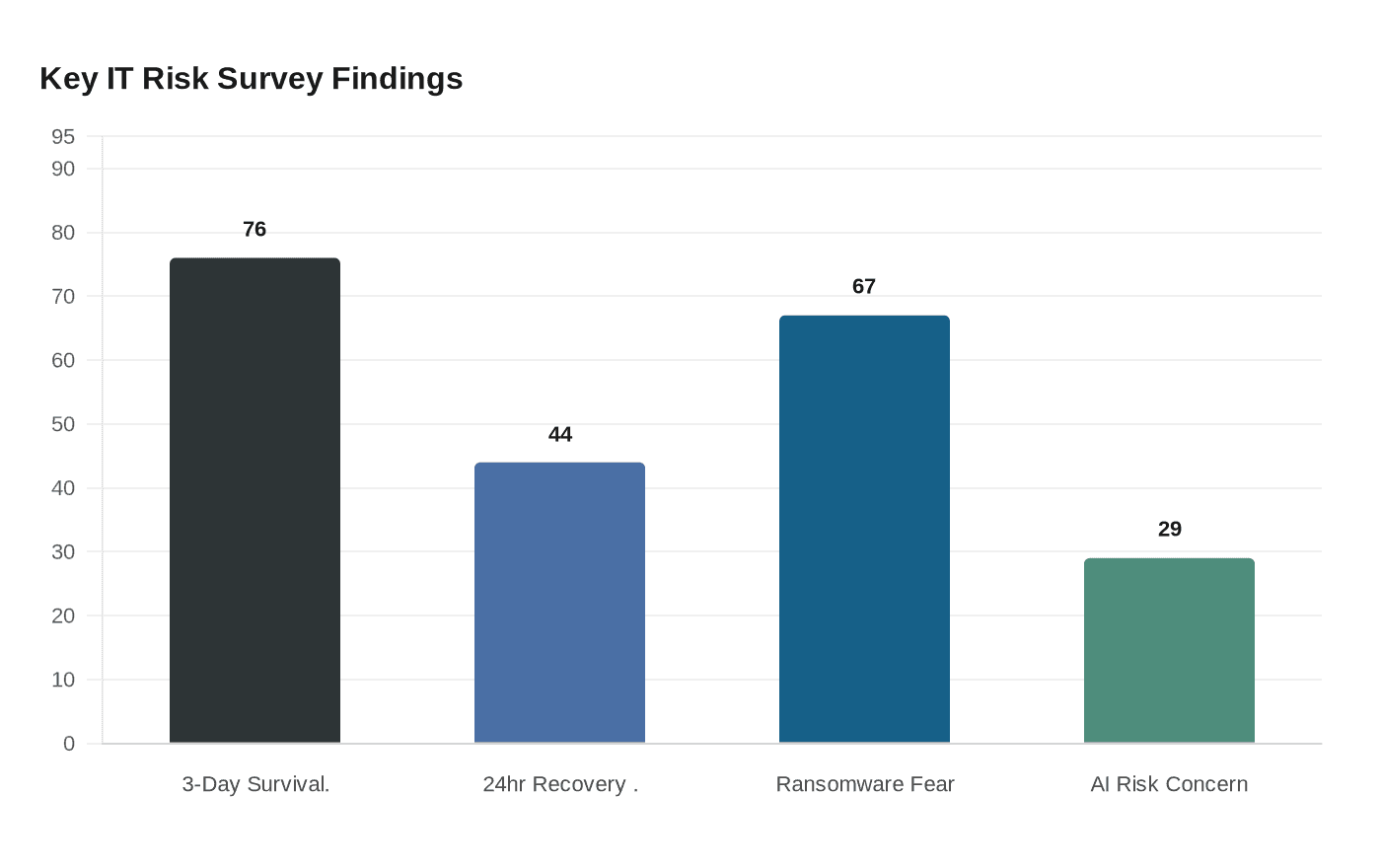
Three days of downtime would collapse most businesses, a Veeam survey of 4,000 leaders found, with 44% unable to recover critical data within 24 hours.

Three days without systems. For a mid-size hospital, that means staff reverting to paper records, surgeries delayed, and medication errors compounding by the hour. For a national retailer, it means collapsed transaction processing, empty digital shelves, and customer relationships that no apology email will repair. For a utility, it means potential safety failures and regulatory investigations that outlast the outage itself, with payroll obligations accumulating the entire time operations remain paralyzed.
That is the real cost embedded in a Veeam survey of more than 4,000 senior executives and IT leaders, released for World Backup Day on March 31: 76% of C-suite and senior IT leaders said their organizations could not survive more than three days of downtime.
The figure is stark, but the one beneath it is arguably more alarming. Forty-four percent of IT leaders said they were not confident they could recover all critical data within 24 hours of a major cyberattack or data loss event. That gap between a 24-hour recovery target and what most organizations can actually deliver is precisely where ransomware operators set their terms, demanding payment not because data is permanently gone but because restoring it independently takes too long to be operationally viable.
Ransomware remains the dominant fear. Sixty-seven percent of respondents identified ransomware and cyberattacks as the risk they fear most in the year ahead. A newer pressure is rising alongside it: 29% of respondents flagged AI-related risks, including data leaks, algorithm bias, and automation failures, as a growing boardroom concern. The convergence of those two threat vectors, with adversarial AI accelerating ransomware delivery and obfuscation, is a scenario that most existing incident response playbooks were not designed to address.
The diagnostic picture the survey paints is one of structural underinvestment in the mechanics of recovery. Many organizations lack tested incident response playbooks, maintain backups that are insufficiently frequent or never verified through actual restore drills, and have no clear coordination protocols among IT, legal, communications, and executive teams during an active incident. The 3-2-1 backup rule, three copies of data across two different media types with one copy held offsite, remains the foundational standard; the survey's findings suggest it is not universally applied.
The defensive priorities identified center on what happens after an attack begins. Immutable backups, which cannot be altered or deleted by ransomware, and air-gapped recovery targets, physically or logically isolated from the production network, are the technical controls that distinguish organizations that restore independently from those that negotiate ransoms. Faster recovery time objectives must be defined, resourced, and tested before an incident, not improvised during one.
The broader implication runs beyond individual balance sheets. In sectors where digital infrastructure intersects with public safety or supply chain continuity, a three-day outage is not merely a business problem. Security leaders have urged boards to treat backup readiness as a strategic resilience metric, funded and measured alongside revenue and operational KPIs, rather than delegated entirely to IT as a maintenance task. The Veeam data makes clear that for most organizations, that elevation has not yet happened.
This article was produced by Prism’s automated news system from verified source data, official records, and press releases, then run through automated quality and moderation checks before publishing. The system is built and supervised by the people who set the standards it runs under. Read our full AI policy.
Did this article answer your question?