Mudryk appeals FA drugs ban to Court of Arbitration for Sport
Mudryk’s appeal puts an adverse meldonium test under CAS scrutiny, with a four-year ban on the table and Chelsea facing a costly legal fight.

Mykhailo Mudryk’s challenge to a Football Association drugs ban has moved to the Court of Arbitration for Sport, turning a Chelsea suspension into a test of how far football’s anti-doping system can go before it must prove its case in detail.
The 25-year-old winger was provisionally suspended in December 2024 after an adverse urine sample, and Chelsea confirmed the FA had contacted the club about the result. The reported banned substance was meldonium, a cardiovascular drug associated with stamina enhancement. Mudryk has said he did not knowingly take any performance-enhancing drugs. He has not played a competitive match since November 2024.
The FA formally charged Mudryk with anti-doping rule violations in June 2025, placing him in line for a potential four-year ban under the governing body’s rules. CAS confirmed it received his appeal on 25 February 2026, but no hearing has been scheduled. The process now shifts from the laboratory and the locker room to a legal forum that can review whether the charge is proved, whether the sanction fits the evidence, and whether the rules were applied consistently and fairly.

That is where this case matters beyond one player. The FA says its anti-doping regulations are consistent with the World Anti-Doping Code, and breaching them can lead to a ban from all sport. Mudryk’s appeal will therefore probe more than whether a sample returned an adverse finding. It will also test how much weight football’s disciplinary system gives to contamination arguments, what level of proof is required to sustain a serious sanction, and whether a four-year penalty is proportionate in a case where intent is disputed.
The financial stakes extend well past Stamford Bridge. Mudryk joined Chelsea from Shakhtar Donetsk in January 2023 for an initial fee of £61 million to £62 million, a deal that could rise to about £88 million to £89 million with add-ons. His contract runs until June 2030. Shakhtar’s chief executive, Serhii Palkin, has said the case could cost the Ukrainian club about €30 million, or £26 million, in performance-related bonuses tied to the transfer.
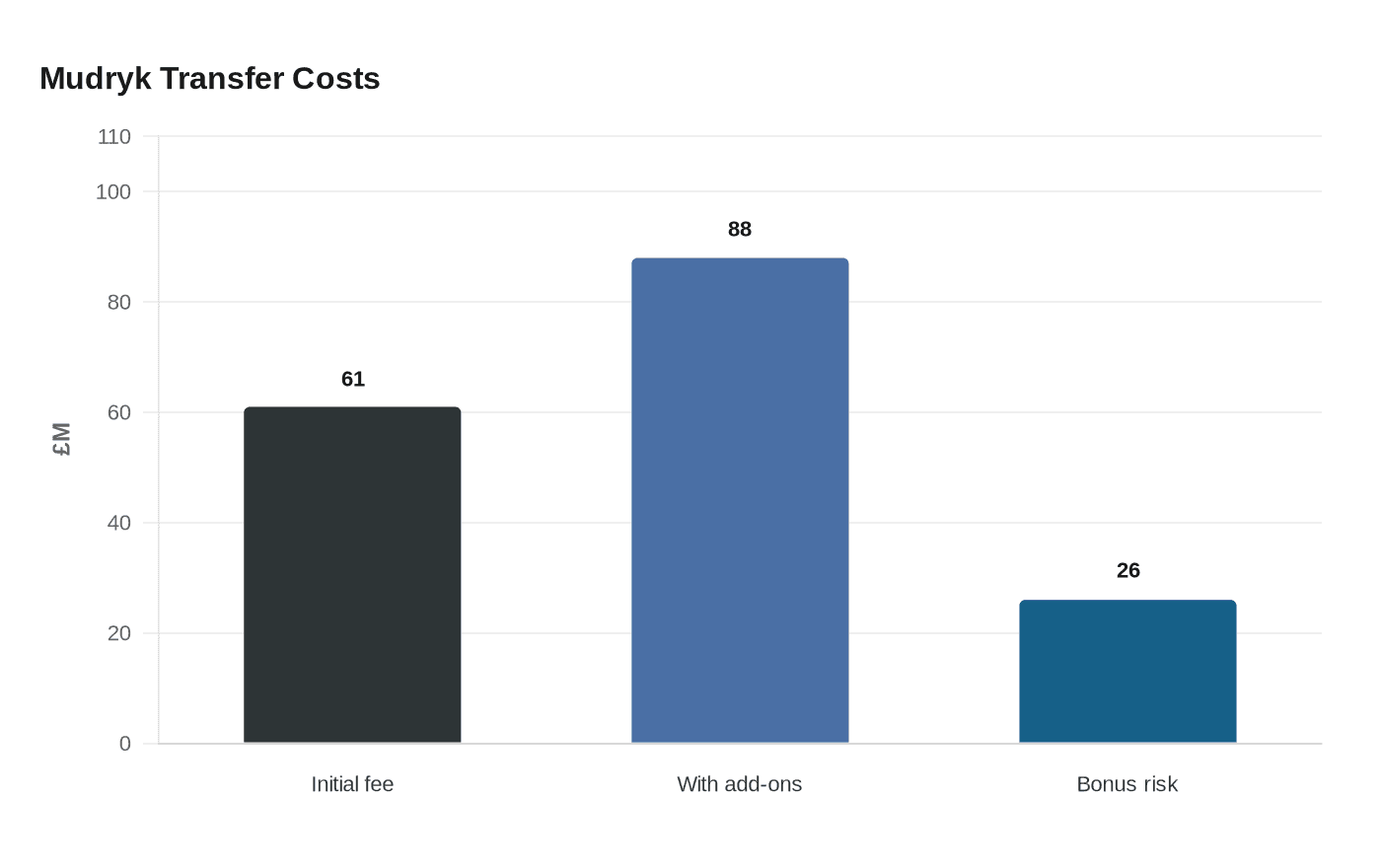
For Chelsea, the case has already frozen a major signing for roughly 18 months. For Mudryk, it now enters a phase where CAS can either uphold the FA’s position, scale back the sanction, or dismantle it entirely if the evidence and procedure do not support the punishment. For elite clubs, that uncertainty is becoming a costly feature of modern anti-doping enforcement.
This article was produced by Prism’s automated news system from verified source data, official records, and press releases, then run through automated quality and moderation checks before publishing. The system is built and supervised by the people who set the standards it runs under. Read our full AI policy.
Did this article answer your question?
.jpg&w=1920&q=75)