Mycelium biofabrication gains mainstream attention as myco-leathers scale production
MycoWorks has opened what sources call the world’s first commercial-scale plant for Reishi, automating roughly 80% of production with AI and automated guided robots.

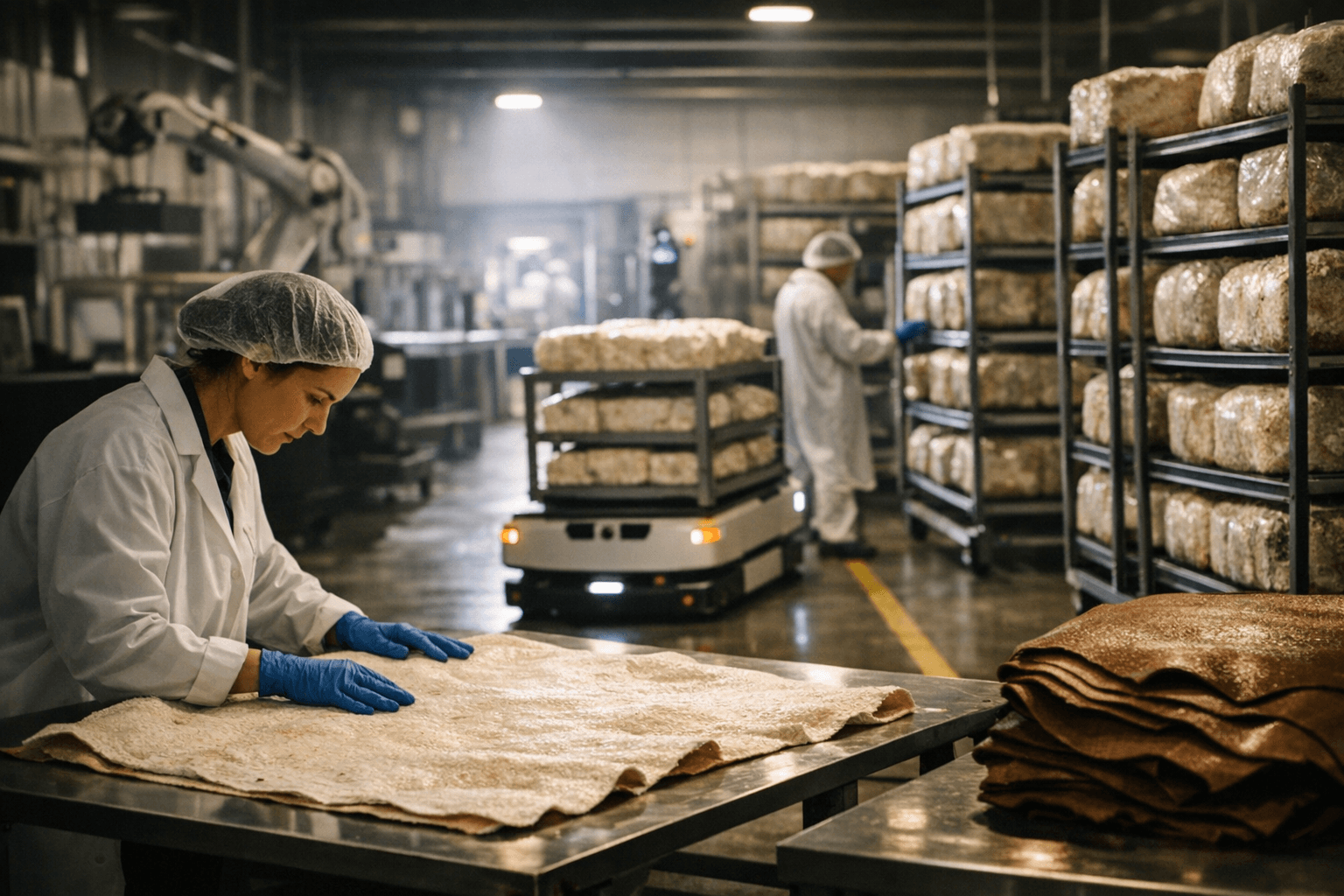
MycoWorks has launched what industry observers describe as the world’s first commercial-scale production plant for its Fine Mycelium material, Reishi, a move framed as the moment biofabrication steps out of lab-scale validation and into industrial capacity. "The most important data point demonstrating its potential for industrial viability is the new facility’s use of AI and automated guided robots to automate 80% of the manufacturing process, signaling a path to high-volume, cost-competitive production." That level of automation and the controlled vertical-farming environment position Reishi as a direct challenge to cattle-based leather and plastic-heavy synthetics.
On the factory floor, Reishi is not a single magic polymer but a composite: mushroom mycelium combined with cotton cellulose, finished with small amounts of additives to achieve a leather hand. "Polyethylene glycol 400 (PEG 400), a hydrophilic low molecular weight polyol, is applied and maintains pliability by ensuring that the internal moisture does not evaporate," a technical account of the process states. Sheets at current scale run from one-by-one foot up to panels several feet across; mechanical manipulation is used to produce the appearance of leather while preserving the material’s biodegradable intent. "MycoWorks is a startup in San Francisco, California that produces a mushroom-based leather alternative," the company profile notes.
Scale-up has required a suite of manufacturing innovations beyond automation. Researchers and practitioners are testing lamination and myco-welding of pure mycelium pellicles, multi-layer lamination and combinations of natural and synthetic fibers to boost strength and mitigate contamination risk. As one summary of methods puts it, "This study explores methods for laminating and myco-welding pure mycelium leather sheets, providing a comprehensive approach to fabricating large-scale mycelium-based textiles... demonstrates a three-week growing period using various types of waste." Those three-week demonstrations contrast sharply with the months-long cycles of animal hides and suggest practical pathways to faster throughput.
Biology remains a variable. Growth trials on sawdust substrates showed species-specific timelines: Cubamyces flavidus and Lentinus squarrosulus achieved full substrate coverage within five days and formed dense mycelial networks by day 14, while Sanghuangporus vaninii and Ganoderma gibbosum were noticeably slower. Researchers recommend increasing spawn size and spawn length to produce larger continuous sheets suitable for upholstery and fashion panels, a technical lever that will determine whether large-format upholstery and automotive interiors are feasible at volume.
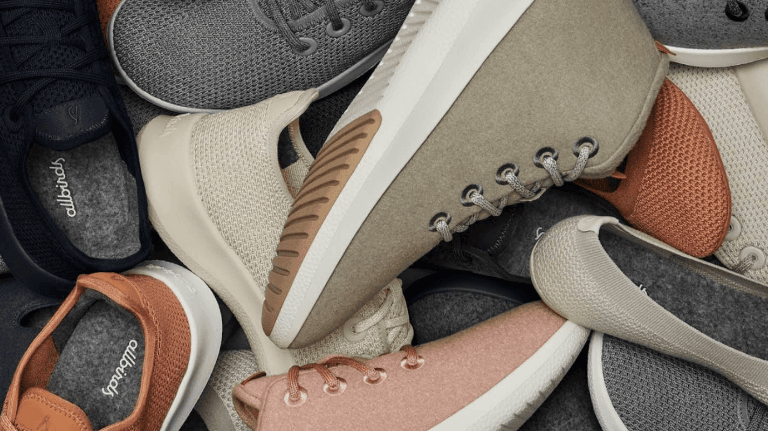
Design houses and prototype labs are already translating mycelium sheets into consumer objects: shoes, wallets, jackets, handbags, hats, watch straps, belts, notebook covers, leather box sets, keychains and an upholstered chair prototype appear in case studies and lab portfolios. Many current firms still focus on high-end fashion and design markets with proprietary, boutique methods; the industry signal watchers expect to see "major luxury auto or furniture brands announcing multi-year, high-volume supply agreements" as the next proof point that price, performance and volume are production-ready.
Obstacles remain explicit: contamination risk, material uniformity, and the absence of published lifecycle analyses for commercial Reishi. Genipin is offered in technical notes as a biodegradable cross-linker option — "Genipin itself is biodegradable, and if no solvent besides distilled/demineralized water is necessary to achieve optimal cross-linking and performance, then the strategy is sustainable and completely biodegradable as well" — but integration parameters still require experimental optimization. Combined reporting across the available sources concludes that MycoWorks’ Reishi plant and its roughly 80% automation mark a sector inflection, yet commercial verification will depend on published capacity figures, independent lifecycle data, and the multi-year supply deals that would move myco-leather from novelty to industrial mainstay.
Know something we missed? Have a correction or additional information?
Submit a Tip