Nadella warns AI could become a bubble unless benefits spread widely
Satya Nadella told Davos leaders AI risks becoming a speculative bubble unless gains reach beyond big tech and wealthy countries.
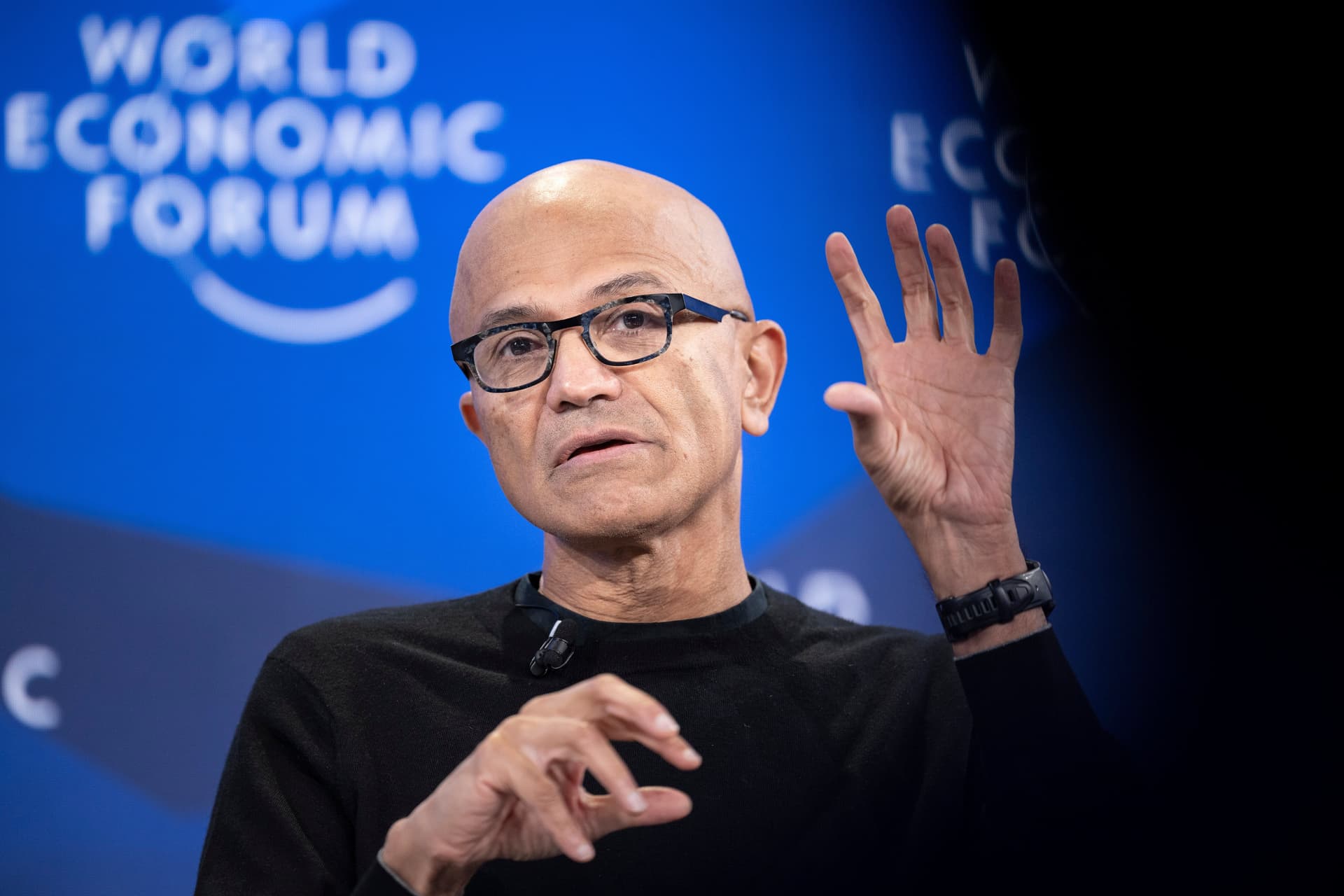
At the World Economic Forum in Davos, Microsoft CEO Satya Nadella warned that the surge of investment in artificial intelligence risked turning into a speculative bubble unless its benefits were broadly shared beyond a handful of firms and rich nations. Speaking in conversation with BlackRock CEO Larry Fink, Nadella framed the danger as one of distribution and adoption rather than of the technology itself.
Nadella said a “telltale sign of if it’s a bubble would be if all we’re talking about are the tech firms,” and he argued that “for this not to be a bubble by definition, it requires that the benefits of this are much more evenly spread.” He cautioned that if AI’s gains remained concentrated on the supply side, data centers, GPUs and other infrastructure, rather than translating into productivity and revenue gains across industries and geographies, market enthusiasm might be disconnected from lasting economic progress.
To avoid that outcome, Nadella urged business leaders to rethink knowledge work and organizational design so that technology actually changes how work gets done. He said leaders “need to think about changing the work, the workflow, with the technology,” describing AI as prompting a “complete inversion” of how information moves through businesses and warning that large organizations risk being “schooled by someone small being able to achieve scale because of these tools.” His prescription was practical: prioritize AI applications that generate measurable outcomes for people, communities, countries and industries, not just high capital spending on servers and chips.
Nadella offered the pharmaceutical sector as an example of incremental, outcome-focused AI use. He argued that using AI to accelerate drug trials or speed development timelines, rather than aiming for a single “magical molecule”, can justify investment by delivering tangible improvements in product development and public health outcomes.

His remarks came amid intense capital expenditures across the technology sector. Companies are pouring money into data centers, power capacity and specialized chips; industry commentary has characterized the buildout as “exploding,” with trillions of dollars committed to infrastructure. Those deployments have helped buoy market valuations, Microsoft reached roughly a $3.4 trillion market capitalization, but Nadella warned that deployment alone does not equal adoption. He noted evidence that AI-related investments already contributed to economic growth, citing a recent estimate that such investments added roughly 1.1 percent to GDP growth in the first half of 2025. Even so, he emphasized that much of the early impact has been capital-expenditure driven rather than delivered through broad productivity gains.
Nadella expressed confidence that diffusion could follow the patterns of cloud and mobile adoption if leaders act deliberately. His message to executives and policymakers was twofold: accelerate practical, cross-sector deployment that changes workflows, and design incentives and support so the benefits of AI extend to smaller firms and less wealthy countries. Without those steps, he warned, today’s euphoria may not translate into durable, inclusive economic progress.
This article was produced by Prism’s automated news system from verified source data, official records, and press releases, then run through automated quality and moderation checks before publishing. The system is built and supervised by the people who set the standards it runs under. Read our full AI policy.
Did this article answer your question?