NASA Artemis II Crew Captures Stunning New Image of Moon's Far Side
The Artemis II crew photographed the moon's Orientale basin, a 600-mile-wide crater first seen in full by human eyes, as Orion began its historic lunar flyby Monday.

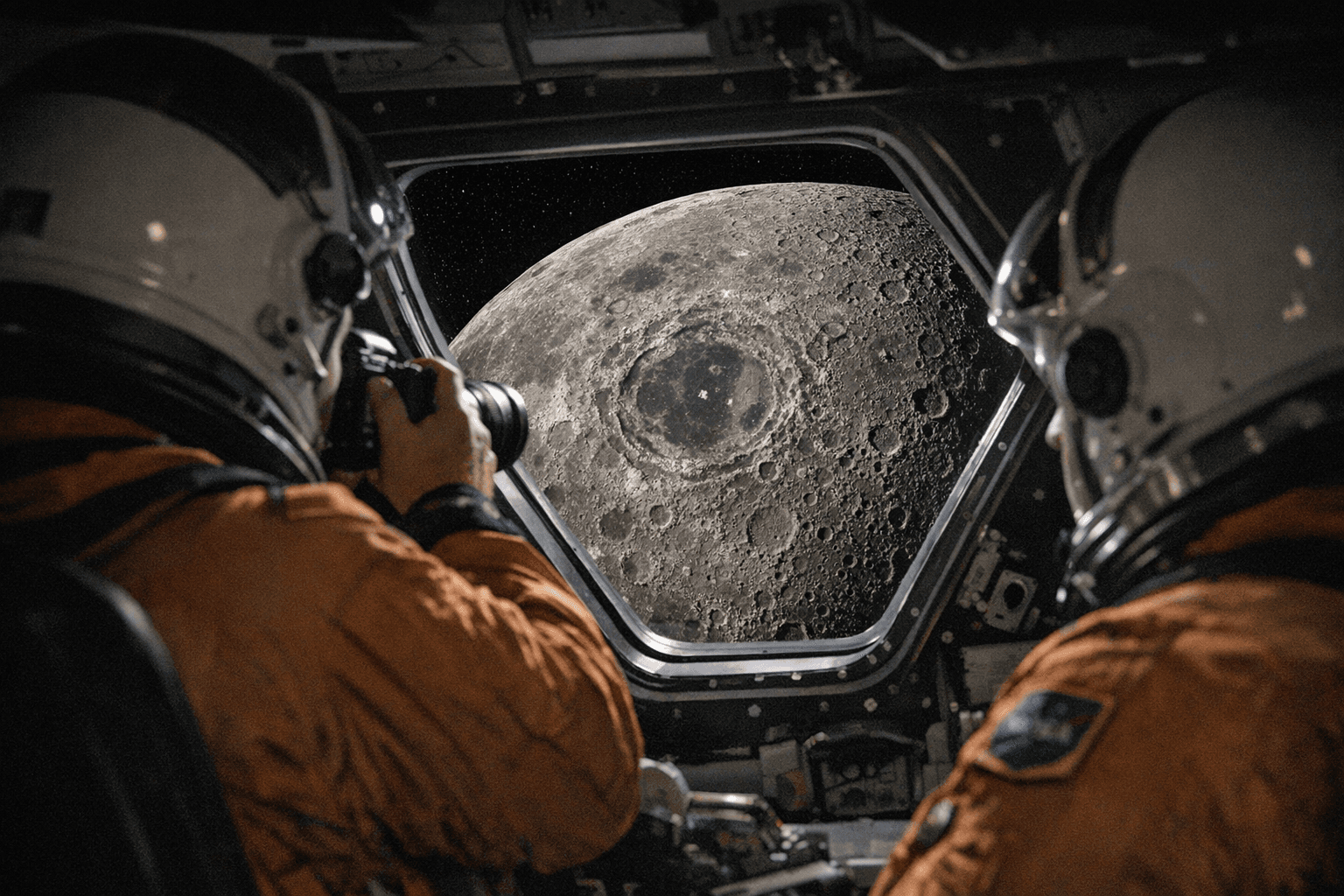
For roughly 3.7 billion years, the Orientale basin sat beyond human sight on the moon's far western edge, too angled away from Earth for any astronaut to witness its full span. That changed when the four-member crew of NASA's Artemis II mission photographed the massive multi-ring impact crater from their Orion spacecraft, named Integrity, and transmitted the image back to Earth on Sunday.
In the image, the moon is oriented upside down, with its South Pole facing upward and parts of its far side visible. The Orientale basin is situated along the right edge of the lunar disk, a crater that is hard to see from Earth. The shadowed crater spans 600 miles (965 kilometers) and represents a key transition region between the near and far sides of the moon. Only robotic spacecraft had mapped it before. "History in the making," NASA posted alongside the image. "This mission marks the first time the entire basin has been seen with human eyes."
The photograph was captured on the fourth day of the astronauts' lunar journey. The Artemis II crew consists of NASA astronauts Commander Reid Wiseman, Mission Specialist Christina Koch, and Pilot Victor Glover, along with Canadian Space Agency Mission Specialist Jeremy Hansen. The lunar flyby ran from 2:45 to 9:40 p.m. EDT Monday, April 6, marking the window during which the crew would be close enough to the moon to make scientific observations with Orion's windows pointed toward the lunar surface.
The image is more than a photographic milestone. Orientale is the textbook multi-ring impact basin used as a baseline to compare other impact craters on rocky worlds from Mercury to Pluto. The Artemis II crew will continue to observe Orientale from multiple angles as they approach the moon and throughout the lunar flyby. What human visual observation adds over robotic imaging is direct, real-time assessment of surface texture and lighting conditions that cameras alone cannot fully convey.
The far side, however, will only be partially illuminated during the flyby, constraining what the crew can document photographically. That limitation reflects a broader truth about what Artemis II is, and is not: it is not a landing mission. At its core, Artemis II is a systems validation mission. The four-person crew will not land on the moon but rather perform a lunar flyby, looping around the far side before returning to Earth.
The agency is testing the Orion spacecraft's life support systems for the first time with humans aboard, helping lay the groundwork for future crewed Artemis missions. The crew also tested the spacecraft's emergency communications system in deep space, and the Deep Space Network, a global system of ground antennas in Goldstone, California; Madrid, Spain; and Canberra, Australia. Artemis II astronauts practiced trajectory adjustments, communications at lunar distances, and piloting Orion during key phases of flight, culminating in a re-entry and splashdown to further validate the spacecraft's performance with crew aboard.
After the lunar flyby, it will take four days for the astronauts to return home, with the capsule aiming for a splashdown in the Pacific Ocean near San Diego on April 10, nine days after its Florida launch. Every system that performs correctly on this flight shortens the distance between now and Artemis III, which would put boots on the lunar surface for the first time since Apollo 17 in 1972.
NASA astronaut Christina Koch described the crew's first views of the lunar far side, which permanently faces away from Earth, as "absolutely spectacular." The Orientale basin, seen whole for the first time by human eyes, gave them good reason.
Sources:
Know something we missed? Have a correction or additional information?
Submit a Tip