NASA Artemis II Crew Countdown Begins for Historic Moon Mission
With a $2 billion rocket awaiting its first crewed deep-space test, NASA's Artemis II countdown began Monday for an April 1 launch that ends humanity's 53-year absence from the Moon.
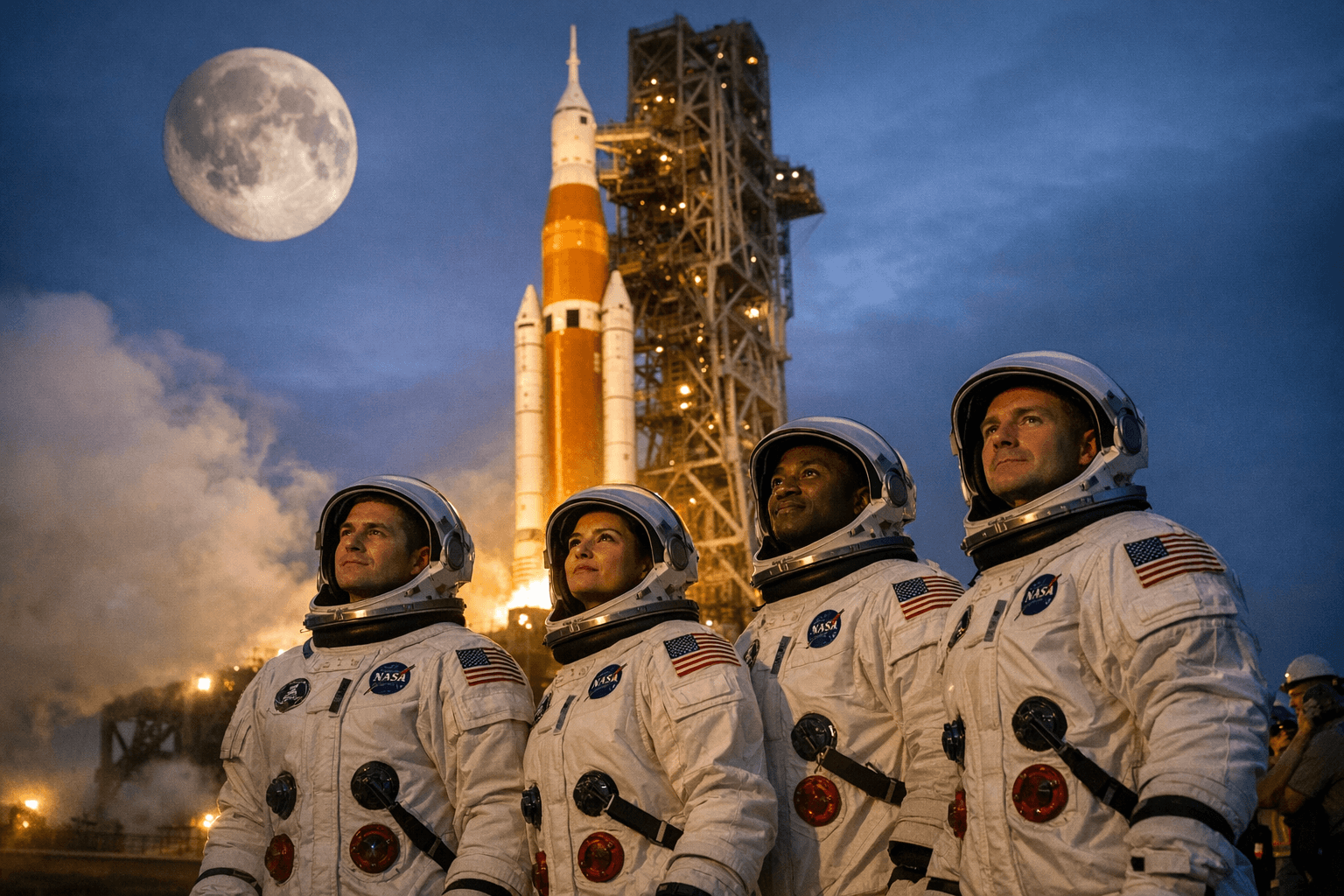
The 49-hour, 40-minute countdown clock at Kennedy Space Center began ticking Monday as NASA moved toward humanity's first crewed journey to the Moon in 53 years, with liftoff of the Artemis II mission scheduled for April 1 at 6:24 p.m. EDT from Launch Complex 39B. Each Space Launch System rocket costs roughly $2 billion to launch, and the mission carries a weight beyond its price tag: it must prove that a sweeping set of redesigns actually hold before any crew ever attempts a lunar landing.
Mission managers cleared the final bureaucratic hurdle Monday, when a review meeting at Kennedy Space Center found no technical obstacles to beginning the formal countdown. The clock started at 4:44 p.m. EDT (20:44 UTC). NASA launch director Charlie Blackwell-Thompson described the approach as unusually clean: "The run up to the countdown start has gone extremely smooth, with only a few extremely minor ground equipment issues to deal with."
The engineering burden Artemis II carries traces directly to 2022. When the uncrewed Artemis I returned from the Moon, engineers found more than 100 sites where chunks of the Orion capsule's Avcoat heat shield had spalled away during reentry. The discovery triggered years of investigation and contributed to a December 2024 announcement that the program was delaying the launch to work through problems with both the heat shield and the life support system. For Artemis II, NASA updated the shield block design to let trapped gases escape more easily and replaced the skip reentry trajectory flown on Artemis I with a more direct reentry profile, reducing the time the shield spends at peak temperatures. Wednesday's flight will be the first live test of whether those fixes hold with a crew inside.
That crew is Commander Reid Wiseman, Pilot Victor Glover, Mission Specialist Christina Koch, all three from NASA, and Mission Specialist Jeremy Hansen of the Canadian Space Agency. Their 10-day mission will carry them on a loop around the lunar far side, farther from Earth than any humans have traveled since Apollo. The flight will not attempt a lunar landing; it is explicitly a crewed verification of the full transportation stack before any landing crew depends on it entirely.
The four arrived at Kennedy Space Center on March 27, flying from Houston aboard T-38 jets. Wiseman addressed the waiting crowd without ambiguity: "Hey, let's go to the Moon!" The crew also introduced "Rise," a small round plush mascot that will serve as the mission's zero-gravity indicator once the Orion capsule clears Earth's pull. Since arriving, the astronauts have toured Launch Pad 39B, spent an evening with families at NASA's astronaut beach house, practiced eating in a microgravity simulator alongside Canadian Space Agency backup crew member Jenni Gibbons, and entered final pre-launch quarantine. Before Wednesday's liftoff, they will also review emergency escape procedures with launch flight controllers.
The geopolitical context gives the countdown added urgency. China has announced plans for a crewed lunar landing by 2030, backed by a program that has already returned samples from the Moon's far side. A failure or prolonged delay on Artemis II would not simply push back a schedule. It would hand Beijing a tighter competitive window and revive pointed questions in Congress about the durability of a program that has already absorbed repeated slips, the 2026 cancellation of the Gateway lunar station, and roughly $100 billion in total investment.
NASA's countdown timeline assigns concrete tasks through every remaining hour. Liquid oxygen and liquid hydrogen propellant preparations run from L-49 hours 40 minutes onward; the Orion spacecraft powers up at L-45 hours 30 minutes; the core stage follows at L-42 hours 20 minutes; and the four RS-25 engines enter final preparations at L-39 hours 45 minutes. Flight batteries for both Orion and the core stage are charged in sequential windows across the final day of the count. If every step holds, the Orion capsule will carry four people past the Moon for the first time since December 1972.
This article was produced by Prism’s automated news system from verified source data, official records, and press releases, then run through automated quality and moderation checks before publishing. The system is built and supervised by the people who set the standards it runs under. Read our full AI policy.
Did this article answer your question?

