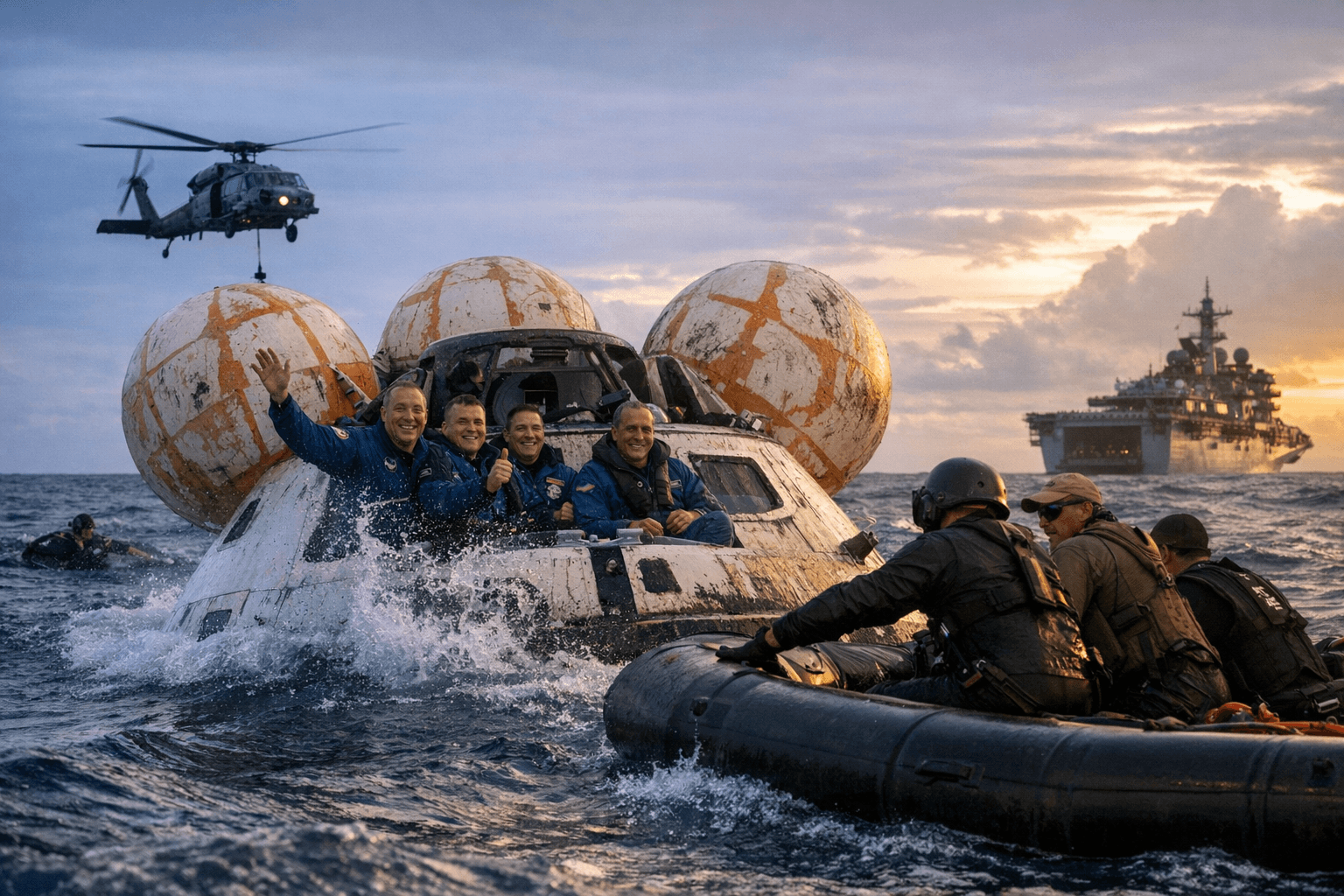
NASA Astronauts Complete Near-Impossible Lunar Flyby Mission After 10 Days
Four astronauts splashed down in the Pacific after flying 252,756 miles from Earth, the farthest any humans have ever traveled, before a fiery 23,840 mph re-entry tested Orion's heat shield.
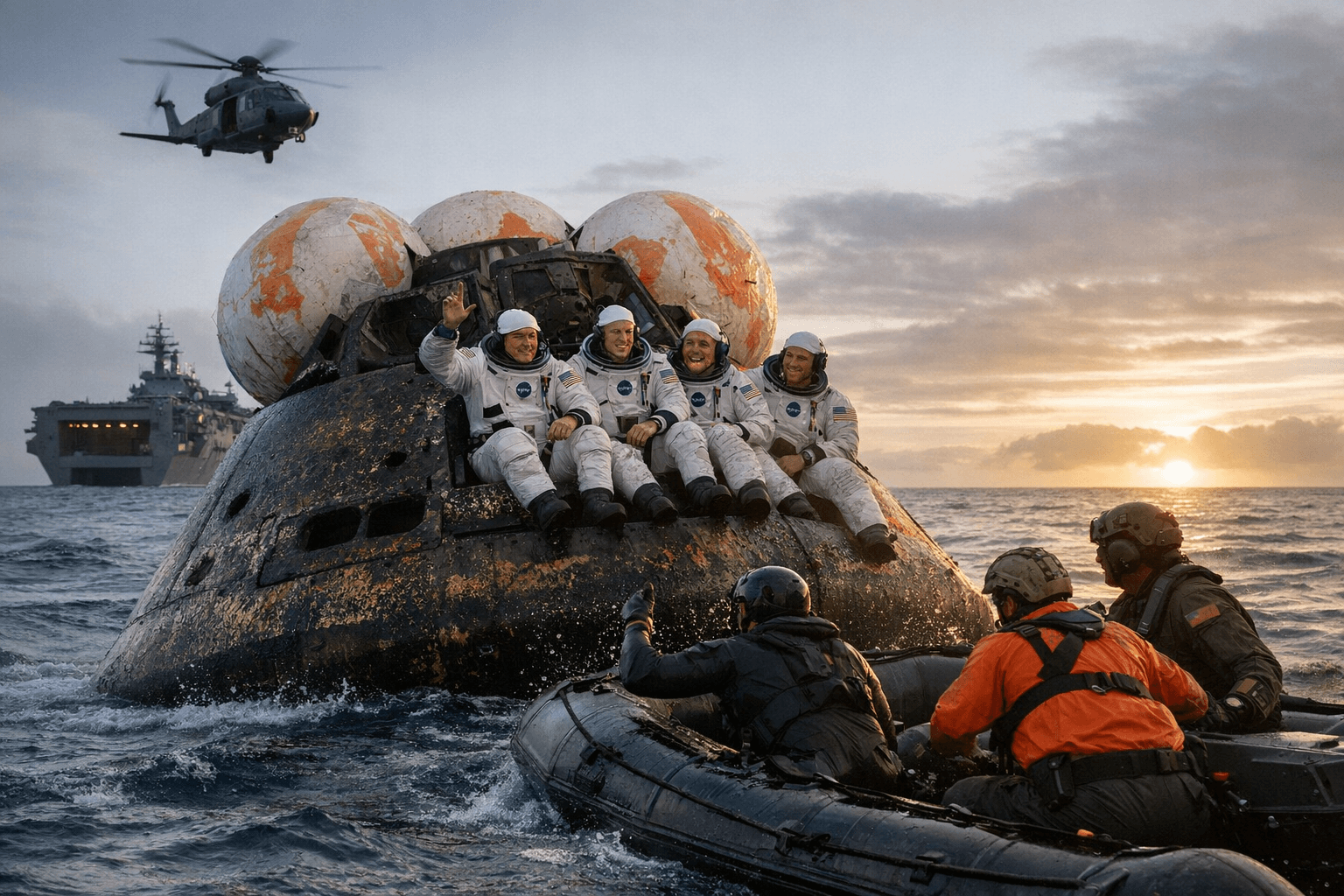
The Orion capsule Integrity hit Earth's atmosphere at 23,840 miles per hour on April 10, scorching through temperatures exceeding 1,600 degrees Celsius as Mission Control in Houston fell silent and waited. When the capsule emerged from its re-entry communication blackout, 11 parachutes deployed in sequence to bring four astronauts to a splashdown off San Diego at 8:07 p.m. EDT, precisely on schedule, completing NASA's first crewed lunar voyage in more than half a century.
NASA's Artemis II mission lifted off on April 1 at 6:35 p.m. EDT from Kennedy Space Center in Florida, and over the 10 days that followed, commander Reid Wiseman, pilot Victor Glover, mission specialist Christina Koch, and Canadian Space Agency astronaut Jeremy Hansen rewrote the record books one milestone at a time. The crew broke Apollo 13's distance record and marked the farthest that humans have ever journeyed from Earth when they reached 252,756 miles, placing them 4,111 miles beyond the previous mark set in 1970.
Victor Glover became the first person of color, Christina Koch the first woman, Jeremy Hansen the first non-U.S. citizen, and Reid Wiseman the oldest person to travel beyond low Earth orbit and near the Moon.
The mission's defining hour came on Flight Day 6. Orion entered the lunar sphere of influence at 12:37 a.m. EDT on April 6, the point at which the Moon's gravity had a stronger pull on the spacecraft than Earth's. The capsule passed within 4,067 miles of the lunar surface during its closest approach, then slipped behind the far side, cutting off all contact with Earth for roughly 45 minutes as the Moon blocked the Deep Space Network's radio signals entirely. The blackout was among the longest communication gaps in human spaceflight history and confirmed that deep-space navigation must function without real-time ground support.
What the crew witnessed in those silent minutes was extraordinary. Wiseman told President Trump: "The surprise of the day: We just came out of an eclipse. We could see the corona of the sun, and then we could see the planet train line up with Mars. And all of us commented how excited we are to watch this nation and this planet become a two planet species." Koch described the emotional weight of re-establishing contact. "One of the biggest highlights was coming back from the far side of the moon and having the first glimpses of planet Earth again, after being out of communication for about 45 minutes," she said.
In the mission's most heart-tugging moment, the crew asked permission to name a pair of craters after their moonship and Wiseman's late wife, Carroll.
The technical stakes were highest not at the Moon but on the way home. Orion's heat shield had left serious questions unanswered since the 2022 uncrewed Artemis I test flight, when its charred exterior returned looking pockmarked and eroded. The heat shield had to withstand temperatures of more than 1,600 degrees Celsius as the spacecraft decelerated rapidly during re-entry, with 11 parachutes deploying in sequence to bring Orion to a splashdown speed of roughly 25 miles per hour. Artemis II's successful recovery of all four crew members provided the closest real-world validation yet of whether that vulnerability had been resolved.
Recovery teams retrieved the crew using helicopters and delivered them to the USS John P. Murtha, where the astronauts underwent post-flight medical evaluations before returning to NASA's Johnson Space Center.
NASA Associate Administrator Amit Kshatriya said the successful conclusion of the mission means "the path to the lunar surface is open," pointing toward Artemis IV and a potential Moon landing as early as 2028. Whether the heat shield data gathered during re-entry fully closes the book on Artemis I's anomalies, and whether Orion's life-support systems can sustain a crew through the longer surface-mission profile that landing would require, remain the central questions NASA engineers must now answer before astronauts can set foot on the Moon for the first time since Apollo 17 in 1972.
Sources:
Know something we missed? Have a correction or additional information?
Submit a Tip