NASA Chief Isaacman, Retired Gen. McKenzie Appear on Face the Nation
NASA chief Isaacman spoke live from Mission Control as Artemis II's four-person crew neared the moon's far side, while retired Gen. McKenzie assessed an ongoing Iran campaign roughly 30 days in.
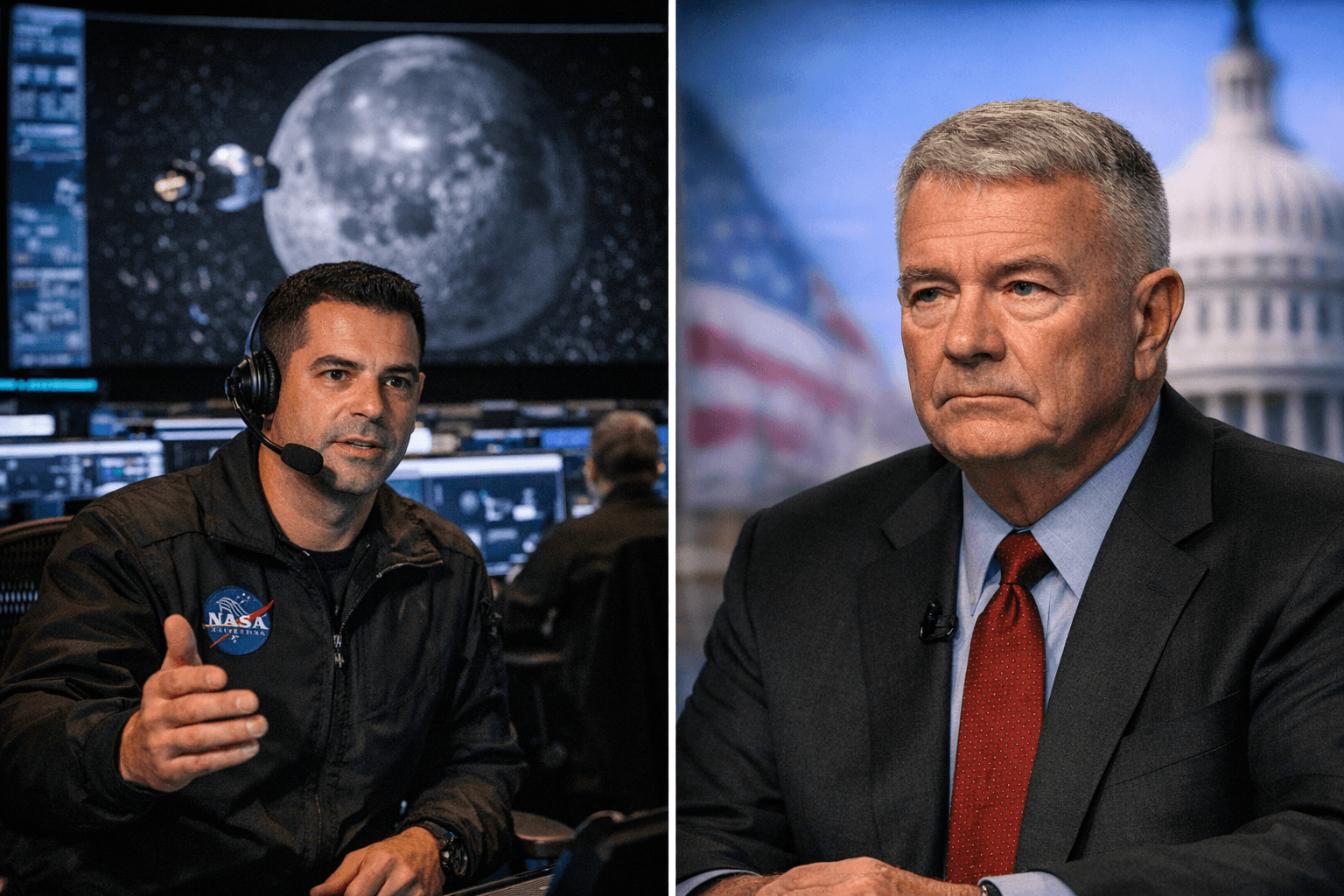
Easter Sunday's edition of "Face the Nation with Margaret Brennan" brought together two sharply divergent stories unfolding simultaneously: four astronauts hurtling toward the far side of the moon and an active U.S. military campaign against Iran now entering its second month. Senior White House and political correspondent Ed O'Keefe moderated the broadcast in place of Margaret Brennan, drawing in NASA Administrator Jared Isaacman live from Houston's Mission Control and retired Gen. Frank McKenzie, the former commander of U.S. Central Command.
Isaacman joined from the floor of Mission Control as the Artemis II crew, approximately 65,000 miles from the lunar surface, prepared for a six-hour flyby around the moon's far side scheduled for the following day. He described the mission's immediate priorities in concrete terms: gathering data from the ECLS system, the Orion spacecraft's life support apparatus. "This is the first time we've ever had humans onboard the Orion spacecraft," Isaacman said, emphasizing the stakes of the data collection effort. The Artemis II crew launched April 1 from Kennedy Space Center in Cape Canaveral, marking the first crewed lunar mission in more than 50 years.
On funding, Isaacman pointed to $10 billion in supplemental appropriations secured through the administration's signature tax legislation, which he called "the biggest supplemental investment in NASA since the Kennedy era." He outlined an ambitious cadence ahead: Artemis III targeting 2027, a permanent moon base in development, and the planned 2028 launch of the first interplanetary nuclear-powered spacecraft.
McKenzie's interview pivoted to an entirely different theater. Iran's Revolutionary Guard had claimed responsibility for attacks on petrochemical plants in the UAE, Kuwait, and Bahrain, with warnings that strikes against U.S. economic interests would intensify. McKenzie, speaking as a former CENTCOM commander with institutional familiarity with the campaign's war-gaming, offered a measured assessment. "They have the ability to inflict damage," he said of Iran and its proxies. "They do not have the ability to gain mass effects." He defined mass effects as the capacity to fire "many, many dozens of rockets, missiles or drones," and argued that capability had been "eroded steadily since this campaign began."
Roughly 30 days into the military campaign, McKenzie said commanders at Central Command could be "reasonably satisfied" with its progress. He discussed the strategic logic of arming Kurdish forces as a pressure mechanism, arguing that making the Iranian regime feel existential strain would move Tehran toward a negotiated outcome, even if outright regime change was not the stated objective. He also addressed the recent rescue of a U.S. airman who evaded capture inside Iran for more than a day after Iran's leadership issued a public appeal for citizens to turn the service member in. That appeal, McKenzie said, "does not appear to have been successful," a failure he characterized as a hard lesson for Tehran.
The broadcast also included Maryland Gov. Wes Moore and Archbishop Timothy Broglio, who heads the Catholic Archdiocese for the Military Services, offering perspectives on the war's domestic and spiritual dimensions on the Easter holiday.
This article was produced by Prism’s automated news system from verified source data, official records, and press releases, then run through automated quality and moderation checks before publishing. The system is built and supervised by the people who set the standards it runs under. Read our full AI policy.
Did this article answer your question?

