NASA shuts down Voyager 1 instrument to preserve power for mission longevity
NASA shut off Voyager 1’s LECP to save power, trading particle data for a better chance the 48-year-old probe keeps talking. Built for five years, it is still in interstellar space.
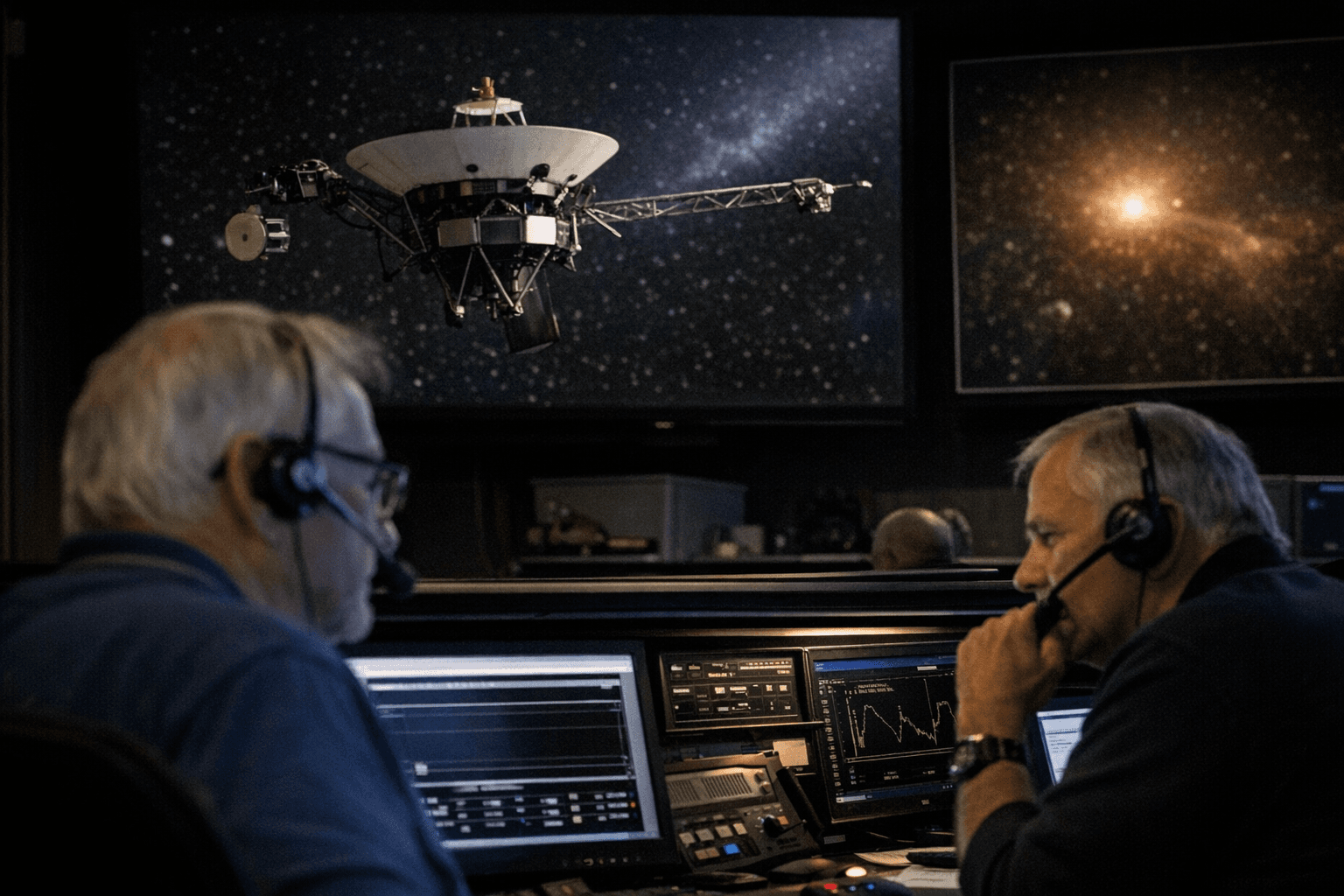
NASA has begun sacrificing one stream of science to keep Voyager 1 alive a little longer. Engineers at the NASA Jet Propulsion Laboratory in Southern California shut down the probe’s Low-energy Charged Particles experiment on April 17, 2026, diverting scarce power toward the systems that still let the spacecraft send data back from deep space.
The tradeoff is stark. The LECP had run almost continuously since Voyager 1 launched on September 5, 1977, from Cape Canaveral aboard a Titan-Centaur rocket, measuring low-energy ions, electrons and cosmic rays. It also helped scientists map the interstellar medium, including pressure fronts and areas where particle density changes. With the probe’s power supply steadily fading, NASA chose to turn off the instrument rather than let the entire mission go dark.
Voyager 1 was never supposed to last this long. It was built for a five-year mission and designed, along with Voyager 2, to exploit a rare planetary alignment that occurs only once every 176 years. Nearly half a century later, Voyager 1 remains the most distant human-made object in existence and the first to enter interstellar space, crossing the heliosphere in August 2012. Voyager 2 followed in 2018, and NASA says the two spacecraft are still the only probes ever to operate outside the Sun’s heliosphere.
The shutdown was not improvised. NASA says Voyager science and engineering teams agreed years ago on the order in which instruments would be turned off as power declined, and the LECP was next on that list. The same instrument on Voyager 2 was switched off in March 2025. NASA says Voyager 1 still has two science instruments operating, while seven of the 10 identical instrument sets on each spacecraft have already been shut down.
The mission’s engineering support remains remarkably active for spacecraft launched in the 1970s. Voyager data reaches Earth at just 160 bits per second, and NASA’s Deep Space Network, with complexes in California, Spain and Australia, gives each spacecraft about six to eight hours of real-time tracking data per day. NASA has also been managing other aging systems, including turning off Voyager 2’s Plasma Science instrument on September 26, 2024 and leaving Voyager 1’s Plasma Science system off since 2007 because of degraded performance. The Planetary Radio Astronomy investigation was shut down on both probes in early 2008.
The result is a rare public-investment story in endurance rather than replacement. Built at JPL, which NASA describes as a federally funded research center managed by the California Institute of Technology, the Voyager spacecraft have outlived every expectation attached to them. The latest shutdown does not mark the end of the mission. It is the price of keeping one of the most successful scientific assets in history alive just a little longer.
Know something we missed? Have a correction or additional information?
Submit a Tip