NASA Targets April 1 Launch for First Crewed Artemis Moon Mission in Decades
NASA reported zero technical issues Sunday ahead of Wednesday's historic 6:24 p.m. liftoff, the first crewed moon mission in over 50 years.
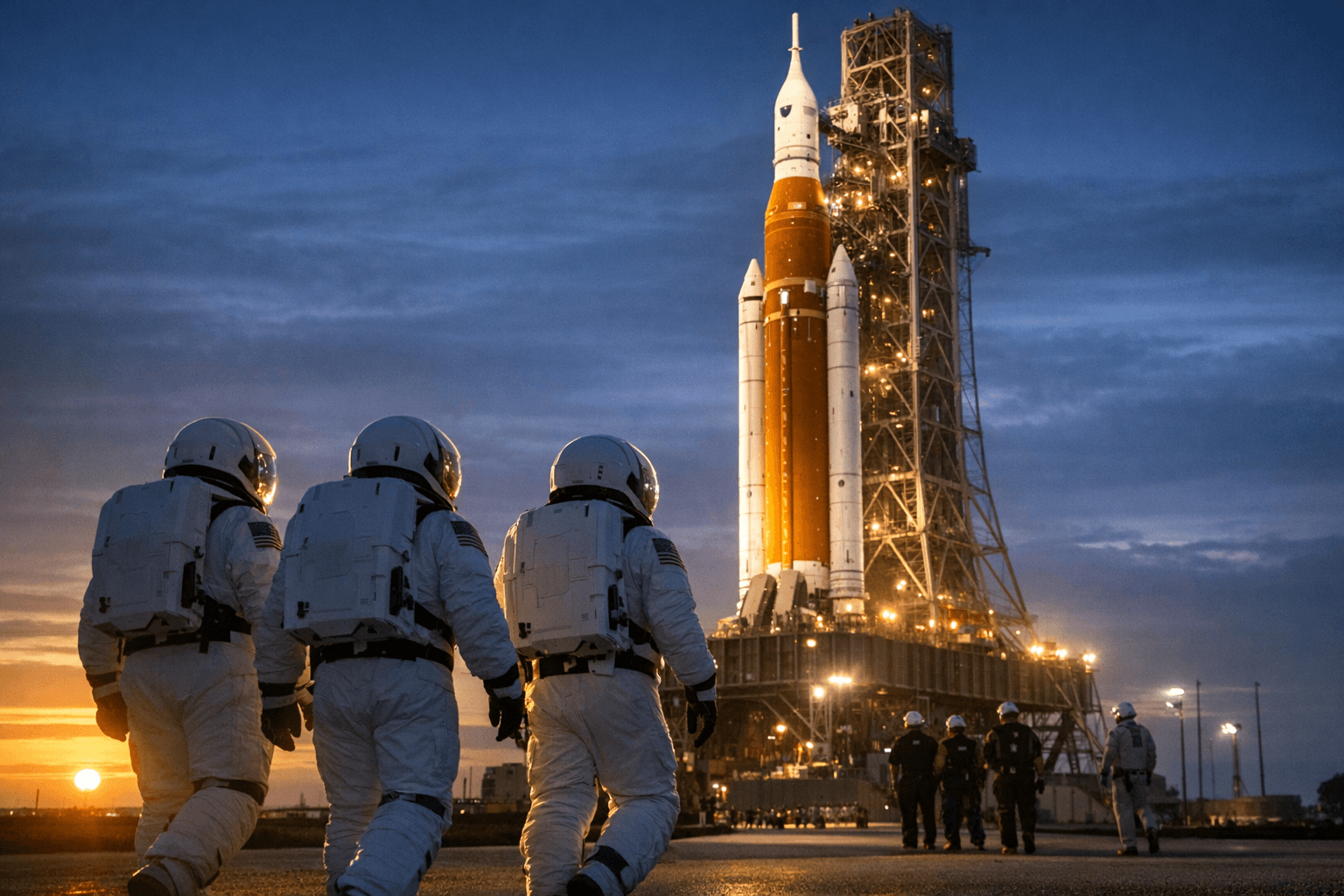
A hydrogen leak cut short a critical rehearsal countdown with barely five minutes on the clock. Then came a trip back to the assembly building for unrelated helium flow problems. On Sunday, with three days until liftoff, NASA reported it was tracking zero technical issues with its Artemis II rocket and crew.
The agency is targeting April 1 at 6:24 p.m. EDT for the launch of four astronauts aboard a 322-foot Space Launch System rocket from Launch Complex 39B at Kennedy Space Center in Cape Canaveral, Florida. If it lifts off as scheduled, Artemis II will mark the first time humans have traveled toward the Moon in more than 50 years.
Commander Reid Wiseman, pilot Victor Glover, mission specialist Christina Koch and Canadian Space Agency astronaut Jeremy Hansen were in quarantine at Kennedy Space Center on Sunday ahead of the mission. Their flight will not land on the lunar surface: Artemis II is a crewed flyby, a test flight designed to carry the four around the Moon and back. It will be the second flight for NASA's Space Launch System rocket and the Orion capsule, but the first time those vehicles will carry humans.
The path to Sunday's clean bill of health was not smooth. During a wet dress rehearsal at Kennedy Space Center, engineers detected leaking hydrogen at the base of the SLS rocket and aborted the simulated countdown with approximately 5 minutes and 15 seconds remaining. Then, on Feb. 25, NASA's crawler-transporter 2 returned the fully stacked rocket and Orion spacecraft to the Vehicle Assembly Building to address a separate problem: helium flow to the rocket's Interim Cryogenic Propulsion Stage, the upper stage that helps push Orion toward the Moon. Once resolved, the stack rolled back out to Launch Complex 39B.
Wiseman marked a key milestone before Sunday's update. "Immense pride seeing the rocket reach 100% fuel load last night, especially knowing how challenging the scenario was for our launch team doing the dangerous and unforgiving work," he wrote on X.
The hydrogen leak that briefly derailed the rehearsal resonated with recent history. Artemis I, the uncrewed 2022 test flight, was itself delayed six months after similar hydrogen leaks emerged during its first wet dress rehearsal. NASA Administrator Isaacman addressed the stakes on X: "As always, safety remains our top priority, for our astronauts, our workforce, our systems, and the public," adding that NASA "will only launch when we believe we are ready to undertake this historic mission."
Lori Glaze, acting associate administrator for Exploration Systems Development at NASA Headquarters in Washington, pointed to the mission as a foundation for something larger. "Our team is up to the challenge of a successful Artemis II mission, and soon thereafter, enabling a more frequent cadence of Moon missions," she said. Boeing Defense, Space & Security president and CEO Steve Parker, whose company builds the SLS core stage at NASA's Michoud Assembly Facility in New Orleans, called it "the world's most powerful rocket stage, and the only one that can carry American astronauts directly to the moon and beyond in a single launch.
This article was produced by Prism’s automated news system from verified source data, official records, and press releases, then run through automated quality and moderation checks before publishing. The system is built and supervised by the people who set the standards it runs under. Read our full AI policy.
Did this article answer your question?

