NASA targets March 6 for Artemis II after successful fueling test
A successful wet dress rehearsal resolved hydrogen leaks and cleared the way for a tentative March 6 launch window; crews and Cape Canaveral communities face weeks of final checks and fallout.

A successful fueling test at Kennedy Space Center has put NASA on track to target March 6, 2026 as the earliest launch attempt for Artemis II, the agency said after engineers addressed recurring liquid hydrogen leaks on the Space Launch System rocket. The mission would send four astronauts on a roughly 10-day, 600,000-mile round trip around the Moon, a flight that would take humans farther from Earth than any Apollo crew and mark the first time people leave low-Earth orbit since 1972.
"Following that successful wet dress yesterday, we’re now targeting March 6 as our earliest launch attempt," Lori Glaze, acting associate administrator for NASA’s Exploration Systems Development Mission Directorate, told reporters, according to the Orlando Sentinel. The announcement followed a redo wet dress rehearsal at Launch Pad 39-B in which teams replaced Quick Disconnect seals and addressed a clogged filter that had halted an earlier simulated countdown in early February.
Mission managers said the remediation materially reduced leak rates during the test. Reporting from SpacePolicyOnline noted the measured leak rate did not rise above 1.6 percent, "well below the threshold." John Honeycutt, chair of the Artemis II Mission Management Team, described the approach as data driven: "When we did the test three weeks ago, the hardware was talking to us, so we listened. The remediation activities that we took turned out really well." He added a cautionary note about remaining tasks and testing, saying, "I am going to caveat that. I want to be open [and] transparent with all of you that there is still pending work."
Officials and news accounts described a short list of outstanding steps before NASA will set a formal launch date. Teams will complete a multiday flight readiness review, finish servicing and retest the rocket’s flight termination system, run the closeout support team through another practice of putting the crew into Orion, and review WDR data in detail. Weather and additional test results could shift the schedule; launch opportunities currently run through March 11, and if managers stand down the next window opens April 1 through April 6.
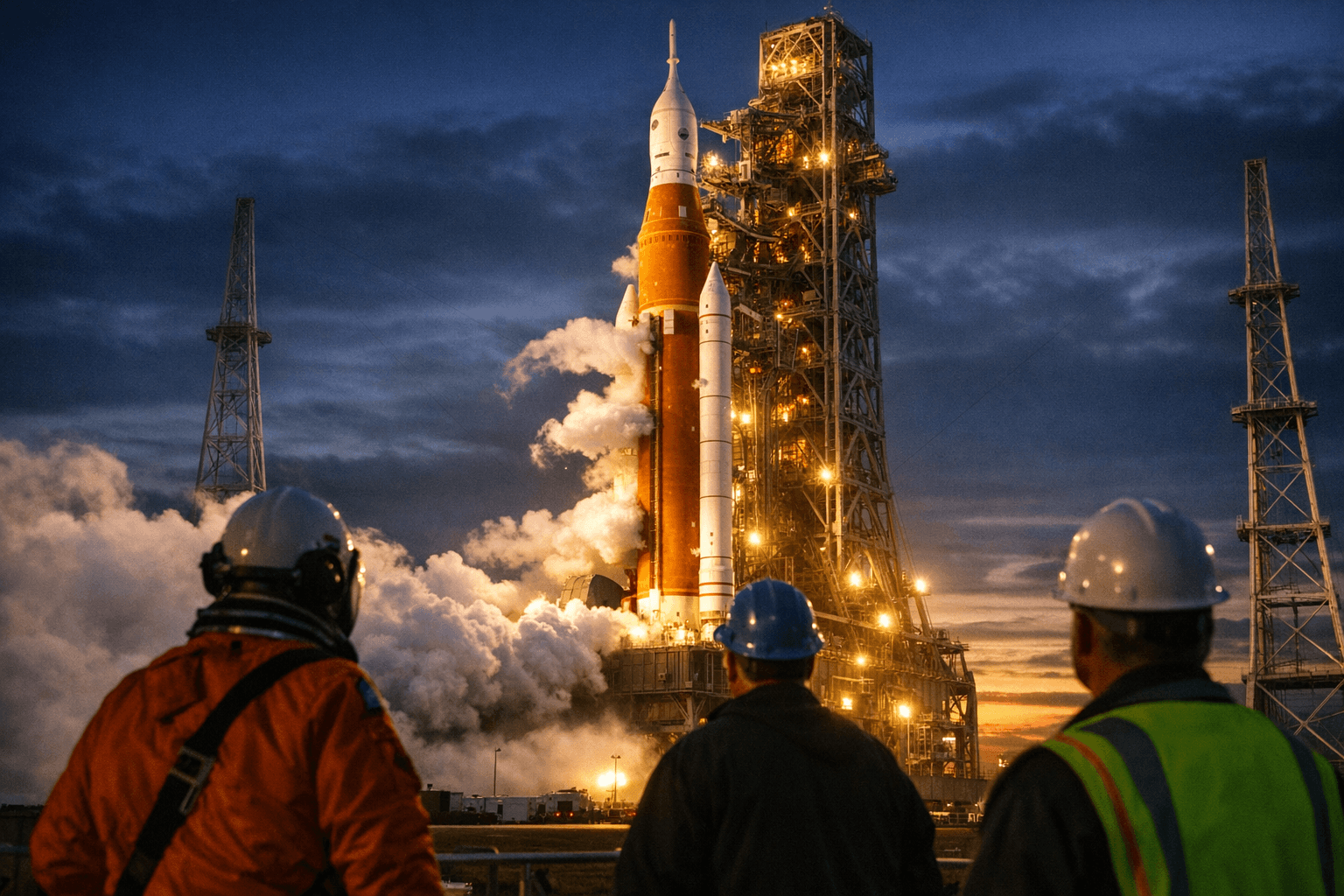
Artemis II’s crew is set to include NASA astronauts Reid Wiseman, Victor Glover and Christina Koch, along with Jeremy Hansen of the Canadian Space Agency. Reports differ on quarantine timing: SpacePolicyOnline said the four astronauts were "entering the 14-day pre-launch quarantine this afternoon," while the Orlando Sentinel reported they would "enter quarantine Friday" and remain in Houston before flying back to KSC roughly five days before launch. NASA has stressed crew safety and updated closeout procedures, including purging Orion service module cavities with breathing air for the safety of closeout teams, according to a NASA writeup by Rachel H. Kraft.
The technical fixes and timetable carry real local consequences. The integrated SLS and Orion stack that rolls to the pad weighs about 3.5 million pounds, and launch operations draw a surge of workers, contractors, and spectators to Brevard County, putting pressure on local services and emergency response. Social media reaction captured both excitement and caution. A public Facebook post by Space FrontPage read, "LAUNCH UPDATE, Mark your calendars! NASA is aiming for March 6, 2026, for the monumental launch of Artemis II, after a successful wet dress rehearsal," and the post showed 116 reactions, seven comments and 32 shares.
Beyond the engineering milestones, Artemis II raises questions about how the risks and economic gains of big space programs are distributed across local communities. Health and emergency planners in Florida will be watching the coming weeks as quarantine rules, workforce movements and visitor crowds test public health and hospital surge capacity in a region still grappling with inequities in access to services. For NASA, managers say, data will decide the next steps; for communities, the countdown signals both opportunity and uncertain strain as the agency moves closer to returning humans to deep space. Photo credit: NASA/Sam Lott.
This article was produced by Prism’s automated news system from verified source data, official records, and press releases, then run through automated quality and moderation checks before publishing. The system is built and supervised by the people who set the standards it runs under. Read our full AI policy.
Did this article answer your question?

