NASA tests laser communications for Artemis II lunar mission
Artemis II tested laser links that can move video and science data at 260 megabits per second, a step toward a lunar network built for heavy traffic.

NASA used Artemis II to test whether the next era of lunar flight can handle the data demands of sustained operations, not just short visits. The mission’s Orion Artemis II Optical Communications System sent information with invisible infrared light instead of radio waves, aiming to move science data, procedures, flight plans, communications, high-resolution images and video at speeds up to 260 megabits per second.
That matters because the communications problem changes once astronauts stay longer, work farther from Earth and depend on faster decision-making from the ground. NASA says laser communications can shrink the size, weight and power requirements of a spacecraft communications package compared with traditional radio systems. The Orion optical module uses a 4-inch telescope and two gimbals, a compact setup designed to point a narrow laser link back to Earth.
Artemis II launched from Kennedy Space Center on April 1, 2026 with NASA astronauts Reid Wiseman, Victor Glover and Christina Koch, along with Canadian Space Agency astronaut Jeremy Hansen. The crew spent about 10 days flying around the Moon before splashing down in the Pacific Ocean off San Diego on April 10, 2026. NASA and MIT Lincoln Laboratory describe the flight as the first crewed mission to demonstrate laser communications at lunar distance, building on the uncrewed Artemis I mission in 2022, which proved Orion could go farther than ever before and return safely.
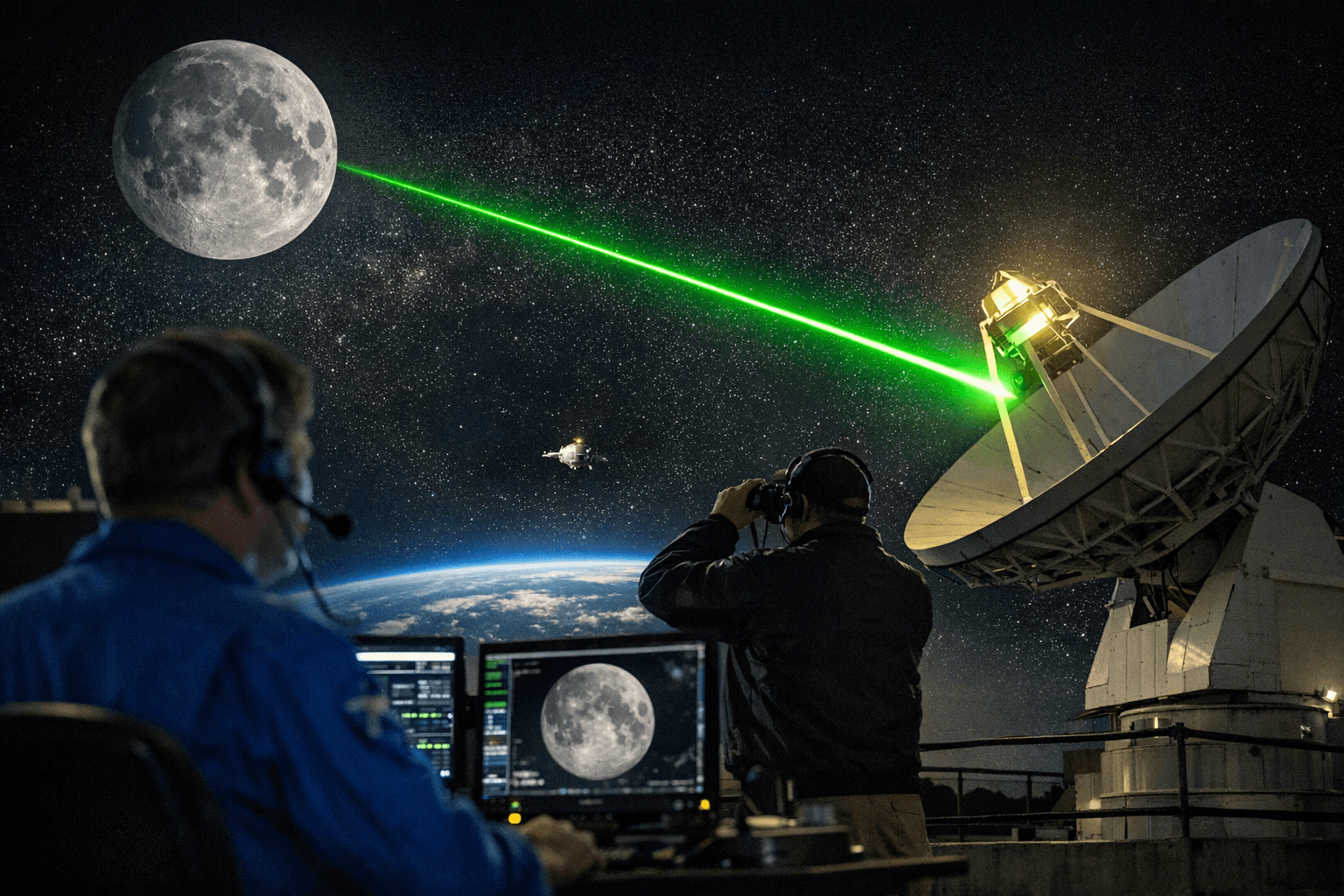
The comparison with Apollo is not cosmetic. Apollo-era missions relied on radio-frequency communications, a system that served a different kind of program. Artemis is aimed at a heavier, more data-rich future in which the communications architecture must support sustained human activity on and around the Moon. NASA says Artemis II still depended on the Near Space Network and Deep Space Network as its primary backbones, with the optical system serving as a critical demonstration layer for later missions.
The ground segment is part of the story. NASA’s primary receivers for the laser signal were at White Sands, New Mexico, and Table Mountain, California, where dry, high-altitude conditions improve link reliability. The demonstration also included the Quantum Optical Ground Station at Mount Stromlo Observatory in Australia, a Southern Hemisphere capability NASA and the Australian National University say could help establish reliable optical coverage for future lunar and Solar System missions.
MIT Lincoln Laboratory said its MAScOT laser communications terminal, developed with NASA Goddard Space Flight Center and launched aboard Artemis II on April 1, was built to send high-definition video and data from lunar vicinity to Earth. Farzana Khatri said radio-frequency spectrum is highly congested and “does not scale well to longer distances across space.” In that context, Artemis II was less a technology stunt than a rehearsal for the communications grid a permanent lunar presence will require.
This article was produced by Prism’s automated news system from verified source data, official records, and press releases, then run through automated quality and moderation checks before publishing. The system is built and supervised by the people who set the standards it runs under. Read our full AI policy.
Did this article answer your question?


