NASA WB-57 research jet makes gear-up landing at Houston’s Ellington Field
A NASA WB-57 performed a gear-up landing at Ellington Field, trailing flames and smoke; FAA and NASA have opened investigations and the runway was closed.
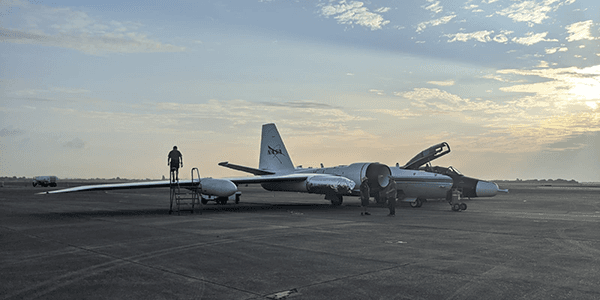
A NASA WB-57 high-altitude research jet landed without its landing gear and slid along Runway 17R–35L at Ellington Field in Houston, trailing flames and smoke before coming to a stop, officials and video footage show. Two people were aboard the aircraft; emergency responders helped at least one pilot exit the cockpit and NASA said all crew were safe "at this time."
Local news helicopter and runway camera footage captured the jet touching down around 11:25–11:30 a.m. on Jan. 27, 2026, then sliding along the pavement as bursts of yellow flame and white smoke emanated from beneath the airframe. Houston Airports officials confirmed the runway was closed while crews worked to remove the plane, and local reports indicated first responders, including personnel from a military subcontractor, were on the scene to assist.
NASA confirmed the incident in a post on X from spokesperson Bethany Stevens, saying "a mechanical issue with one of NASA’s WB-57s resulted in a gear-up landing at Ellington Field" and that the agency "will conduct a thorough investigation into why the landing gear could not be deployed." The Federal Aviation Administration issued a statement noting, "A Martin WB-57 landed with its gear up at Ellington Airport in Houston around 11:25 a.m. local time on Tuesday, Jan. 27. Two people were on board. The FAA will investigate."
The WB-57 is a thin-fuselage, two-seat research jet that NASA has used since the 1970s for high-altitude atmospheric and scientific missions. Capable of reaching altitudes above 63,000 feet, the aircraft has been repurposed from its Cold War origins to support atmospheric science and remote sensing programs. Agency and media coverage have emphasized that the airframe is a low-density, high-demand asset for NASA and the broader scientific community.

Beyond the immediate mechanical failure, the incident raises public safety and environmental questions for the Houston community. While responders contained the situation without reported injuries, smoke and burning jet fuel can pose short-term air quality and respiratory risks, particularly for nearby residents and workers at the airport. The closure of a primary runway also interrupted airport operations and required deployment of emergency resources, which can strain local response capacity and potentially delay other critical flights.
The event underscores broader issues of oversight and stewardship of aging federal research aircraft. The WB-57 fleet has provided unique capabilities for atmospheric research, but its longevity also reflects the challenge of maintaining specialized, older airframes in active service. Safety investigators from the FAA and NASA are expected to examine mechanical systems, maintenance records, and operational procedures to determine the cause of the landing-gear failure and to assess whether systemic maintenance or funding shortfalls contributed.
Families of crew, airport employees, and community members will be watching the investigations for clear, timely answers. For researchers who rely on the WB-57 for atmospheric data, the incident spotlights the vulnerability of scientific infrastructure and the need for accountable maintenance and contingency planning. NASA and the FAA have not released a timeline for preliminary findings; investigators will need to address both the technical cause and the public health and operational consequences of the belly landing.
This article was produced by Prism’s automated news system from verified source data, official records, and press releases, then run through automated quality and moderation checks before publishing. The system is built and supervised by the people who set the standards it runs under. Read our full AI policy.
Did this article answer your question?