NASA's Orion Capsule Completes Historic Journey, Returns Safely to Earth
After 10 days and 695,081 miles, NASA's Artemis II crew splashed down safely despite a known heat shield flaw that made re-entry the mission's most dangerous 13 minutes.
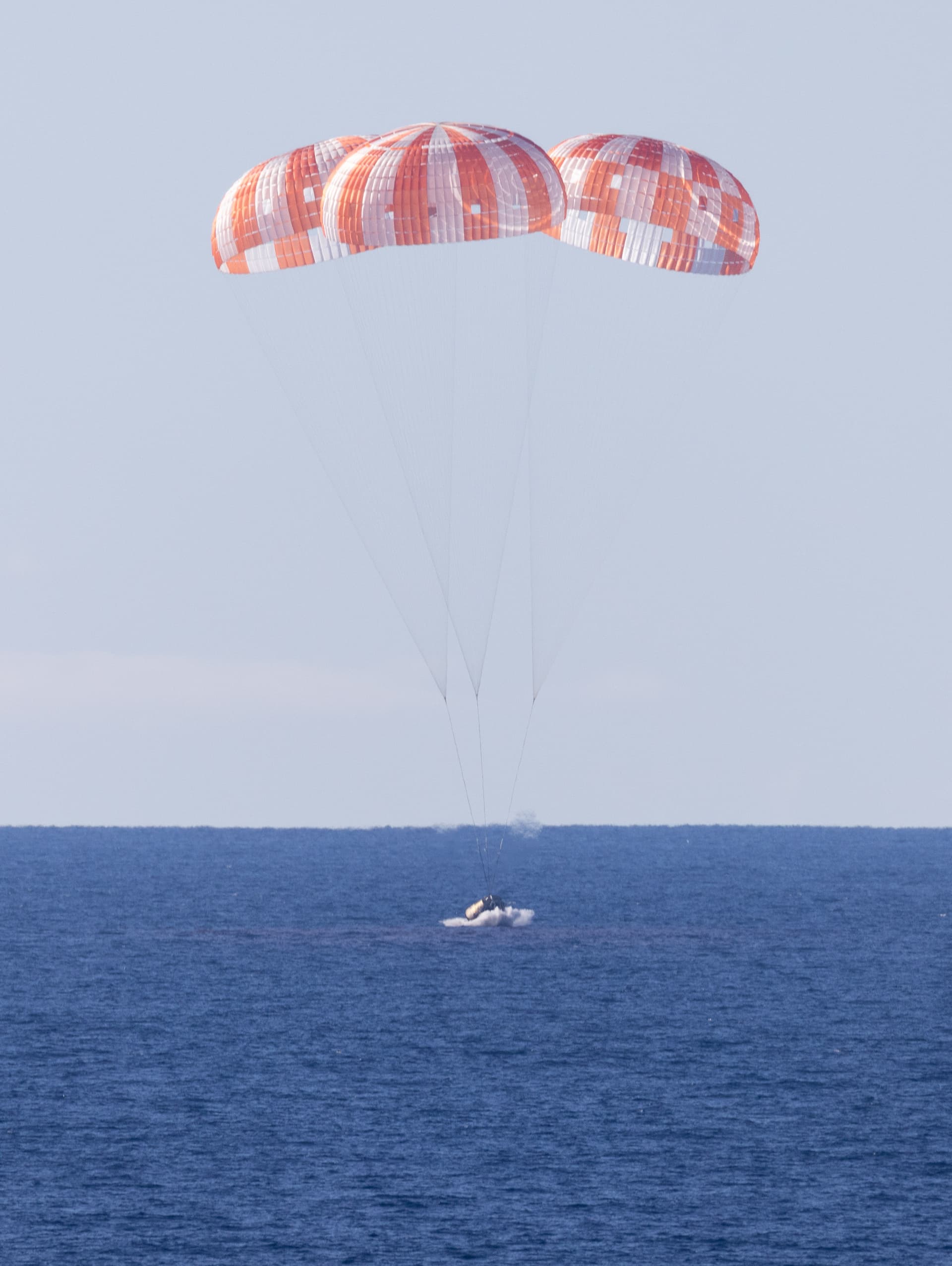
Four astronauts flying aboard NASA's Orion spacecraft, named Integrity by the crew, splashed down in the Pacific Ocean off the coast of San Diego at 8:07 p.m. ET on Friday, completing the first crewed lunar mission since Apollo 17 in 1972 and validating critical systems aboard a capsule that entered Earth's atmosphere carrying a known structural flaw.
Commander Reid Wiseman, Pilot Victor Glover, Mission Specialist Christina Koch and Canadian Space Agency Mission Specialist Jeremy Hansen completed a nearly 10-day, 695,081-mile journey that broke the record for farthest distance humans have traveled from Earth. On April 6, Orion reached 252,756 miles from home, surpassing the previous mark set by Apollo 13 in 1970 by 4,111 miles. Glover became the first Black astronaut to travel to the Moon, Koch the first woman, and Hansen the first Canadian.
The crew lifted off from Launch Pad 39B at Kennedy Space Center on April 1 at 6:35 p.m. ET aboard the Space Launch System rocket. On April 6, Integrity performed a flyby of the Moon at a closest approach of 4,067 miles above the lunar surface, the closest any crewed spacecraft had come in over half a century.
Re-entry was the mission's highest-stakes checkpoint. Orion's heat shield, made of an ablative material called Avcoat, carried a known flaw discovered after the uncrewed Artemis I test in 2022. Because of that defect, NASA abandoned its originally planned "skip re-entry" approach, in which a capsule briefly dips into the upper atmosphere to bleed off energy, and substituted a steeper entry profile instead. Integrity hit the atmosphere at a maximum velocity of roughly 24,661 miles per hour, decelerating to approximately 325 miles per hour within 13 minutes while enduring temperatures between 3,000 and 5,000 degrees Fahrenheit before a parachute system brought it to a splashdown speed of around 17 miles per hour.

The capsule came down with no immediately obvious catastrophic issues, but mission managers were candid at the post-splashdown news conference: the heat shield was expected to return showing divots and cracking, and close inspection of the Avcoat material is already underway. Engineers also flagged that the service module, contributed by the European Space Agency, will require a valve redesign before the next flight, and other systems on board will face scrutiny in the weeks ahead.
Those findings carry direct implications for Artemis III, which originally aimed to put astronauts on the Moon's surface in 2027. Telemetry collected during re-entry, gathered in part by aircraft from NASA's Armstrong Flight Research Center using advanced telescopes and sensors, will drive the most consequential engineering decisions of the coming months. What analysts find in that data, and what engineers discover when they disassemble Integrity at Kennedy Space Center after it is transported from Naval Base San Diego, will determine whether design changes are required before any crew flies again, and at what cost.
Glover, speaking to media the day before splashdown, acknowledged that re-entry had weighed on him since the crew's assignment was announced in April 2023. "There's so much data that you've seen already," he said, "but all the good stuff is coming back with us." Those six words now frame the next phase of the Artemis program precisely: safe return was the goal, but the data Integrity carried home is what will decide when humans go back.
Sources:
Know something we missed? Have a correction or additional information?
Submit a Tip