NASA's Van Allen Probe A Burns Up After 14 Years Circling Earth
A 1,323-pound NASA spacecraft re-entered Earth's atmosphere Monday, ending a mission that transformed our understanding of radiation belts.

After nearly 14 years in orbit, NASA's Van Allen Probe A made its uncontrolled return through Earth's atmosphere Monday evening, closing the chapter on a mission that fundamentally reshaped scientists' understanding of the radiation zones encircling our planet.
The U.S. Space Force forecast re-entry at approximately 7:45 p.m. ET on March 10, and NASA confirmed that most of the 1,323-pound spacecraft burned up during its fiery descent. The agency was careful to note, however, that not everything incinerated. "Some components are expected to survive re-entry," NASA said, adding that "the risk of harm coming to anyone on Earth is low, approximately 1 in 4,200."
That roughly 0.02% probability reflected both the spacecraft's relatively modest mass and a statistical reality familiar to orbital debris specialists: oceans cover about 71% of Earth's surface, and most surviving fragments fall into water or remote, uninhabited land.
Probe A launched on Aug. 30, 2012, alongside its twin, Van Allen Probe B, as part of a NASA mission designed to study the Van Allen belts, the doughnut-shaped regions of charged particles trapped by Earth's magnetic field. The twin probes gathered what scientists described as unprecedented data on how solar activity energizes and reshapes those belts, at one point revealing a previously unknown third radiation belt. The mission ceased operations around 2019, leaving both spacecraft drifting in increasingly decaying orbits.
The timing of Monday's re-entry surprised mission planners. Earlier analyses, conducted when the mission ended, had projected that Probe A would not return until 2034. The current solar cycle proved those projections wrong. The Sun reached solar maximum in 2024, unleashing frequent and intense space weather events that inflated Earth's upper atmosphere and dramatically increased aerodynamic drag on the spacecraft, accelerating its orbital decay well beyond original estimates.
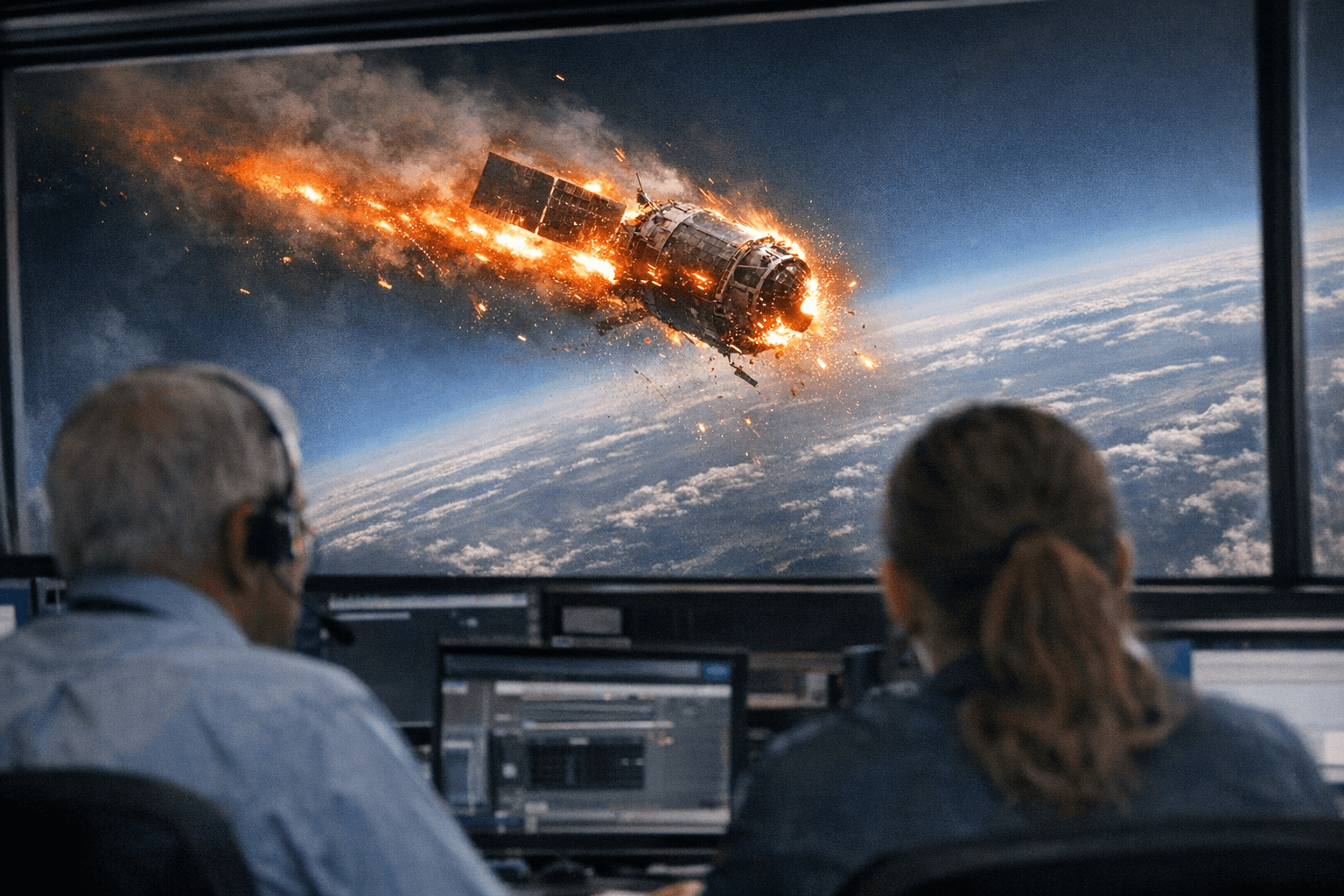
Predicting exactly when and where an uncontrolled spacecraft will re-enter is inherently difficult. Atmospheric density, solar activity, and the vehicle's shifting orbit all interact in ways that resist precise modeling, which is why the re-entry forecast carried an uncertainty window of plus or minus 24 hours. NASA and the U.S. Space Force monitored Probe A continuously in the final days, issuing updated predictions as the window narrowed.
Uncontrolled re-entries are not extraordinary events. The European Space Agency has noted that old satellites, spent rocket stages, and miscellaneous orbital debris fall back through the atmosphere almost daily, with the vast majority burning up harmlessly. What sets the Van Allen Probe A case apart is the spacecraft's scientific legacy and the solar-cycle dynamics that brought it home years ahead of schedule.
Van Allen Probe B, the surviving twin, remains in orbit. Most reporting places its expected re-entry around 2030, though earlier analyses before the current solar cycle had projected 2034. Given how aggressively the Sun's activity shortened Probe A's orbital life, that timeline for Probe B may itself be subject to revision as solar maximum conditions persist.
The FAA has separately flagged the long-term pattern as a growing concern: an agency report projects that by 2035, falling satellite debris could kill one person every two years globally as low-Earth orbit becomes more congested. For now, Monday's re-entry appears to have concluded without incident, a quiet ending for a spacecraft that spent more than a decade illuminating one of space's most hazardous environments.
This article was produced by Prism’s automated news system from verified source data, official records, and press releases, then run through automated quality and moderation checks before publishing. The system is built and supervised by the people who set the standards it runs under. Read our full AI policy.
Did this article answer your question?


