National Weather Service Warns Winter Hazards and Dry Spring Risks
Multiple National Weather Service forecast products issued Jan. 2–3, 2026 highlighted imminent cold, snow and ice risks across the central and eastern United States, warning of travel disruption and higher heating demand. A regional January–March outlook for the Lower Rio Grande Valley and Deep South Texas also flagged a strong tendency toward warmer, drier conditions with implications for drought, reservoirs, wildfire risk and coastal hazards.
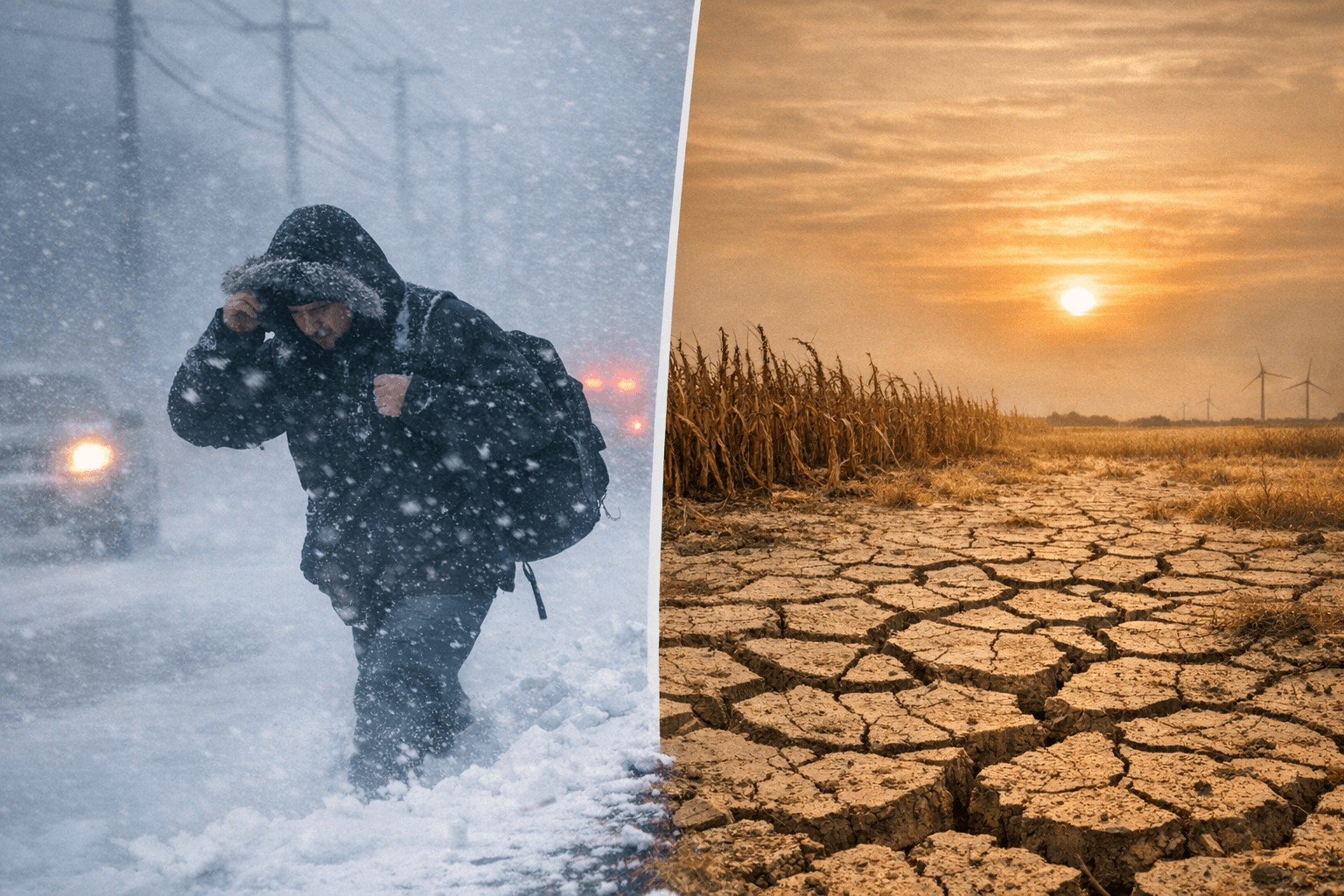
Multiple National Weather Service forecast products and public forecast discussions issued Jan. 2–3, 2026 warned of active winter hazards across portions of the central and eastern United States, emphasizing cold temperatures, the potential for snow and ice, and likely increases in residential and commercial heating demand. Those operational forecasts, issued as short term guidance rather than seasonal outlooks, signaled near term risks for travel disruption, localized precipitation hazards and strains on energy systems as communities respond to abrupt temperature declines.
In parallel, the NWS Brownsville/Rio Grande Valley office published a regional outlook dated Dec. 29, 2025, titled "January–March 2026 Outlook: Perspective for the Lower Rio Grande Valley/Deep S. Texas Region," authored by Andrei Evbuoma, Barry Goldsmith and Rodney Chai and framed under Building a Weather-Ready Nation. That outlook favors warmer than normal conditions for January through March 2026 with medium high confidence in the temperature signal. It also favors drier than normal conditions through the same period, though the source materials include two different confidence characterizations for the dryness signal: one passage assigns high confidence at 70 to 90 percent, while a separate excerpt ties a medium 40 to 50 percent confidence to continued dryness for the region. Journalists and decision makers are advised to cite the specific NWS product or section when relying on a single confidence estimate because the materials present differing ranges.
The regional outlook links the warmer, drier tendency to a suite of operational impacts: persistence of drought, elevated wildfire potential, concerns over water supply tied to low or record reservoir levels, and heightened marine and coastal hazards. It stresses that the spatial distribution of any rainfall this winter and early spring will be critical to providing reservoir relief, and that continued low reservoir levels pose the risk of major downstream water supply issues for communities and agriculture across the Rio Grande Valley.
The juxtaposition of immediate winter hazards in the central and eastern United States with a warm dry outlook for South Texas underscores how climate variability produces divergent local impacts that require targeted public health and emergency responses. In colder regions, short term increases in heating demand can exacerbate energy insecurity for low income households, older adults and people with chronic health conditions, increasing the need for expanded energy assistance, sheltering options and outreach to homebound patients. In the Rio Grande Valley, persistent drought and falling reservoir levels threaten irrigation-dependent agriculture, municipal water systems and communities already grappling with inequities in water access and infrastructure.
Public health officials, emergency managers and utility providers will need to coordinate with NWS guidance to prioritize resources to vulnerable populations, accelerate wildfire mitigation where risks are rising, and plan for targeted water conservation and assistance measures. As the winter season unfolds, the combination of operational NWS forecasts and the January–March outlook provides a roadmap for policymakers to balance immediate cold weather response with longer lead planning for water and fire resilience.
This article was produced by Prism’s automated news system from verified source data, official records, and press releases, then run through automated quality and moderation checks before publishing. The system is built and supervised by the people who set the standards it runs under. Read our full AI policy.
Did this article answer your question?