Nebraska Senate primary pits Democrats against each other over fake candidate claims
Two Democrats are trading fake-candidate accusations in Nebraska's Senate primary, where Cindy Burbank's ballot fight could shape a fall race against Pete Ricketts or Dan Osborn.
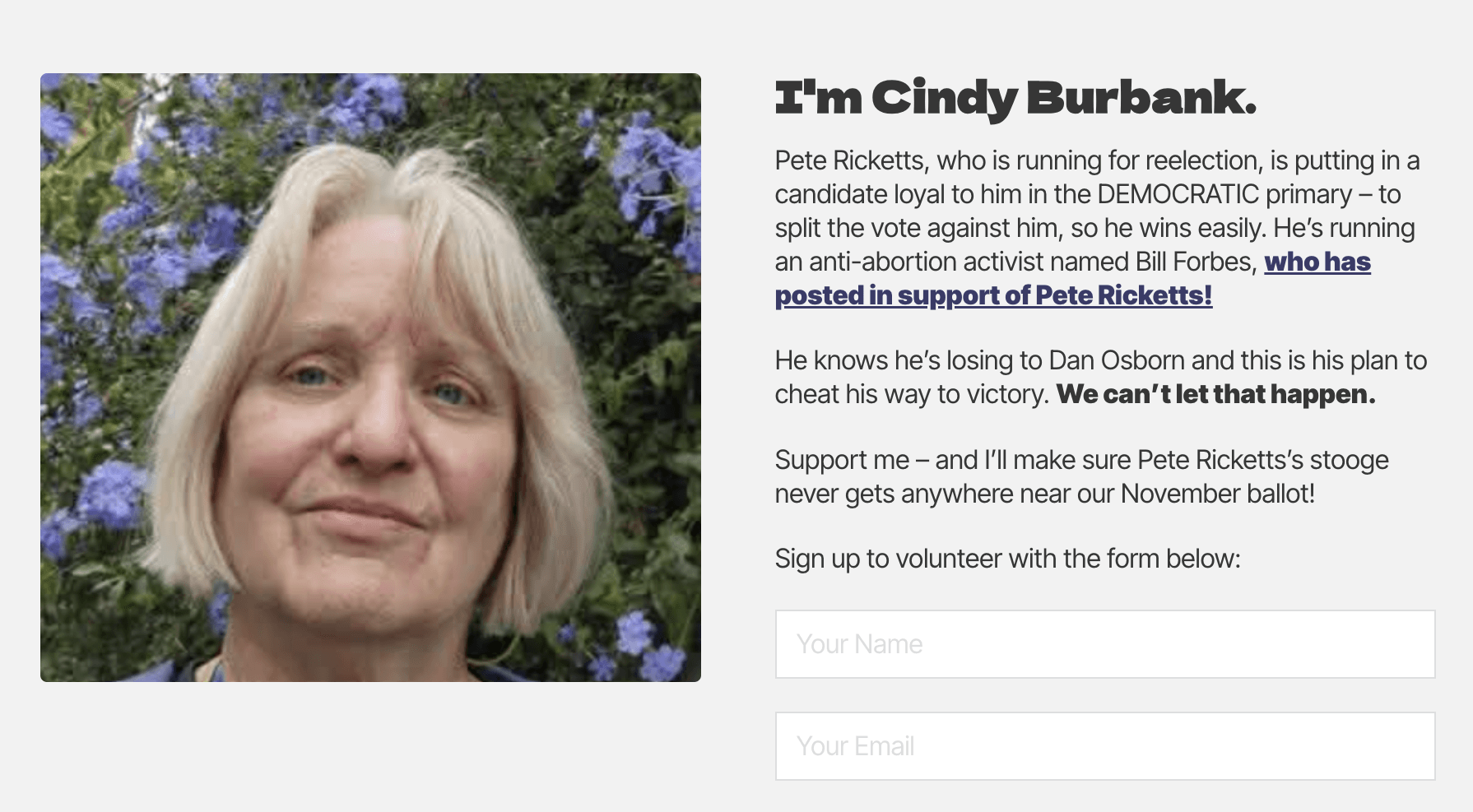
Nebraska’s Senate contest has turned into an argument over who is real and who is there to help the other side. Cindy Burbank and pastor Bill Forbes were on the ballot Tuesday in a Democratic primary shadowed by accusations that each is a fake contender, and the dispute mattered far beyond party labels because it could determine whether Republicans face a credible challenge in November.
The stakes are unusually high in a state that has long favored Republicans. Pete Ricketts, appointed to the Senate in 2023 and then elected in a 2024 special election, is now seeking a full term and faces four Republican primary challengers of his own. But the race many strategists are watching is the general election battle that could follow, especially if independent Dan Osborn remains viable. Osborn, an industrial mechanic and military veteran, came within 7 points of defeating Republican Deb Fischer in 2024, a near miss that showed how competitive Nebraska can become when a protest candidate has enough energy and money behind him.

That possibility has made the Democratic primary politically awkward. State records show Forbes is a registered Democrat, but party leaders have suspected him of entering the race to siphon votes from Osborn and indirectly help Ricketts, an allegation Forbes denies. The Nebraska Democratic Party has backed Burbank for the primary and Osborn for the general election, a split that underscores how fractured the usual party playbook has become in this race. Instead of building a clear nominee, Democrats have been forced to sort through a contest in which ballot access and political intent are both part of the fight.
Burbank’s own ballot access became a test of that struggle. Nebraska’s Republican secretary of state initially removed her from the ballot after a complaint from the state GOP that she was running in bad faith, but the Nebraska Supreme Court ordered her restored. That ruling put her back in the primary, but it also amplified the sense that the race was being shaped as much by legal maneuvering as by campaigning.
The money trail has been thin. Burbank reported about $4,300 in fundraising, while Forbes reported no monetary contributions as of late April. Those numbers point to a low-dollar race with outsized consequences, because even modest confusion over candidate labels could affect turnout, credibility and the odds that Nebraska ends up with a genuinely competitive Senate race in the fall.
This article was produced by Prism’s automated news system from verified source data, official records, and press releases, then run through automated quality and moderation checks before publishing. The system is built and supervised by the people who set the standards it runs under. Read our full AI policy.
Did this article answer your question?

