New Mexico and California Juries Hold Tech Giants Liable for Youth Harms
A California woman identified as K.G.M. was awarded $3 million after jurors found Meta bore 70% responsibility for her depression — one of two landmark verdicts totaling $381 million.
Lori Schott stood outside Los Angeles Superior Court on Wednesday holding a photograph of her daughter Annalee, joining a crowd of families who had traveled from around the country to witness what plaintiffs' lawyers immediately called a turning point in American legal history. Inside, a jury had just found Meta and Google's YouTube liable for the mental-health harms of a young woman known in court documents as K.G.M., a now-20-year-old Californian who sued the companies for intentionally hooking her on social media as a child and contributing to her depression and suicidal thoughts.
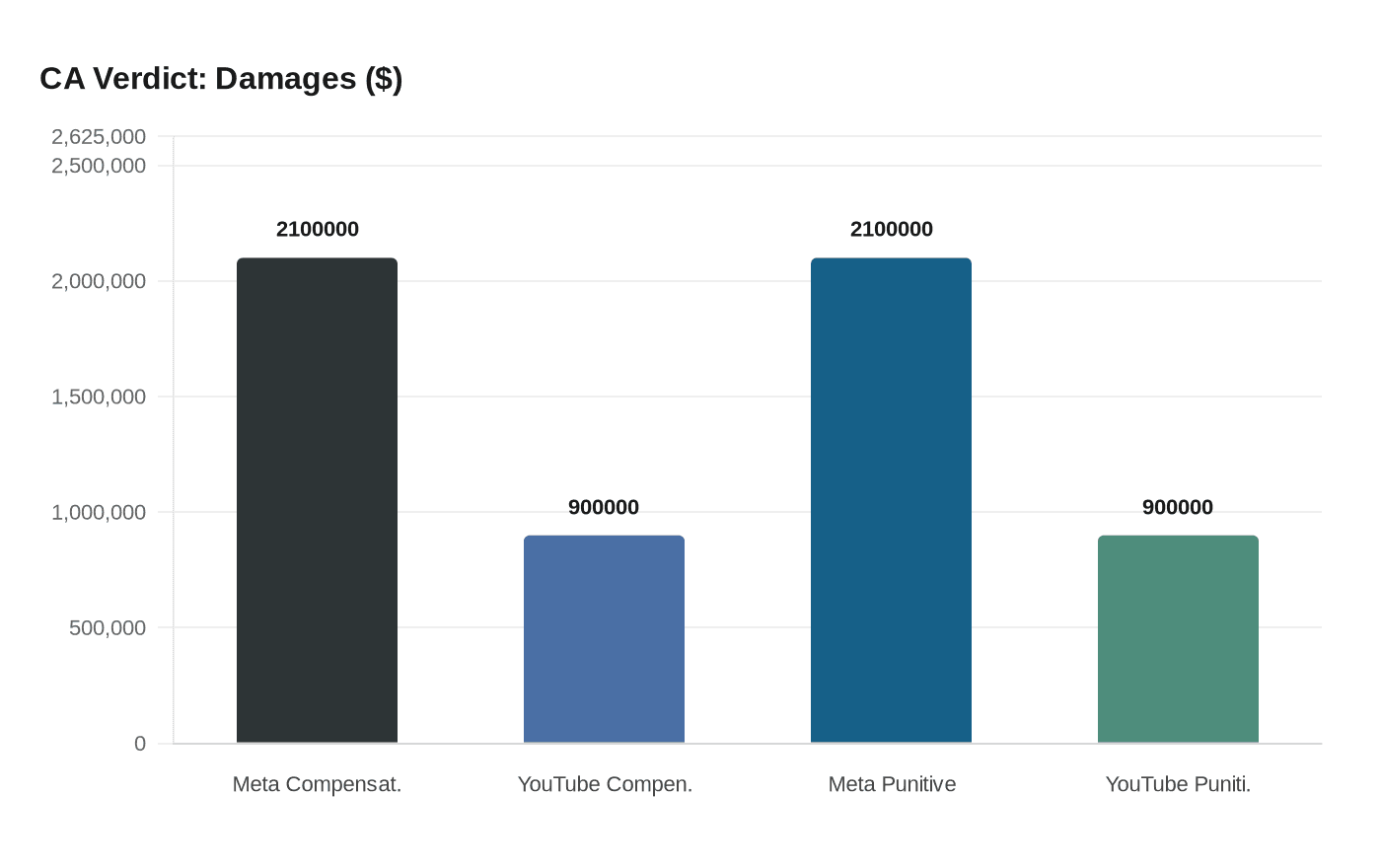
The California jury found Meta and YouTube liable on all counts, concluding that both companies were negligent in platform design, knew their design was dangerous, and failed to warn their youngest users of those risks. Jurors awarded K.G.M. $3 million in compensatory damages, assigning Meta 70% of the responsibility and YouTube 30%. The jury also recommended $2.1 million in punitive damages from Meta and an additional $900,000 from YouTube, pending a judge's final review.
The Los Angeles verdict arrived one day after a jury in a separate trial in New Mexico ordered Meta to pay $375 million in damages for failing to protect young users from child predators on Instagram and Facebook. Jurors in that case found the Facebook and Instagram parent company violated New Mexico's consumer protection law following a lawsuit brought by Attorney General Raúl Torrez, who accused Meta of failing to protect children from predators. The jury agreed that Meta engaged in "unconscionable" trade practices that unfairly took advantage of the vulnerabilities and inexperience of children.
Torrez sued Meta in 2023 following an undercover operation in which investigators created a fake social media profile of a 13-year-old girl. During the trial, prosecutors revealed internal messages from Meta employees discussing how CEO Mark Zuckerberg's 2019 announcement to make Facebook Messenger end-to-end encrypted by default would impact the ability to disclose to law enforcement some 7.5 million child sexual abuse material reports.

"Juries in New Mexico and California have recognized that Meta's public deception and design features are putting children in harm's way," Torrez said in a statement Wednesday. Joseph VanZandt, co-lead lawyer for families and others suing social media companies, was more direct about the industry-wide implications. "For years, social media companies have profited from targeting children while concealing their addictive and dangerous design features," VanZandt said in a joint statement with the plaintiff's legal team. "Today's verdict is a referendum, from a jury, to an entire industry, that accountability has arrived."
The California case was designated as a bellwether test tied to about 2,000 other pending lawsuits brought by parents and school districts arguing that social media giants should be considered manufacturers of defective products for hooking a generation of young people to social media feeds. Attorneys general in more than 40 states have filed suit against Meta, claiming it is contributing to a mental health crisis among young people.
The California verdict validated the plaintiffs' legal strategy of shifting focus away from the content people see on social media toward how the services were designed; Meta's apps and Google's YouTube, the jury concluded, were deliberately built to be addictive and the companies' executives knew this.
Neither verdict immediately forces Meta to change its algorithms or platform architecture. The rulings do not mandate specific changes to the design of social media platforms or the algorithms that power them, but a second phase of the New Mexico trial in May, before a judge with no jury, could spell out changes for Meta's platforms for local users by court order. Torrez said he will seek injunctive relief in that proceeding, including "changes to the design features of the platform itself, real age verification, changes to the algorithm, an independent monitor to oversee those changes and fundamentally a demand that they do business differently in New Mexico." Judge Bryan Biedscheid, who oversaw the New Mexico trial, is slated to preside over that bench proceeding.
Meta said it plans to appeal both verdicts. A Meta spokesperson said "teen mental health is profoundly complex and cannot be linked to a single app" and that the company remains "confident in our record of protecting teens online." A Google spokesperson said the case "misunderstands YouTube, which is a responsibly built streaming platform, not a social media site."
Investors largely shrugged off the verdicts; Meta's stock closed slightly higher on Wednesday, though it remains down about 8% year-to-date. Torrez acknowledged the $375 million New Mexico penalty may not be sufficient deterrence on its own against a company valued at roughly $1.5 trillion, but said that if similar actions are brought in other jurisdictions, "the potential penalties will add up really quickly."
Legal experts have characterized the twin verdicts as the social media industry's "Big Tobacco" moment, comparing them to the 1990s, when tobacco companies were forced to pay billions of dollars for lying to the public about the safety and potential harms of their products. Torrez predicted the wave of litigation would also prompt congressional action, pushing lawmakers to reexamine Section 230 and stalled child safety legislation.
Know something we missed? Have a correction or additional information?
Submit a Tip