New York City Adds Mobile Screening, Tightens Policing in Times Square
New York City announced intensified security for the Times Square New Year’s Eve celebration, introducing mobile screening teams to conduct secondary checks inside crowd viewing areas in addition to standard perimeter checkpoints. The move aimed to add a second layer of protection for roughly one million attendees, while raising questions about crowd flow, civil liberties and economic impacts for businesses reliant on the holiday surge.
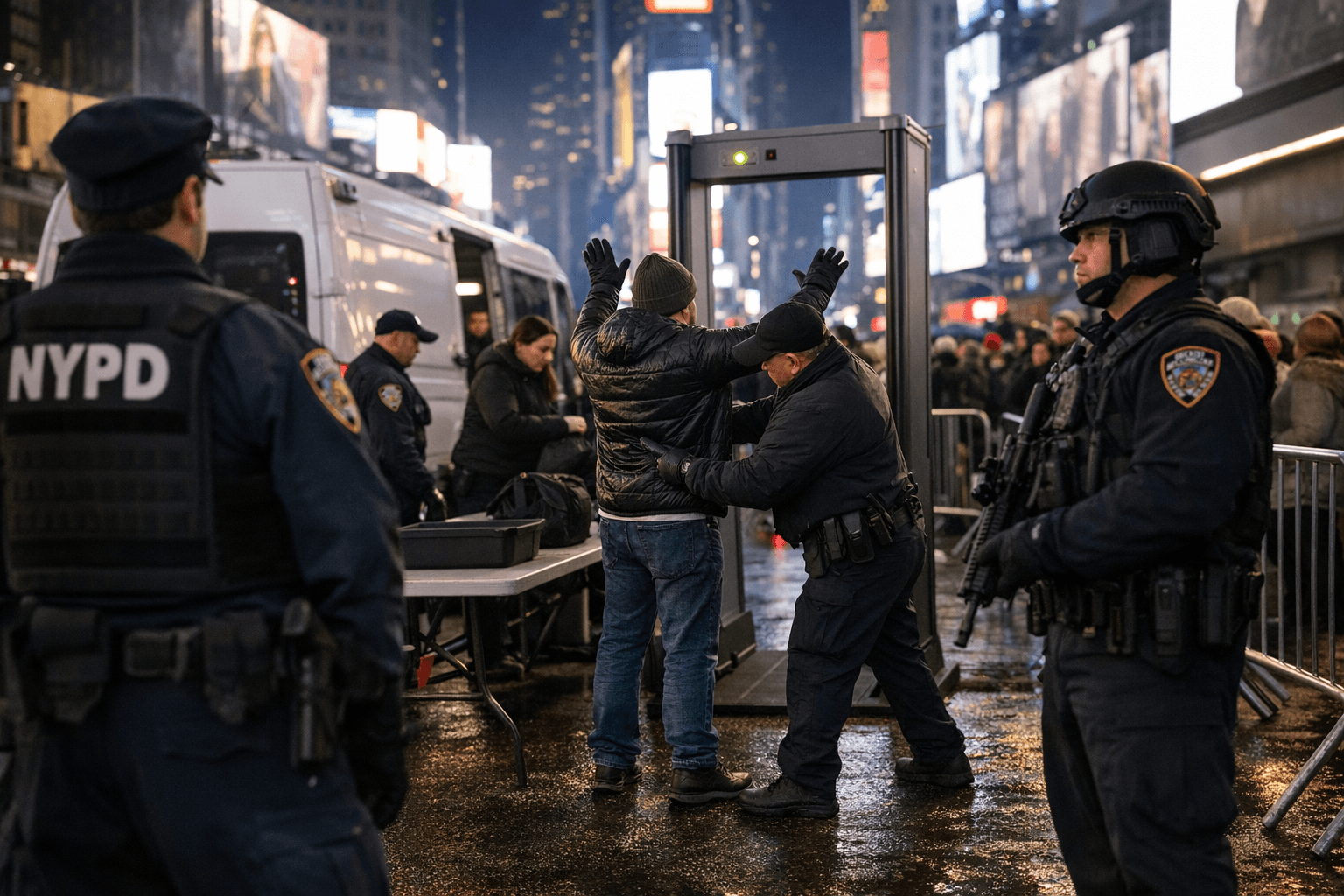
New York City officials on December 30, 2025 announced enhanced security measures for the Times Square New Year’s Eve celebration, adding mobile screening teams that carried out secondary screenings inside designated crowd viewing areas alongside existing perimeter checkpoints. The announcement came as tens of thousands of spectators gathered in Midtown Manhattan and as municipal authorities said they were increasing police presence for the night.
The additional screening element was presented as a layered security approach intended to identify threats that might bypass outer checkpoints. City officials did not provide precise numbers for the mobile teams, or detailed descriptions of screening technology and procedures, but emphasized that the secondary checks would operate within the viewing zones rather than replacing established perimeter controls. Standard checkpoints at vehicular and pedestrian access points remained in place.
Times Square’s celebration typically draws about one million people to Midtown on New Year’s Eve, and hotels in the area often report near full occupancy. For New York’s hospitality and retail sectors the event is an important seasonal revenue generator, so measures that affect access or movement can have immediate economic consequences for restaurants, bars and transportation hubs. Officials said the security measures were calibrated to maintain public safety while allowing the event to proceed.
Policing was ramped up across the area, with additional officers and support units deployed throughout the evening. Officials framed the strategy as balancing deterrence and rapid response while minimizing disruption to crowd movement. The city declined to disclose operational details that could compromise security, including the number of officers assigned to plain clothes teams or the precise movement patterns of mobile screeners.
Security experts say layered screening has become a more common public safety tool at high density events because it creates redundancy. From a policy perspective, the shift illustrates a broader trend in urban event management toward more intrusive but mobile forms of surveillance and inspection. That trend raises trade offs between safety, civil liberties and public convenience, especially when secondary screening takes place inside large crowds where delays can compound and create bottlenecks.
Economic and market implications are modest in the short term but politically sensitive. A single night of heightened security can affect taxi and ride share demand, spur additional transit use and impose overtime costs on municipal budgets. For local businesses the reputational effect of a safe, orderly celebration supports future tourism. Conversely, visible intensification of security can deter some visitors and complicate logistics for vendors and service providers.
As the city moves forward, officials said they would review the effectiveness of the new measures, while providing after action assessments where appropriate. For now the new mobile screening teams represented a tangible example of how major American cities are recalibrating public safety for mass gatherings in the post pandemic, post global tension era, weighing immediate protection against broader social and economic costs.
This article was produced by Prism’s automated news system from verified source data, official records, and press releases, then run through automated quality and moderation checks before publishing. The system is built and supervised by the people who set the standards it runs under. Read our full AI policy.
Did this article answer your question?

