New York City Population Stagnates as Immigration Falls Sharply Nationwide
New York State gained just 1,008 residents in a year as immigrant arrivals plunged 70% — putting the state on track to lose congressional seats after 2030.
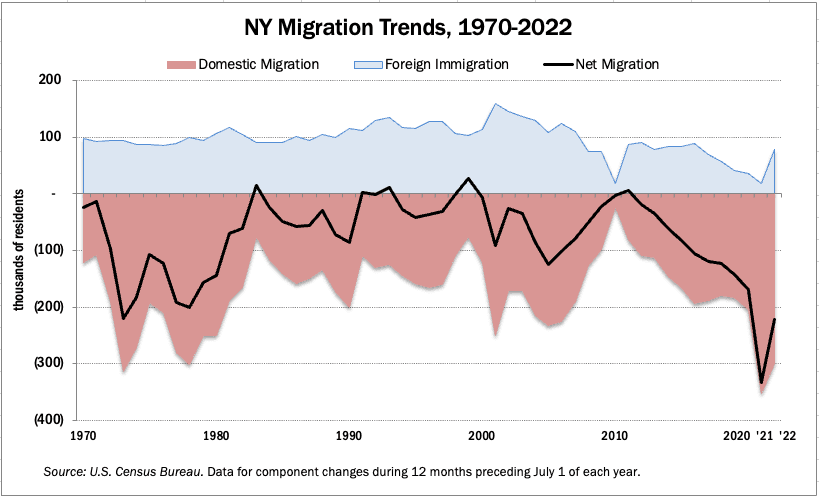
Roughly 96,000 immigrants moved to New York State in the 12 months ending mid-2025, less than a third of the 290,637 who arrived the year before — a collapse so steep it reduced the state's net population gain to just 1,008 people, according to U.S. Census Bureau estimates released in January 2026.
The Census Bureau attributed the broader national slowdown to what it called "a historic decline in net international migration, which dropped from 2.7 million to 1.3 million in the period from July 2024 through June 2025," according to Christine Hartley, assistant division chief for Estimates and Projections at the agency. National population growth in 2024-25 was only about half of the previous year's growth, and the drop in immigration accounted for virtually all of that slowdown.
For New York, the timing was punishing. The state was hit hard by what the Census Bureau called a "historic decline in net international migration" — meaning far fewer immigrants arriving from abroad — over the 12 months from July 2024 through June 2025. New York saw an inflow of 96,000 immigrant arrivals in 2024-25, down from 207,000 the year before, while U.S. residents continued moving away from New York faster than they moved in, resulting in a domestic migration loss of 137,000 and an overall migration loss of 42,000. That deficit was narrowly offset by natural growth of 43,000, the product of 203,000 births minus 160,000 deaths.
The domestic outflow is not new, but its cumulative weight is staggering. The 2024-25 net outflow of 137,586 New York residents brought the state's total five-year domestic migration loss to just over 1 million, and only California has lost more people to the rest of the country during the same period. Yet California's losses are proportionally smaller: New York's estimated population of just over 20 million was down by about 120,000, or 0.6 percent, since 2020 — the fifth-slowest growth rate through the first half of the decade.
For the immigrants who did come and stay, the arithmetic of survival in New York has grown unforgiving. Tania Mattos, executive director of Unlocal, a nonprofit that provides legal representation to immigrants in New York City, described the reality firsthand: "I've firsthand heard from so many people that it's so expensive to live here, and these are new New Yorkers who came here and were dropped off here, living at shelters, trying to make it." Unlike in prior years, finding a job in New York without a Social Security number or a work authorization card has become more difficult than before, Mattos added.

After a three-year rise, fewer immigrants decided to call New York State home in 2025. The drop in foreign-born people moving to the U.S. occurred nationwide, but immigration advocates pointed to one major issue driving them out of the state: affordability. The numbers bear out the reversal: from a pandemic-era low of 28,772 arrivals in 2021, New York saw immigrant inflows climb to 121,570 in 2022 and 211,383 in 2023 before the latest sharp contraction.
The political consequences are already coming into focus. New York's sluggish growth rate is a sign that the state is likely to lose further seats in Congress and in the Electoral College after the next decennial census in 2030. Empire Center senior fellow Bill Hammond, who analyzed the Census data, framed the trajectory in stark terms: "The trend of weakening growth is symptom of economic stagnation that should be a wake-up call for New York's elected leaders, starting with Governor Hochul and Mayor Mamdani."
Nationally, net international migration declined to 1.3 million in 2025 and is projected to further decline to approximately 321,000 in 2026 if current trends continue. "With natural change less of a contributor to growth than it used to be, some states — especially those without positive net domestic migration — are dependent on international migration for their population to grow," said Marc Perry, senior demographer at the U.S. Census Bureau. New York, bleeding residents to other states for five consecutive years with no countervailing surge of new arrivals, fits that description precisely.
This article was produced by Prism’s automated news system from verified source data, official records, and press releases, then run through automated quality and moderation checks before publishing. The system is built and supervised by the people who set the standards it runs under. Read our full AI policy.
Did this article answer your question?

