New Zealand edge England by DLS to level ODI series in Cardiff
Rain turned Cardiff into a DLS stress test, and New Zealand read it better. Brooke Halliday’s unbeaten 42 carried the White Ferns past England by 17 runs.

England did not lose control in one passage so much as in two weather-driven resets, and New Zealand handled both with greater composure. At Sophia Gardens in Cardiff, the third ODI was reduced to 33 overs per side after a two-and-a-half-hour interruption, then ended with New Zealand on 141-4 in 24.4 overs, ahead of the Duckworth-Lewis-Stern par score and 17 runs clear.
England had actually built pressure before the first break, with New Zealand sliding to 40-3 after Lauren Bell struck three times lbw. Suzie Bates, Georgia Plimmer and Amelia Kerr all fell to Bell’s straight, accurate spell, and at that point England looked in position to force a series win. But the rain changed the arithmetic and, just as importantly, the tempo of the game. Once the overs were cut, the match became less about accumulation and more about who could keep judgment intact under a shrinking target.
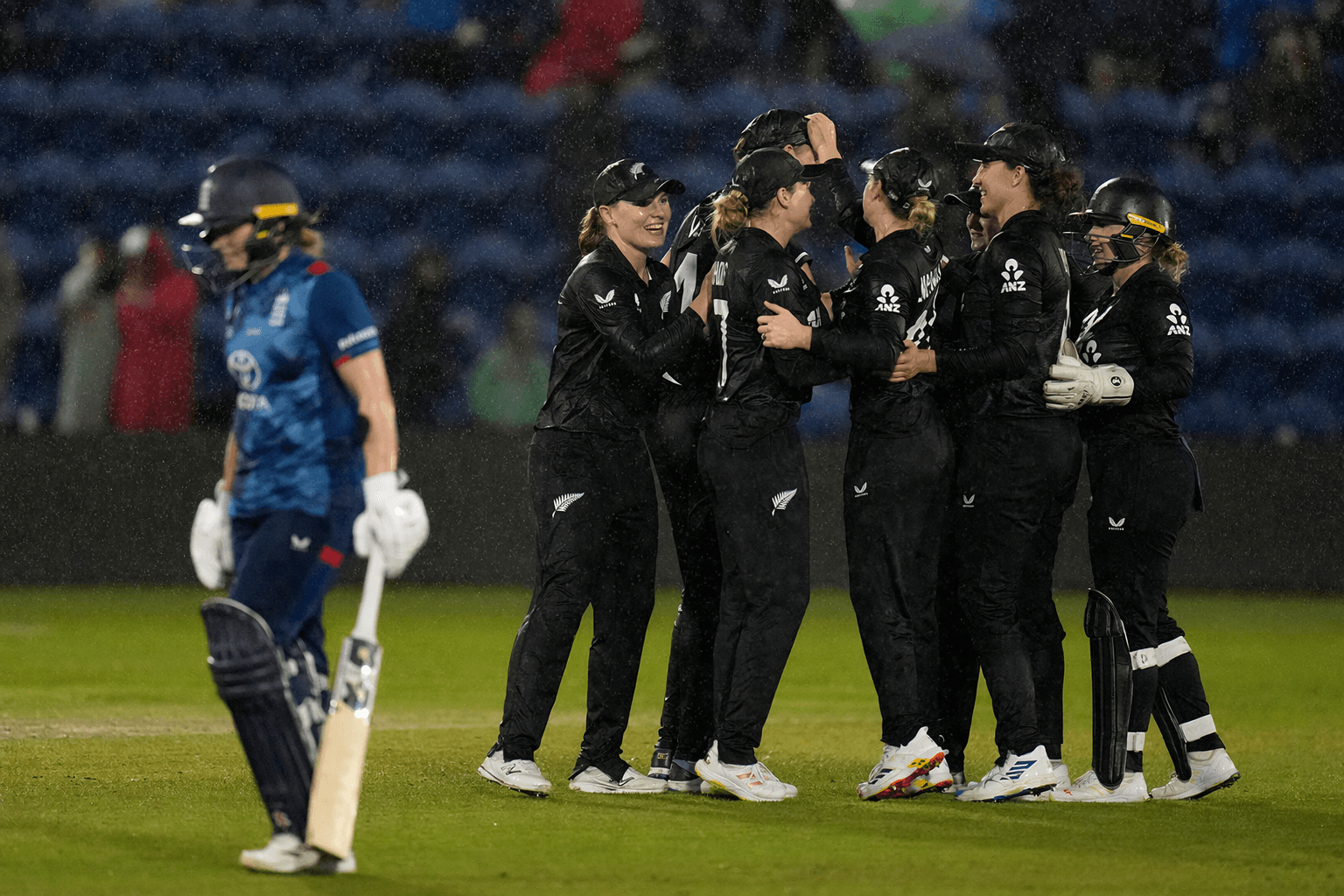
England’s innings reflected that squeeze. Asked to bat first, they reached 181-7 in 33 overs, with Alice Capsey making 45 off 45 balls to top-score. That was a useful anchor, but not a dominating one, and England never quite converted the platform into the sort of late surge that can make a reduced-overs contest safer. Dani Gibson added 21 runs with the ball in hand, while Bell’s 3-29 kept England in touch by denying New Zealand their top-order stability.
New Zealand’s reply turned on a 57-run partnership between Maddy Green and Brooke Halliday after the White Ferns had been reduced to 40-3. Green made 37 and Halliday finished 42 not out, the innings pivot that kept New Zealand ahead of the DLS calculation even as the second rain stoppage ended the match. Bree Illing’s 2-29 and Rosemary Mair’s 2-41 also mattered, as they helped prevent England from stretching the chase into a cleaner margin.

The result leveled the three-match series at 1-1, after England’s one-wicket win at Chester-le-Street on May 10 and the abandoned second ODI at Northampton on May 13. For Cardiff, it was the first women’s ODI in 23 years, and for England it was a reminder that in weather-shortened cricket, fast adaptation is as important as skill. New Zealand simply adapted first.
This article was produced by Prism’s automated news system from verified source data, official records, and press releases, then run through automated quality and moderation checks before publishing. The system is built and supervised by the people who set the standards it runs under. Read our full AI policy.
Did this article answer your question?
.jpg&w=1920&q=75)