Nintendo Maintains Switch 2 Sales and Earnings Forecasts Despite Strong Results
Nintendo posted a big nine-month profit jump but left its Switch 2 sales and earnings targets unchanged, signaling management caution that matters for staff across manufacturing, development, and retail.
Nintendo posted a 51 percent rise in nine-month net profit to ¥358.86 billion and nearly doubled revenue to ¥1.906 trillion, yet management opted on Feb. 3 to keep the full-year Switch 2 sales and earnings forecasts it had already raised in November. That decision reflects a mix of strong hardware momentum and pressure on margins that will shape hiring, production and development priorities across the company and its suppliers.
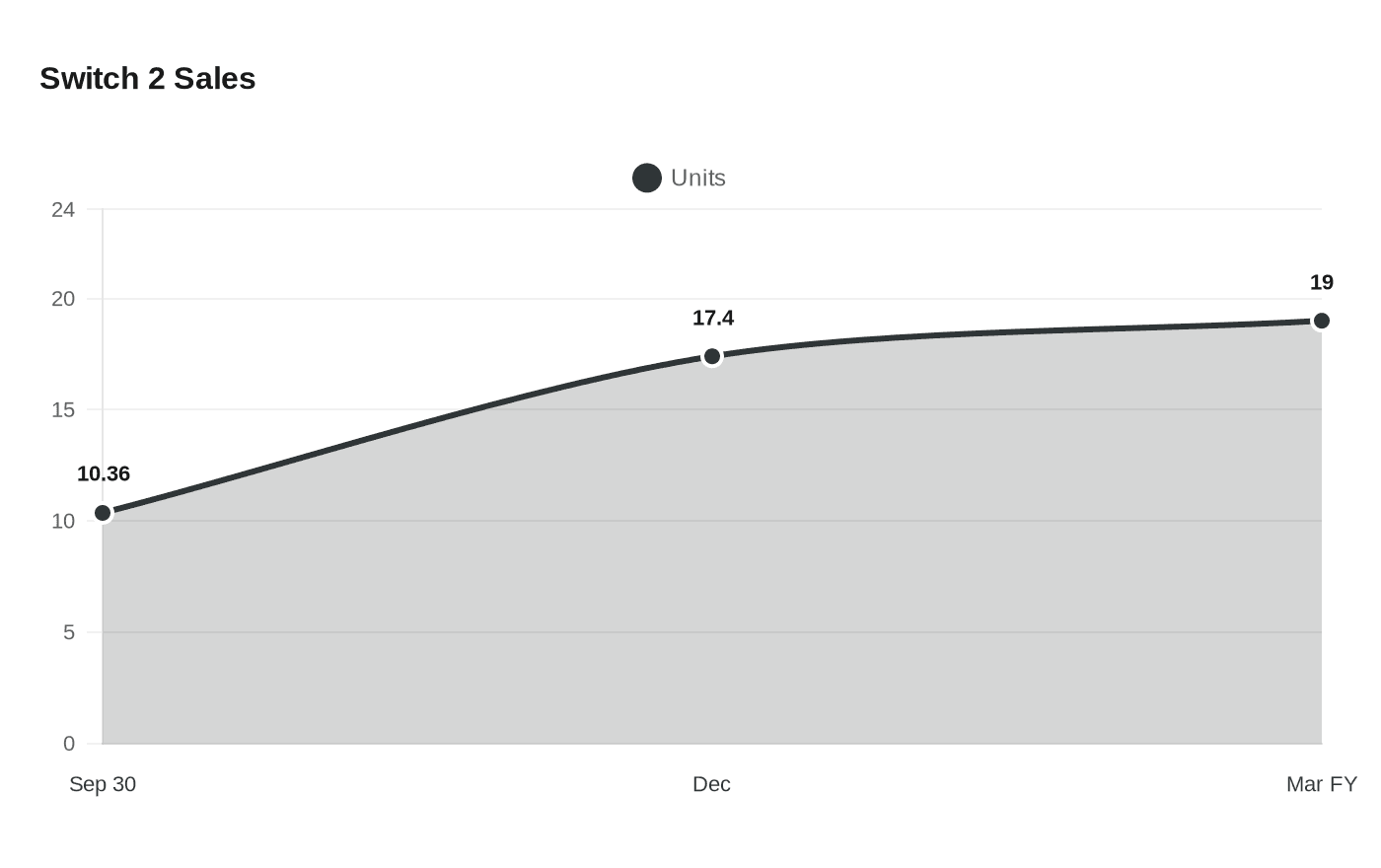
The company lifted fiscal-year targets on Nov. 4 to revenue of JPY 2.25 trillion and net profit of JPY 350 billion and increased its Switch 2 hardware and software unit plans to 19 million and 48 million respectively. Nintendo also beat expectations for the quarter to Sept. 30, with revenue of ¥527.2 billion versus ¥461.76 billion expected and net profit of ¥102.9 billion versus ¥63.6 billion expected. Hardware sales fed those gains: Nintendo sold 4.54 million Switch 2 consoles in the Sept. quarter and had shipped 10.36 million units since the June launch by Sept. 30. Holiday demand pushed cumulative sales higher, with 17.4 million Switch 2 consoles sold as of December, and Nintendo still projects 19 million units by the March fiscal year end.
Analysts and company watchers point to an early software attach rate that helps explain the pattern of results. “There have been 2 games sold for every Switch 2 sold so far, with nearly half of those being bundled copies of Mario Kart World,” Niko Partners reported, highlighting heavy reliance on bundles and a need for fresh, high-margin full-price titles. Nintendo moved 11.95 million Switch 2 games in the Sept. quarter; marquee releases include Mario Kart World, Donkey Kong Bonanza and Pokémon Legends: Z-A, which began shipping Oct. 16. Upcoming titles such as Kirby Air Riders and Metroid Prime 4: Beyond are expected to be important for sustaining software revenue.
Margin dynamics help explain management’s caution. Hardware typically carries lower gross margins than software, and industry analysis projects the operating profit margin for the fiscal year at 16.4 percent, down about 7.8 percentage points from 2024. That mismatch means strong unit sales do not automatically translate into higher per-unit profit until software sales catch up.
Supply and production issues add another operational layer. Company commentary acknowledged that while overseas Switch 2 inventory is adequate, availability in Japan remains limited; separate supply-chain reports suggested Nintendo asked suppliers to build as many as 25 million units by the end of March to meet demand. Nintendo framed its commercial plan around keeping content momentum, saying, “We will aim to keep the momentum of released titles and continuously introduce new titles to expand the platform's user base.” At the same time, “Furukawa admitted that while overseas Switch 2 inventory is adequate, availability in Japan is still limited.”
For employees and workers, the mix of robust demand and margin scrutiny means continued production intensification at suppliers, concentrated retail and support workloads during peak windows, and pressure on internal teams to deliver hit software that converts hardware buyers into long-term customers. The next milestones to watch are how upcoming game releases affect software attach rates and whether unit production and Japan availability normalize before the fiscal year closes at March 31.
Know something we missed? Have a correction or additional information?
Submit a Tip