North Slope Oil Output Drops 1% in January to 472,413 b/d
North Slope output averaged 472,413 b/d in January 2026, down about 1% (4,751 b/d) from December and 3.4% below January 2025, with crude at 420,727 b/d.

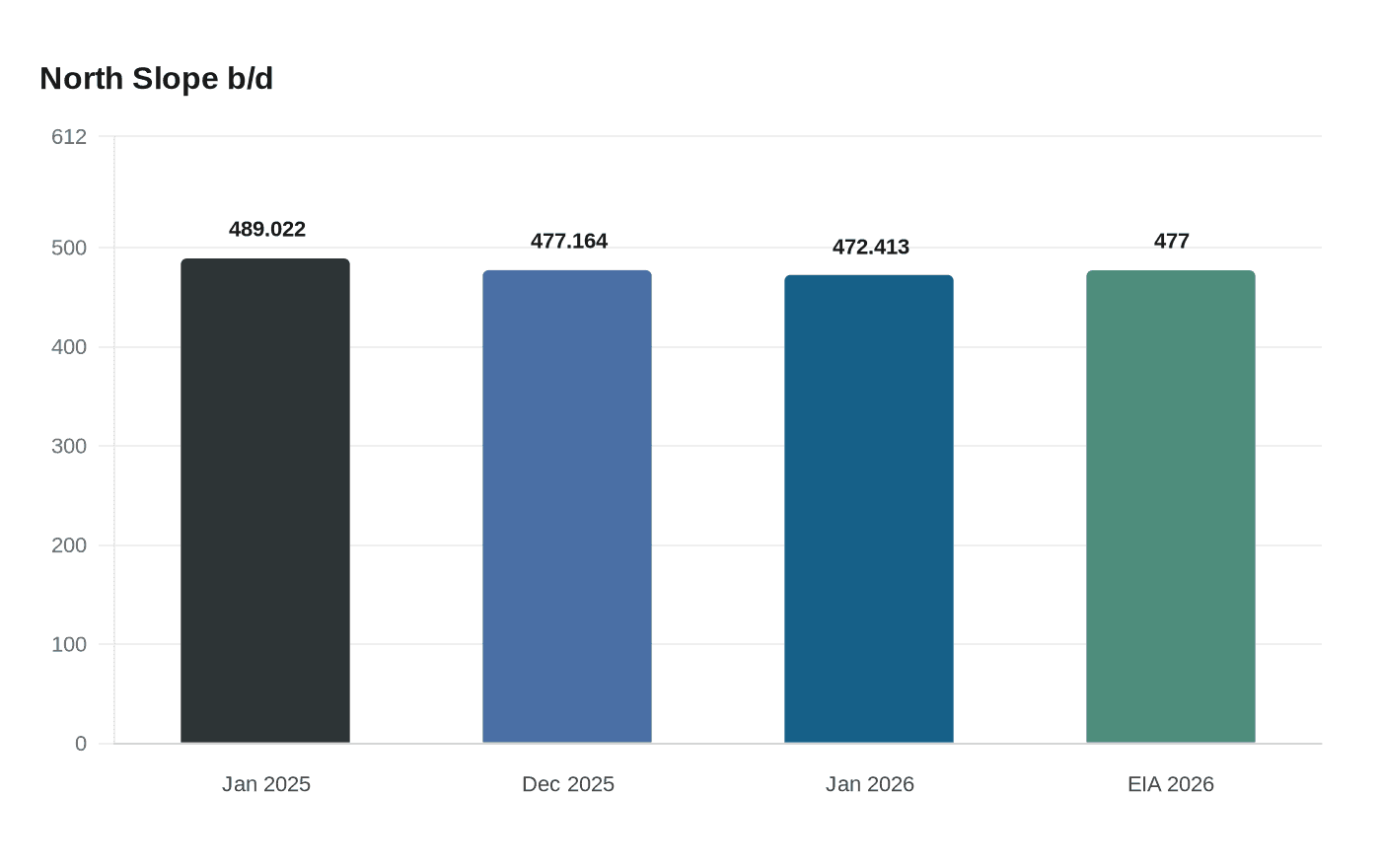
Alaska’s North Slope crude-oil production averaged 472,413 barrels per day in January 2026, a decline of about 1 percent, or 4,751 b/d, from December’s 477,164 b/d and 3.4 percent below January 2025’s 489,022 b/d, industry reporting shows. The monthly fall trimmed output from figures that hovered near the levels cited by forecasters preparing for a stronger 2026.
Crude oil made up 89.06 percent of the January total, equal to 420,727 bpd, down 4,343 bpd from December’s crude average, leaving roughly 51,686 bpd of non-crude product in the monthly mix. Those figures underline that most of the North Slope’s volume remains traditional crude; the modest decline in crude drove nearly the entirety of January’s overall drop.
Field-level swings were uneven: Petroleum News reported a major month-over-month increase at Greater Mooses Tooth while Prudhoe, Milne and Colville River showed the largest month-over-month declines. The contrasting movement across those fields suggests localized operational or well-level factors shaped January flows rather than a single statewide disruption.

The measured January dip comes against a broader outlook that points toward growth for Alaska in 2026. Upstreamonline cited an EIA projection that Alaska crude production will increase by 55,000 bpd to 477,000 bpd in 2026, a 13 percent rise from 2025 and the largest annual expansion since the 1980s. The EIA explicitly attributed that projected gain to two North Slope developments: ConocoPhillips’ Nuna project and Pikka Phase 1, the joint venture of Santos and Repsol.
January’s average of 472,413 bpd sits slightly below the EIA’s 2026 projection of 477,000 bpd and virtually level with December’s reported average of 477,164 bpd, highlighting that short-term monthly variability can coexist with expectations of a full-year ramp if Nuna and Pikka Phase 1 reach anticipated production rates. State and operator reporting will be watched closely in the coming months to see whether Greater Mooses Tooth’s upward move persists and whether output from Prudhoe, Milne and Colville River stabilizes.
The January numbers leave the North Slope roughly 16,609 bpd below January 2025 levels even as federal projections forecast a rebound for the year. For North Slope Borough leaders and oil-industry stakeholders, the next quarterly and monthly releases will determine if January’s dip is a temporary blip or an early signal of volatility ahead of the EIA-expected recovery.
Know something we missed? Have a correction or additional information?
Submit a Tip