Norway's New-Car Market Becomes Nearly All-Electric in 2025
Official registration data show that battery-electric vehicles accounted for 95.9% of new-car registrations in Norway in 2025, driven by generous incentives and a rush ahead of a planned EV tax increase. The shift reconfigures domestic transport emissions, fiscal policy levers and automaker strategies while exposing gaps in heavy vehicle electrification.
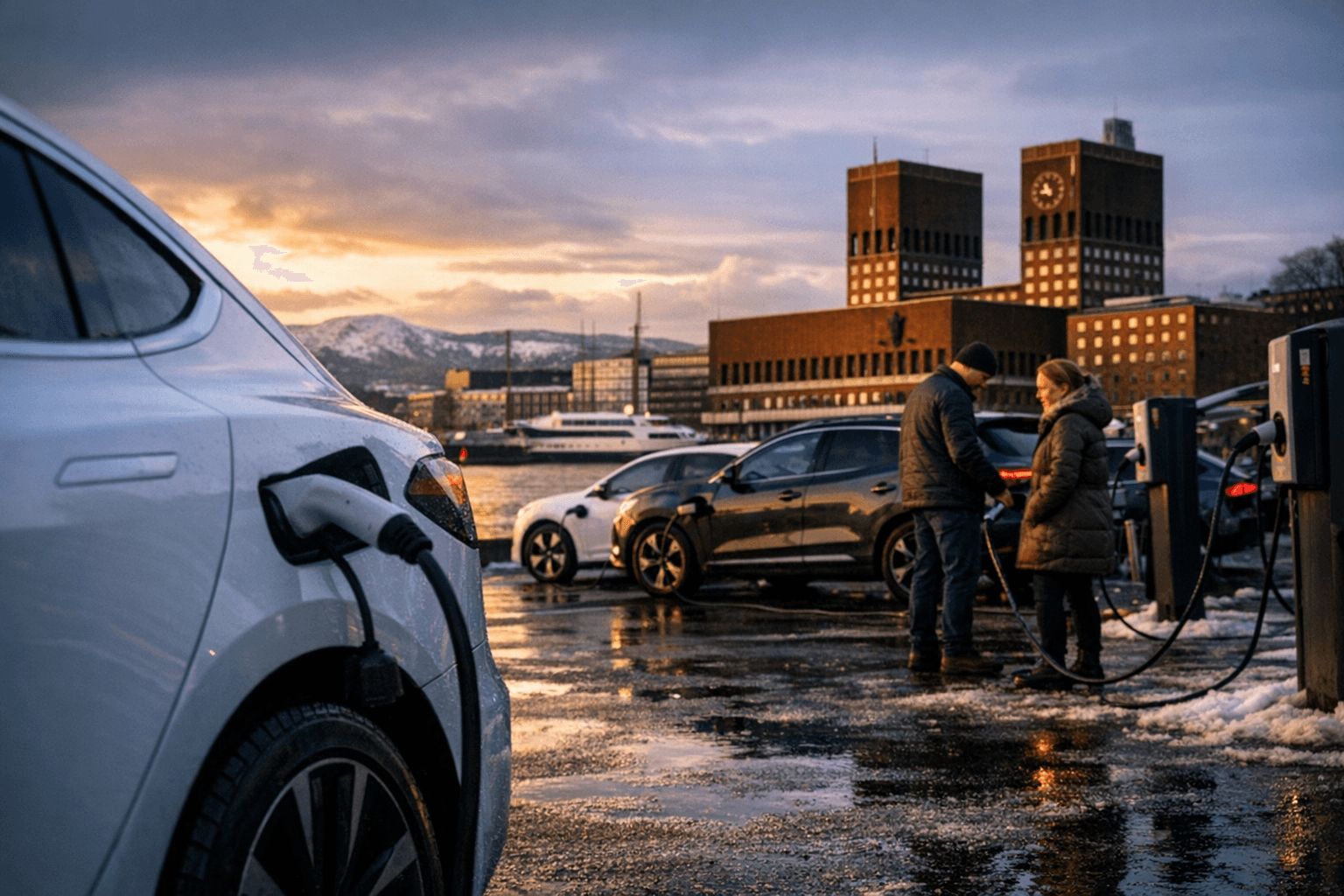
Official registration figures published in early January 2026 show that battery-electric vehicles (BEVs) made up 95.9% of all new cars registered in Norway in 2025, with December registrations rising to roughly 97.6%. A record 179,549 new cars were registered for the year, roughly a 40% increase from 2024, and the national EV share climbed from 88.9% in 2024 to 95.9% in 2025.
The spike in registrations followed policy and market dynamics that combined to accelerate purchases. Tax incentives long used to promote electrification remained a primary driver, while an announced increase in EV taxation scheduled for January 2026 prompted many buyers and manufacturers to accelerate transactions into 2025. The result was an unusually concentrated year of demand that set new national records while crystallizing core trade-offs for policymakers.
Market composition shows Tesla at the head of Norway’s rapid transition, though published tallies differ. One widely cited OFV-derived brand-level figure puts Tesla registrations at 34,285 vehicles in 2025, representing roughly 19.1% of the market. An alternate tally appearing in other summaries records 27,621 Tesla registrations; the discrepancy likely reflects differing counting definitions or partial sub-tallies. Both figures underscore Tesla’s dominant position, led by its mass-market Model Y.
Electrification was not uniform across vehicle types. Vans accounted for 29,650 new registrations in 2025, with BEVs comprising 45.2% of that segment. Buses achieved a 56.3% electric share. Heavy trucks lagged: of 4,770 new trucks over 3.5 tonnes, just 17.3% were electric while 73.2% remained diesel. That divergence highlights infrastructure, technology and policy constraints that make freight and heavy-duty vehicle electrification more difficult than passenger car conversion.
The Norwegian case sharpens important policy questions. Generous incentives achieved rapid behavioral change in the passenger car market but produced significant fiscal and regulatory consequences. The pre-tax-hike surge shows how future tax adjustments can lead to timing distortions in consumer demand and complicate government revenue forecasting. For automakers and dealers, the apparent front-loading of purchases may have short-term benefits but raises questions about market sustainability once incentives normalize.
Equally consequential is the persistence of diesel in heavy transport. Without targeted policy measures, such as tailored subsidies for heavy electric trucks, accelerated charging infrastructure for freight corridors and procurement standards for public fleets, emissions from freight and road haulage will remain a policy blind spot even as passenger fleets electrify.
International observers have noted that Norway’s trajectory is exceptional in Europe. Domestic politics and fiscal priorities have kept the country on a faster electrification path than many peers, underscoring how national policy choices, not only technology, shape the pace of transition. For Norwegian voters and policymakers, the experience of 2025 crystallizes a choice about how quickly to wind down incentives, how to manage fiscal impacts and how to accelerate electrification where it still lags.
This article was produced by Prism’s automated news system from verified source data, official records, and press releases, then run through automated quality and moderation checks before publishing. The system is built and supervised by the people who set the standards it runs under. Read our full AI policy.
Did this article answer your question?