Nvidia raises $25 billion in first bond sale in five years
Demand for Nvidia’s new bonds reportedly reached $85 billion, far above the $25 billion sale, as investors backed the AI giant’s next stage of growth.
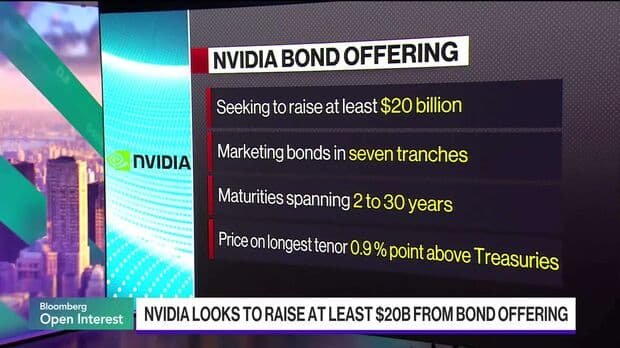
Demand for Nvidia’s new bonds surged to about $85 billion, overwhelming a $25 billion offering and turning the company’s first debt sale in five years into a sharp market test of the AI boom’s staying power. The order book was so strong that Nvidia capped the issue at $25 billion to keep credit spreads low, even though it had initially been considering a smaller $20 billion raise.
The company chose debt at a moment when it already looks flush with cash, a move that points to strategy as much as funding need. A company spokesperson said the proceeds would go toward general corporate purposes, including the repayment and refinancing of outstanding notes. One source said the real aim was to establish a liquid benchmark for Nvidia’s cost of credit rather than to finance capital expenditures, a sign that the company wants cheaper, clearer access to the bond market as it continues to scale.

The package was split into seven tranches, with maturities stretching as far out as 2056, underscoring how far investors are willing to extend their confidence in a company tied so closely to artificial intelligence infrastructure. Demand was mainly domestic, and the speed of the oversubscription surprised some investors because Nvidia had given little warning before coming to market. For buyers, the message was straightforward: Nvidia remains one of the most coveted credits in corporate finance, and capital markets are still eager to fund the buildout behind AI chips, servers and data-center capacity.
This was Nvidia’s first access to the U.S. investment-grade bond market since June 2021, when it sold $5 billion of senior unsecured notes in four tranches due in 2023, 2024, 2028 and 2031. Those earlier proceeds, like the new ones, were earmarked for general corporate purposes, including repayment of indebtedness. The company’s latest move comes after a first fiscal quarter ended April 26, 2026, in which it reported record revenue of $81.6 billion, and after it announced an additional $80 billion share repurchase authorization and a higher quarterly dividend on May 20.
The sale also lands against a broader debt boom tied to artificial intelligence. Morgan Stanley has forecast that global AI-related debt issuance could nearly double to about $570 billion in 2026, a backdrop that helps explain why Nvidia’s deal drew such extraordinary demand. With a market capitalization estimated at about $5.14 trillion in June 2026, Nvidia is no longer just a chipmaker financing operations; it is a bellwether for how long investors believe the AI capital cycle can run.
This article was produced by Prism’s automated news system from verified source data, official records, and press releases, then run through automated quality and moderation checks before publishing. The system is built and supervised by the people who set the standards it runs under. Read our full AI policy.
Know something we missed? Have a correction or additional information?
Submit a Tip