Nvidia’s Jensen Huang visits Shanghai as H200 import decision looms
Jensen Huang traveled to Shanghai to meet staff and attend company events as Chinese authorities weigh whether to allow H200 AI accelerator imports.
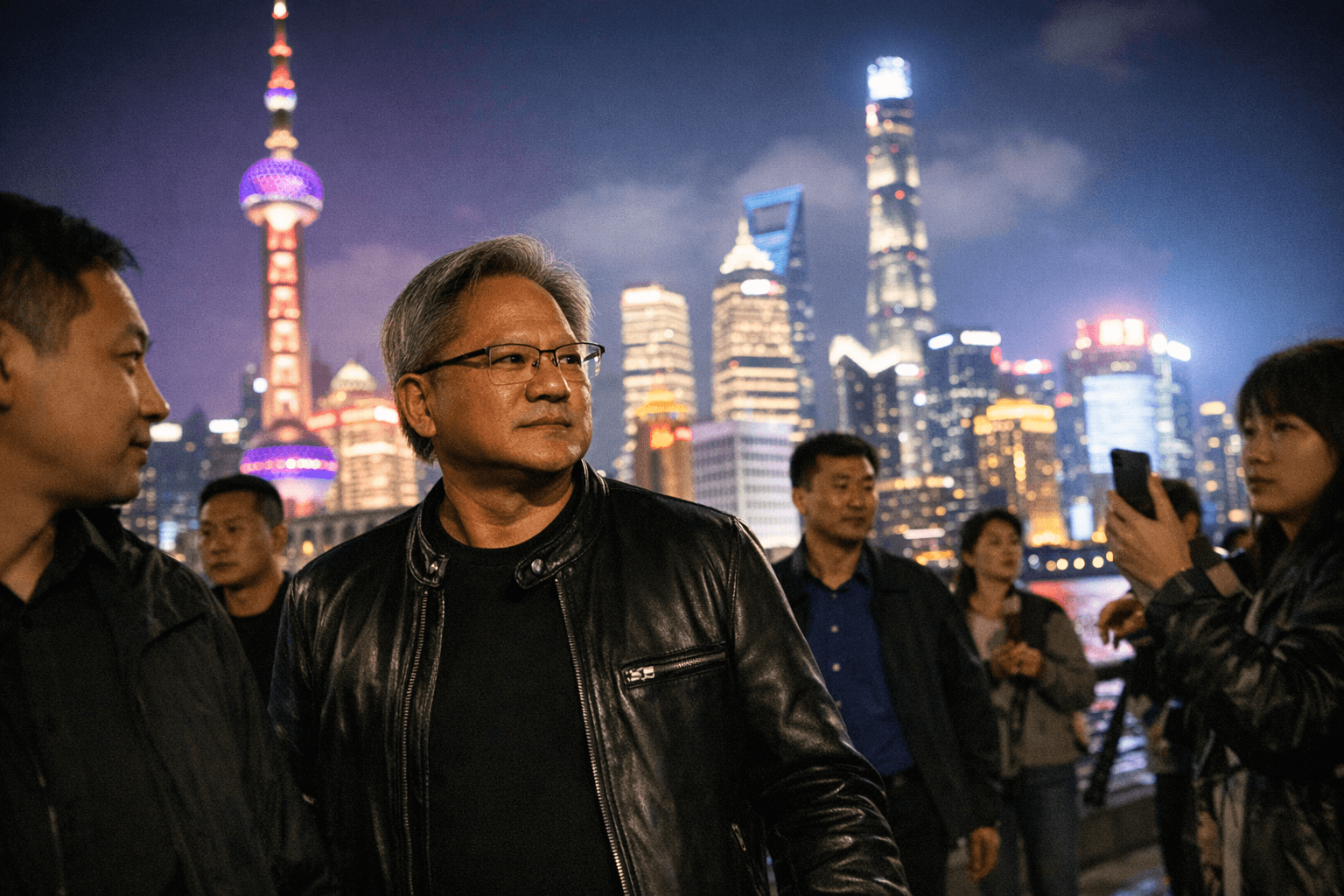
Nvidia Chief Executive Jensen Huang traveled to Shanghai on January 25 to attend company New Year events and meet staff, a visit that coincided with growing uncertainty over whether Chinese regulators will permit imports of the company’s high-end H200 AI accelerator. The timing has drawn attention from customers, investors and policymakers because the H200 is central to Nvidia’s strategy to serve advanced artificial intelligence workloads globally.
Huang’s presence in China, where Nvidia operates significant sales and support operations, highlighted the commercial and technological stakes. The H200, positioned above prior generations in Nvidia’s data center product lineup, is designed for large-scale machine learning training and inference tasks that power sophisticated AI applications. Access to that hardware would be an important input for Chinese cloud providers, research institutions and startups racing to develop next-generation models.
Chinese authorities face a consequential decision. Approving imports would clear a pathway for enterprises in China to obtain one of the most capable commercially available AI accelerators, potentially accelerating model development and deployment. A refusal or prolonged delay would complicate procurement plans for customers in China and could shift demand toward domestic chip makers or alternative architectures as firms seek to maintain development timelines.
The outcome also has broader commercial implications for Nvidia. China represents a major market for cloud computing services and AI infrastructure purchases, and restrictions on high-end accelerators could affect revenue trajectories and supply chain planning. At the same time, continued uncertainty may prompt customers to diversify procurement strategies and intensify investments in local silicon development.
Industry observers note that decisions about advanced semiconductor imports are rarely just commercial. They sit at the intersection of technology policy, national security considerations and industrial strategy. Regulators must weigh the benefits of commercial access against concerns about the dual-use potential of cutting-edge AI hardware. For companies operating on both sides of geopolitical divides, these choices impose complex trade-offs between market access and compliance with evolving controls.
Huang’s visit offered an opportunity for internal engagement and visible assurance to Nvidia staff in China, who play a role in sales, support and customer integration. It also served as a reminder of how company leadership can be drawn into geopolitical contests over critical technologies. For Nvidia’s customers in China, the immediate question is practical: will procurement plans change, or will they have to wait for a ruling that could shape their development timetables?
If Chinese authorities grant approval, firms in China could move rapidly to incorporate the H200 into their data centers and AI pipelines. If approval is withheld or restricted, expect accelerated efforts to substitute local accelerators and increased emphasis on software optimizations that reduce dependency on singular high-end chips.
As regulators deliberate, companies, investors and technologists will watch closely. The decision on H200 imports will be a bellwether for how governments balance industrial ambitions with concerns about the strategic deployment of powerful AI hardware.
This article was produced by Prism’s automated news system from verified source data, official records, and press releases, then run through automated quality and moderation checks before publishing. The system is built and supervised by the people who set the standards it runs under. Read our full AI policy.
Did this article answer your question?