Official SlamBall Rules: 96' x 64' Court, Trampolines, Gameplay
SlamBall’s rulebook codifies a 96' x 64' court with four trampolines in front of each net, detailed equipment and safety standards, and several timing and scoring conflicts for fans and operators to note.
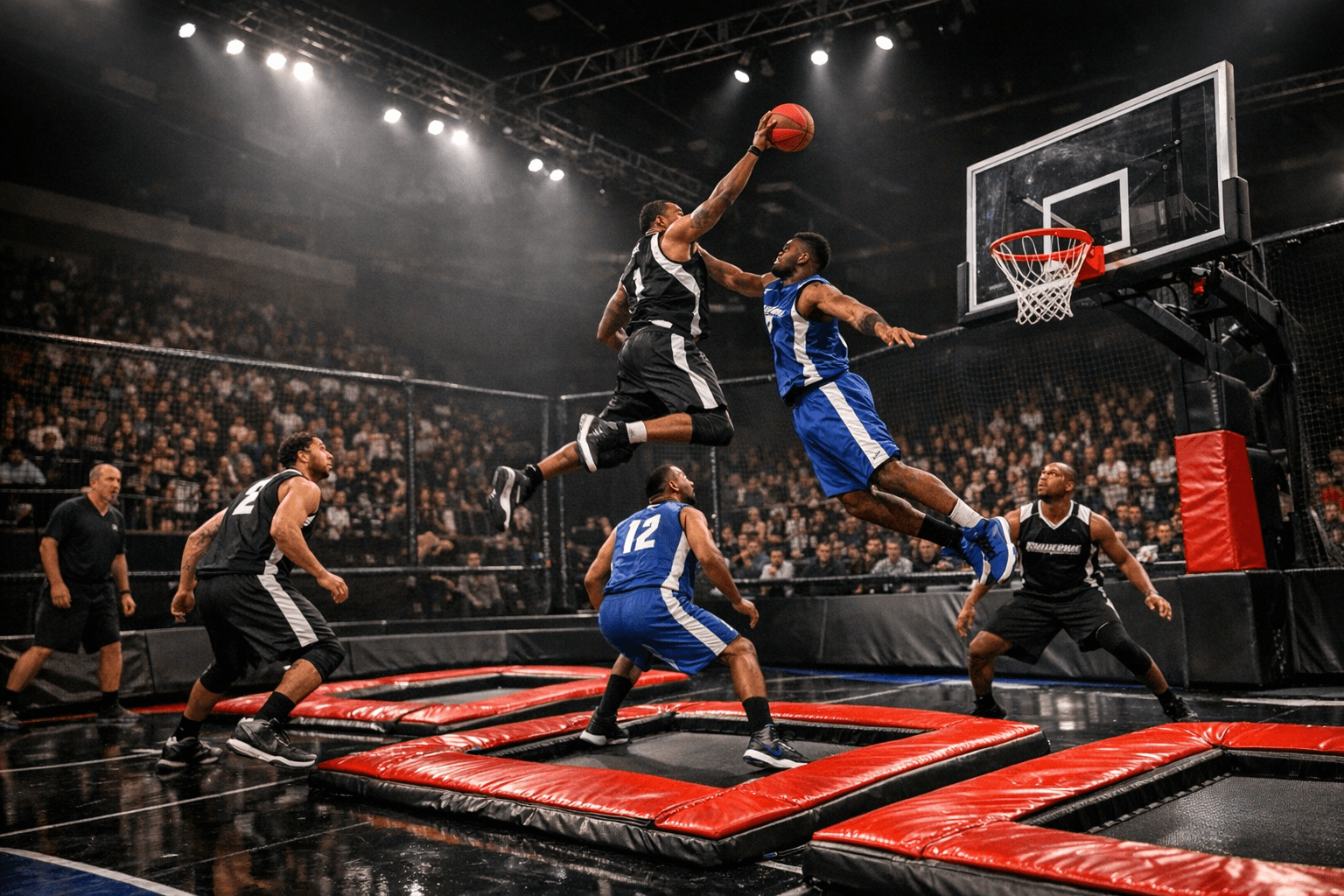
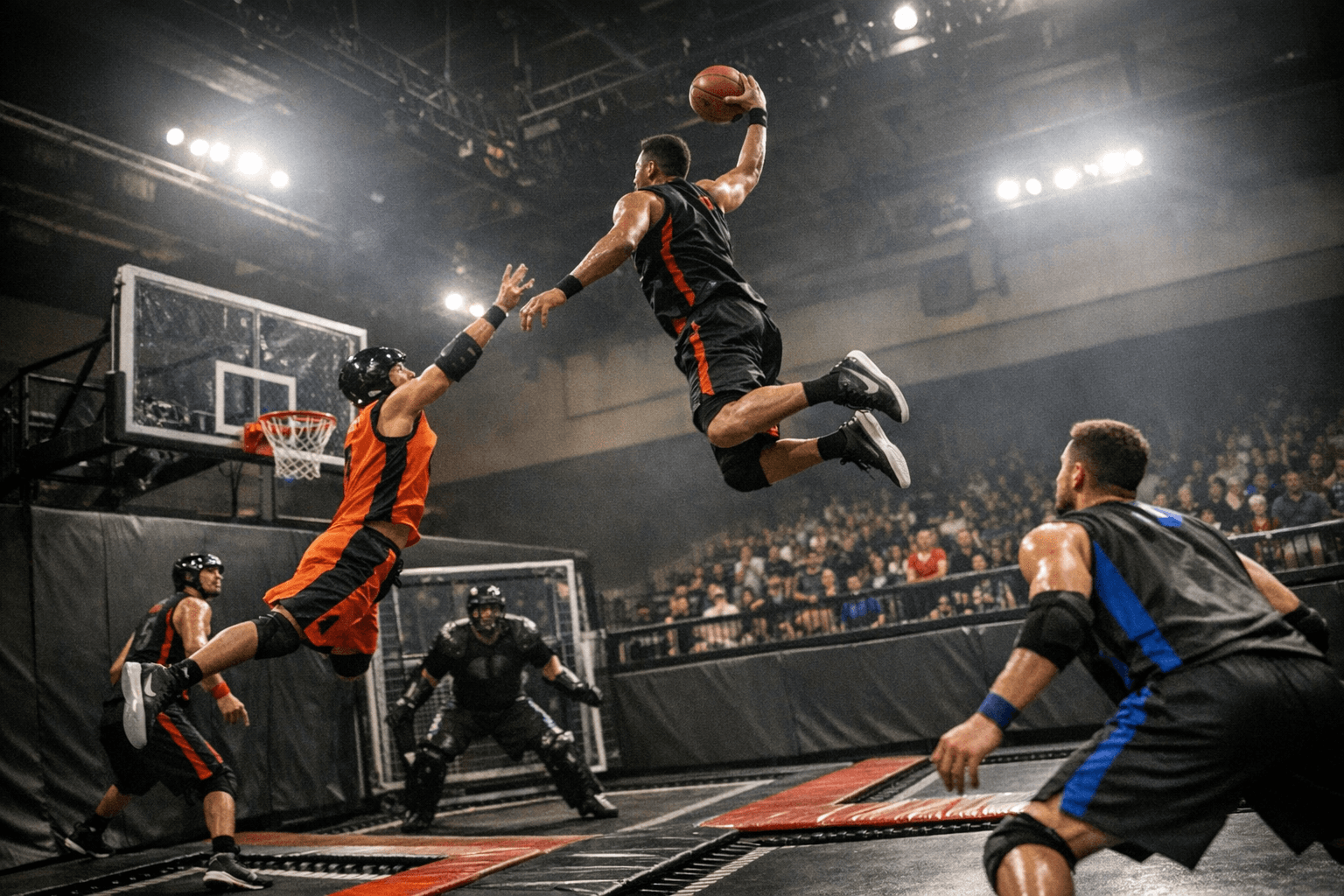
High-flying action in SlamBall is engineered as much by rules as by athletes. The official court measures 96' x 64' and places four springbeds or trampolines in front of each team’s net, creating the vertical playground that defines the sport. The configuration, combined with court islands, hashmarks and perimeter barriers, drives nonstop transitions and hockey-style line changes that broadcasters and arenas market as edge-of-your-seat entertainment.
The league’s own language sets clear equipment and safety floors. “Only the official SlamBall ball (the ‘ball’) may be permitted in each game,” and “The ball shall be officially approved by the League with a weight not less than 20 ounces and no more than 22 ounces. The circumference of the ball shall be within a maximum of 30 inches and a minimum of 28 inches. The ball shall be inflated to a maximum of nine (9) pounds per square inch (‘psi’) and a minimum of seven and a half (7.5) psi.” Protective gear is mandatory: “Players are to wear protective gear at all times,” including elbow pads, knee pads, elective padded helmets and custom padded undergarments, and “Players are not permitted to wear any equipment not authorized by the League.”
Rosters run 4-on-4 with a maximum of seven players, enabling three bench substitutions and fast, hockey-like line changes. Substitutions are live, and Sportingnews specifies that the exiting player “must be within five feet of his own team box before a new player enters the playing floor.” Those mechanics influence coaching strategy: coaches can cycle breathers for high-risk dunks or send in specialists for trampoline-based plays such as the gainer and the chaser.
Timing and scoring remain areas of competing reports. Multiple sources list games as four quarters but conflict on length: Sportingnews, Wikipedia and Sports Yahoo report four 5-minute quarters (20 minutes total), while Rulesofsport lists four 6-minute quarters. Shot-clock reports differ as well: Sportingnews and Wikipedia give a 20-second clock with a 12-second reset on offensive rebounds, whereas Rulesofsport reports 15 seconds. Scoring descriptions vary across accounts; Sportingnews details a nuanced system including a 4-point shot from a 26.5-foot arc and the notable caveat that “attempted slams that rattle around the rim and drop through, do not travel through the rim cleanly or travel through the basket without the offensive player’s hand/arm making contact with the rim are only awarded two points.” Other sources portray a simpler 2-point throw, 3-point dunk or outside-arc scoring structure. Because the supplied official excerpt did not include a full scoring chart, these contradictions should be resolved against the Slamballleague Rules & Regulations page for competition and broadcast accuracy.
Contact rules meld spectacle and safety. The league warns that “Aggressive hits may only occur on the ball handler or in the vicinity of the ball. Unnecessary aggressive contact away from the ball is prohibited,” and adds parenthetical language tying off-ball illegal contact to “face off or subsequent bonus penalty point situations.” Sportingnews clarifies permitted contact as waist-up, below the neck, and notes that body checks are allowed provided arms are not extended above shoulder height. Face-offs replace free throws; the Throwdown opening remains ceremonial and tactical: “The Throwdown” is a “bounce-off” where “The ball must reach its apex uninterrupted, at which point the players are allowed to 'check' each other.”
For performance analysts and rights holders, these rules shape athlete skill sets and roster construction. Skills such as the chaser, gainer, kill bounce and revolutions reward gymnastic explosiveness and trampoline mastery, increasing the sport’s crossover appeal to action sports and stunt-driven entertainment. For operators, the mix of mandated protective gear and physical rules frames liability management and insurance costs, while unresolved timing and scoring variances create a communications task for promoters and referees.
Verify scoring tables, quarter lengths and shot-clock specifics on the official Slamballleague Rules & Regulations page before staging events or producing broadcasts; clarity on those points will determine coaching tactics, broadcast pacing and, ultimately, fan comprehension as the sport scales.
Know something we missed? Have a correction or additional information?
Submit a Tip