Officials outline manatee-viewing rules, safety, reporting on Weeki Wachee River
Weeki Wachee springs are key manatee refuges; follow posted buoys and park rules, avoid disturbance, and call the FWC Wildlife Alert at 1-888-404-FWCC for sick or injured manatees.

Why this matters now: Weeki Wachee and other Hernando County springs are important manatee aggregation and spring-habitat sites. Manatee season and local protection rules make understanding safe viewing and vessel conduct essential, both to protect wildlife and to avoid fines or legal citations.
Weeki Wachee at a glance The Weeki Wachee River runs 7.4 miles west from Weeki Wachee to the Gulf of Mexico at the Weeki Wachee estuary, and its spring is the surfacing point of an underground river described as the deepest naturally occurring spring in the United States. The spring measures about 150 feet wide and 250 feet long, pushes an average 170 million gallons of water a day, and holds a steady 72°F year‑round. The river and its state park, home to the Weeki Wachee Springs attraction, function as a thermal refuge where manatees gather, especially when gulf waters cool.
Where to look for manatees in Hernando County Manatees are visible in several public access points and paddling routes around Hernando County. Notable spots include Bayport Park, which offers vantage points, a boat launch and picnic areas; Linda Pedersen Park, where visitors frequently scan the shallows; and the 1.7-mile Bayport-Linda Pedersen Paddling Trail that links the two. Jenkins Creek Park is another inland location where manatees can appear. Weeki Wachee Springs State Park manages the park waters and posts maps and seasonal advisories for visitors.
Manatee behavior, diet and seasonal movement Florida Manatees, sometimes referred to as "Sea Cows," inhabit freshwater, brackish and saltwater environments around coastal Florida. They spend long periods grazing on aquatic vegetation, with seagrass as the main ingredient in their diet, and they surface regularly to breathe. As gulf waters cool in winter months, manatees move inshore toward warmer springs and spring-fed rivers, which is why Weeki Wachee and other springs are important aggregation points.
- "Do not harass the wildlife. This is their home, you are a guest."
- "Do not feed or water Manatees."
- "Never chase a manatee. They are curious by nature and will come to you if they want interaction."
- "No excessive noise and splashing when swimming with the manatees."
- "Give manatees space to move. Do not isolate or single out an individual manatee from its group, and never separate a cow and her calf."
- "Do not ride, climb or grab fins & tails."
- "When attempting to watch manatees. Quietly watch them and avoid stirring up the bottom."
- "Never interrupt a sleeping or feeding manatee."
- "No Alcohol or Glass on the River."
- "Well behaved, leashed pets are welcome."
- "DO NOT LITTER. Collect all your trash. Bags are available."
- "Manatees are an endangered species and protected by the U.S. Fish and Wildlife Service."
- \\\ Violation of these rules is punishable by law \\\
Rules and behavior expectations on the river
Officials and park managers give clear, nonnegotiable instructions to protect the animals and visitors alike. The Weeki Wachee "Rules of the River" block includes several commands and reminders:
MyFWC guidance for in-water viewing reinforces the same principles and adds practical tips: "Keep hands and objects to yourself. Don't attempt to snag, hook, hold, grab, pinch, hit or ride a manatee." If in-water viewing is allowed, use snorkel gear and float at the surface to observe passively; avoid SCUBA and other devices that produce bubbles because "The sound of bubbles from SCUBA gear or other devices may cause manatees to leave the area."
Buoys and signs: what to follow on the water "Trust what you see on the water. Posted buoys and shoreline signs are legally authoritative for boating conduct." Posted markers are the actionable rules you must obey while on the river or estuary, so treat them as law in the moment. Boat operators should also consult "A boater's guide to living with Florida Manatees" for broader boater-specific guidance.
Who enforces the rules and what penalties apply Multiple agencies collaborate on protection and enforcement. The Florida Fish and Wildlife Conservation Commission focuses on boating and wildlife protection and handles questions about boating and manatee protection zones. Weeki Wachee Springs State Park manages park waters and park-specific rules. Hernando County enforces local ordinances, dock compliance and permitting. The Florida Department of Environmental Protection and the Southwest Florida Water Management District provide springs health and watershed guidance. Marine patrols, wildlife officers and state park rangers carry out on-water enforcement.
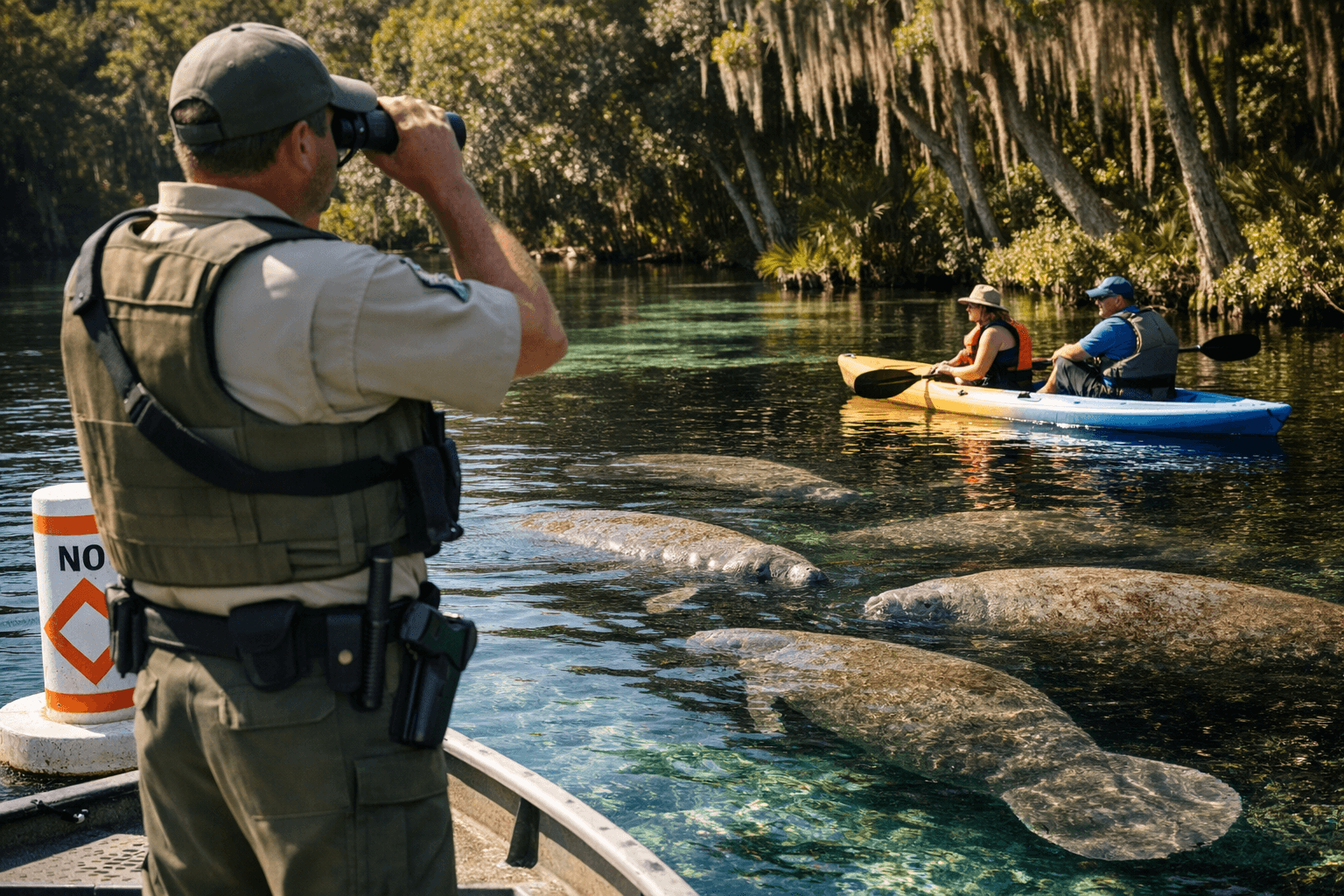
Consequences for violating rules include citations and fines, removal orders for unlawful structures and possible criminal charges for major violations like hazardous dumping. Officials urge visitors and boaters to follow posted markers and local instructions to avoid penalties and to protect manatees.
How to report a problem or an injured animal If you need to report a sick, injured or distressed manatee, act promptly and provide clear documentation. Follow these steps when making a report: 1. Record the time and location of the sighting. 2. Note the closest buoy marker or shoreline sign. 3. Capture a vessel description and registration if visible. 4. Take photos or video and save them to share when requested. Direct reports to the appropriate agency for the issue, and for injured or tagged manatees call the FWC Wildlife Alert Toll-Free Number 1-888-404-FWCC (1-888-404-3922). "If you see a sick, injured, distressed, or tagged manatee, call the FWC’s Wildlife Alert Toll-Free Number 1-888-404-FWCC (1-888-404-3922)." Scientists and volunteers can often successfully rescue and release these gentle animals back into the wild.
- Check posted buoys and shoreline signs on the water; they are authoritative.
- Contact Hernando County for permits, local ordinances and dock-permit questions.
- Call the Florida Fish and Wildlife Conservation Commission for boating and manatee protection zone maps and enforcement questions.
- Review Weeki Wachee Springs State Park information for park-specific rules, maps and seasonal advisories.
- Consult the Florida Department of Environmental Protection and the Southwest Florida Water Management District for springs health and watershed updates.
How to confirm current rules, maps and seasonal advisories
Before you launch or plan in-water activities, confirm current guidance with the managing agencies and rely on on-water signs:
Local contacts and practical details For park directions and reservations call Weeki Wachee, "DIRECTIONS / RESERVATIONS (352) 610-4169." For animal emergencies call the FWC Wildlife Alert number above. When in doubt about a map or a buoy, the posted marker governs what you must do in that moment.
Special note about Crystal River and swimmer monitoring Be aware that Crystal River and Kings Bay are explicitly the only area in Florida identified here where swimmers are monitored around manatees; volunteers and law enforcement officers there give directions to protect the animals. That monitoring model has been described only for Crystal River and Kings Bay, not for Weeki Wachee.
Local flavor and visitor context Weeki Wachee’s state park remains both a natural refuge and a visitor attraction; wild manatees are "even known to share the stage with Weeki Wachee Springs Mermaids from time to time." Kayak operators describe the river as a quiet estuary perfect for paddling but emphasize that the wildlife rules apply regardless of whether you approach by boat, paddlecraft or shore.
Final reminder "Trust what you see on the water. Posted buoys and shoreline signs are legally authoritative for boating conduct." Respect the river rules, keep your distance, document and report problems properly, and remember: "Manatees are an endangered species and protected by the U.S. Fish and Wildlife Service." Compliance protects the animals and spares you legal trouble as Hernando County and state agencies continue to monitor and enforce protections.
Know something we missed? Have a correction or additional information?
Submit a Tip