Oil Prices Drop 6% as Trump Peace Plan Targets Middle East War
Brent crude fell to $94 a barrel after the U.S. sent Iran a 15-point peace plan; Tehran had vowed to hit American energy assets if struck.

Brent crude plunged to about $94 a barrel on Wednesday after the United States sent Iran a 15-point plan for ending the war in the Middle East, and President Trump declared that the Iranians would like "to make a deal." The drop of roughly 6 percent reversed a violent run-up that had pushed Brent as high as $119.50 and above $113 on Monday morning in European trading, as fears over the near-total closure of the Strait of Hormuz sent shockwaves through global markets.
The diplomatic signals arrived in quick succession. On Tuesday, Trump confirmed that negotiations were underway, and a letter Iran had circulated to the United Nations' maritime organization, dated March 22, indicated Tehran was willing to allow ships not tied to the United States or Israel to pass through the Strait. West Texas Intermediate crude, the U.S. benchmark, tracked Brent lower, falling to around $88 a barrel on Wednesday, down 5 percent, after touching $92.35 on Tuesday.
The retreat came against a backdrop of sharp escalation earlier in the week. Trump had warned over the weekend that the U.S. would "obliterate" Iran's power plants if Tehran did not fully reopen the Strait within 48 hours. Iran countered that it would respond to any such strike with attacks "on US and Israeli energy and infrastructure assets in the region." The International Energy Agency described the global economy as facing a "major, major threat" from the conflict, and reported that at least 40 energy assets across nine countries had already been damaged.
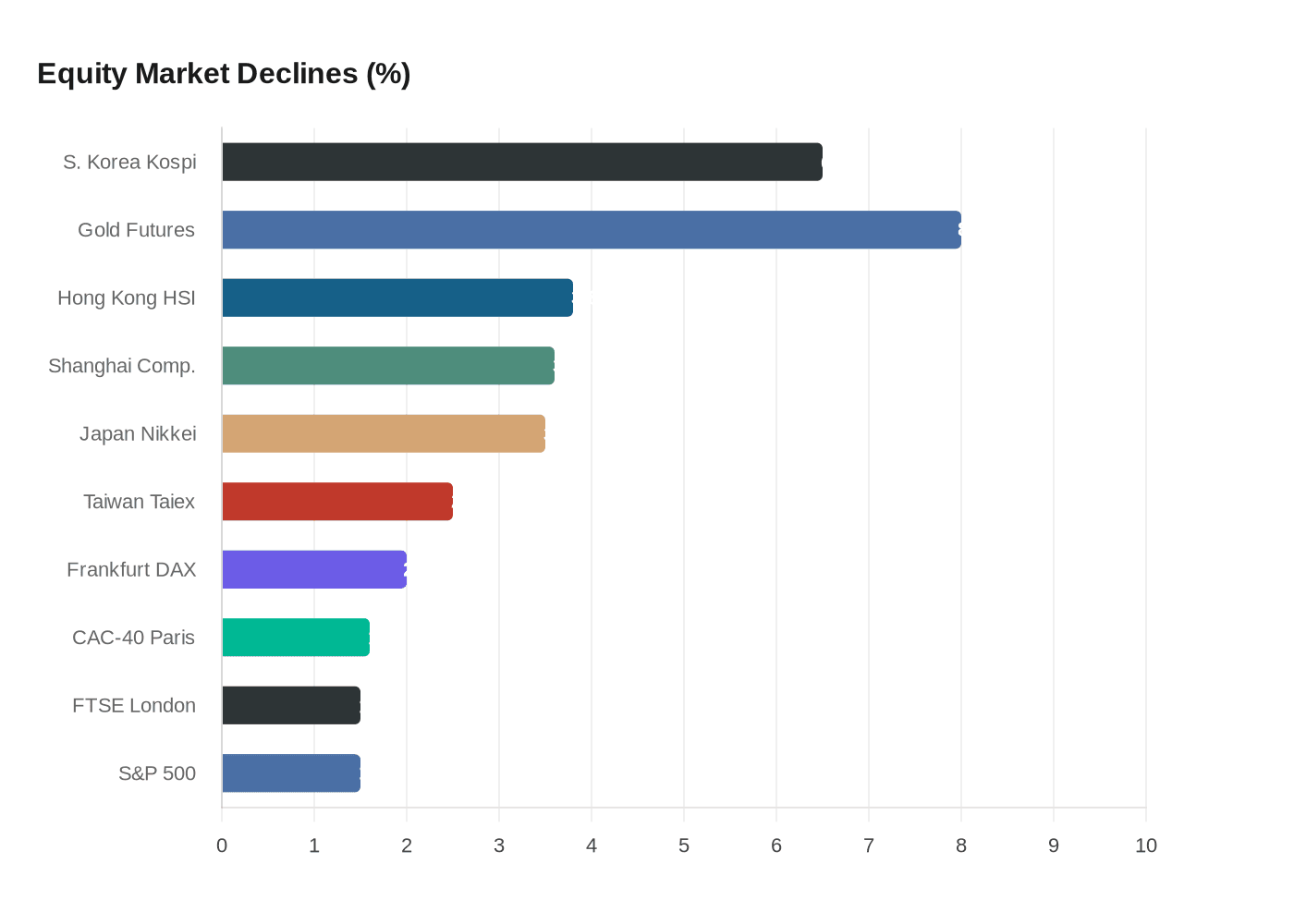
Before diplomatic signals softened prices, the market selloff had spread far beyond the oil patch. Asian equities were hammered on Monday, with South Korea's Kospi dropping 6.5 percent, Hong Kong's Hang Seng slipping 3.8 percent, the Shanghai Composite declining 3.6 percent, Japan's Nikkei 225 falling 3.5 percent, and Taiwan's Taiex shedding 2.5 percent. The S&P 500 fell 1.5 percent on Friday to close its fourth consecutive losing week, its longest such streak in a year. European indexes opened with losses as well: the FTSE in London lost 1.5 percent, the CAC-40 in Paris fell 1.6 percent, and Frankfurt's DAX dropped 2 percent at the open. Gold futures also tumbled roughly 8 percent in the selloff.
The oil surge had already complicated the Federal Reserve's calculus. Analysts said higher energy prices dashed expectations for rate cuts; before the war, traders had priced in at least two Fed reductions this year. Central banks in Europe, Japan, and the United Kingdom have held rates steady as the conflict reshapes the inflation outlook.
The path back to stability, even if a deal materializes, remains long. Analysts projected that it would still take six to eight weeks for oil production and shipments to normalize if the fighting stopped immediately, with Brent potentially settling around $80 a barrel, still well above the roughly $70 level it traded at before the war began. Diesel and jet fuel, where supply strains are most acute, could stay elevated for even longer. Adding to the uncertainty, the Guardian reported that an elite U.S. airborne division is headed to the region, a signal that military pressure is being maintained alongside any diplomatic overture.
Know something we missed? Have a correction or additional information?
Submit a Tip

