Ozymandias warns of presidential hubris and fleeting power
A classic sonnet about a ruined statue now doubles as a warning: power that looks permanent can vanish fast.
Decoding the allusion
The phrase at the center of this story comes from Percy Bysshe Shelley’s 1818 sonnet “Ozymandias,” a poem that turns triumph into ruin. Shelley wrote it in 1817, and it was first published in The Examiner on January 11, 1818. The title itself points to Ramses II, the ancient Egyptian pharaoh known in Greek as Ozymandias, which matters because the poem is not just about one ruler’s vanity. It is about the fate that eventually meets all rulers who mistake power for permanence.
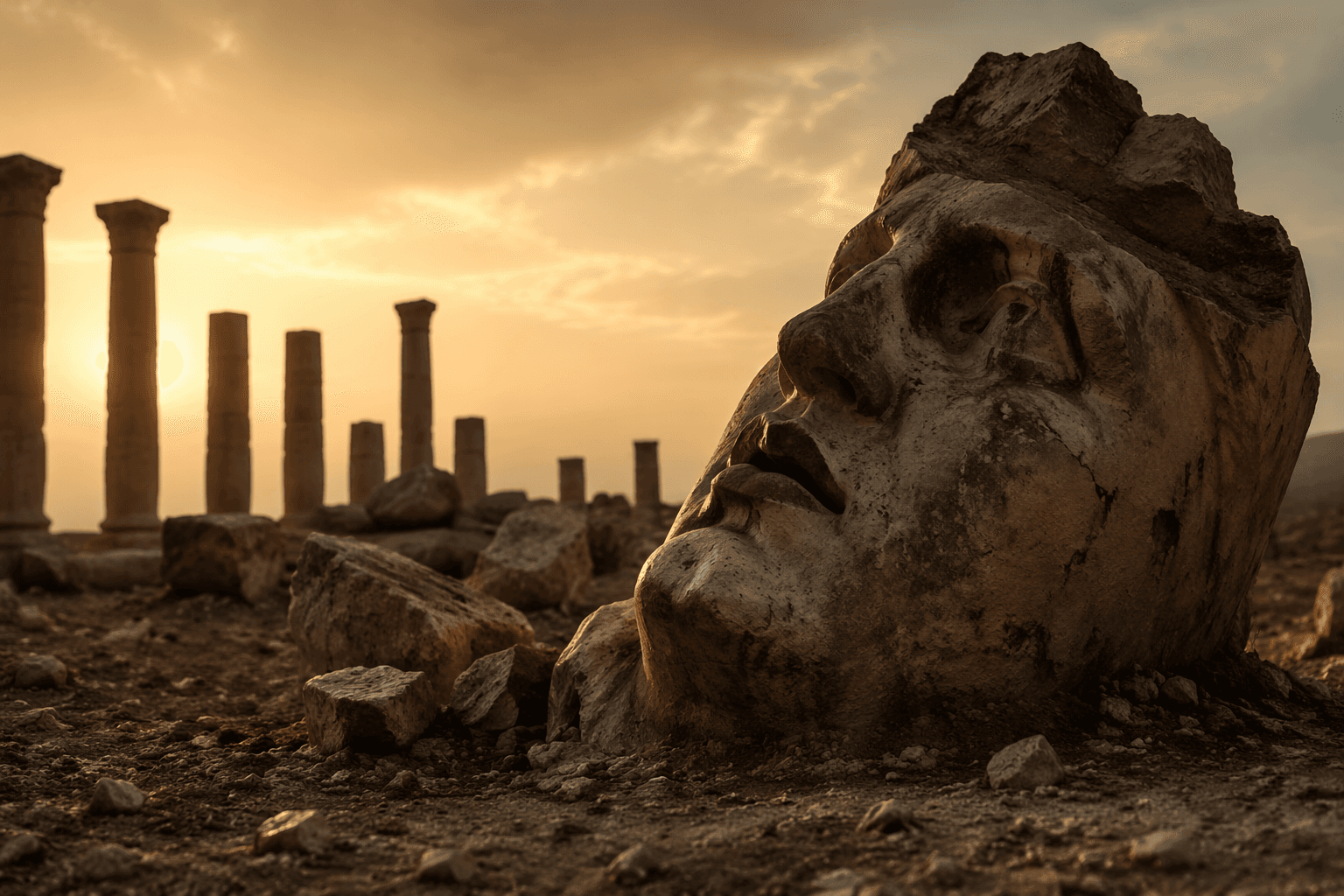
Shelley’s poem is built as a sonnet and framed as a traveler’s account. The opening line, “I met a traveller from an antique land,” immediately places the reader at a distance, as if the story has already passed into history. That frame matters because the traveler does not describe a glorious empire, but a ruined statue in the desert, a relic stripped of its authority by time, sand, and neglect.
Why the boast becomes irony
The poem’s most famous line, “Look on my Works, ye Mighty, and despair!” sounds like the declaration of a ruler at the height of confidence. It is meant to project scale, dominance, and lasting achievement. But Shelley’s central irony is brutal: the boast is undercut by the total ruin of the monument, and by extension the collapse of the ruler’s legacy.
That is why the final image carries so much force. The poem ends with “the lone and level sands stretch far away,” an image of emptiness rather than empire. The sand does not merely surround the statue. It erases it, leaving behind a warning that pride cannot outlast time. In political terms, the poem suggests that public works, grand rhetoric, and official self-praise can all be swallowed by history if they lack durable substance.
What the metaphor is really targeting
In a modern political article, the Ozymandias reference usually aims less at one person than at a style of rule. It targets presidential hubris, the instinct to speak as though authority can bend institutions, history, and memory to one will. The metaphor is especially sharp when a presidency is wrapped in claims of restoration, national rebirth, or transformative legacy, because Shelley’s poem asks a simple question: what remains when the applause stops?
The title therefore points not just to a leader, but to the machinery of legacy itself. It asks whether an administration’s signature project is built to endure, or whether it is already headed toward the same fate as the statue in the desert. In that sense, the comparison holds only if the project depends more on spectacle than on institutions, more on personality than on durable policy, and more on self-mythology than on democratic legitimacy.
Why it resonates in debates over executive power
The poem has become widely read as a meditation on the transience of power, pride, and political legacy because it captures a recurring democratic problem. Presidents often govern with the language of permanence, even though the office is temporary and constrained by law, courts, elections, and public judgment. Shelley’s ruined king is a reminder that authority can look absolute in the moment and fragile in retrospect.
That is what makes the Ozymandias allusion so effective in discussions of executive power. It does not argue that all ambitious presidents fail, or that all major reforms decay. It argues something more exacting: power that ignores institutional limits, or treats legacy as self-proclaimed fact, often leaves behind less than it promised. The statue’s collapse is not only physical. It is reputational.
How to read the comparison carefully
The strongest use of the metaphor is not to claim that a leader is literally doomed to ruin, but to test the durability of the leader’s record. Three questions matter most:
- Does the presidency strengthen institutions, or does it personalize power?
- Are the achievements measurable and durable, or mostly symbolic and theatrical?
- Will the policy project still matter after the rhetoric fades and the political coalition changes?
Those questions fit Shelley’s sonnet because the poem does not celebrate destruction for its own sake. It exposes the gap between boast and reality. A leader may command headlines, dominate the day’s debate, and even leave behind visible artifacts of office, but the Ozymandias comparison becomes meaningful only if those artifacts cannot survive scrutiny, succession, or time.
The lasting lesson of the desert
Shelley’s poem endures because it compresses a political truth into a single image: empire, prestige, and self-regard can all be reduced to fragments. The traveler sees a shattered monument, not a living kingdom. The reader sees that the ruler’s command to “despair” has been reversed by history itself. What remains is not greatness preserved, but greatness mocked by ruin.
That is why the Ozymandias reference still lands in modern political writing. It is a warning against the fantasy that a presidency can outmuscle time. It also forces a harder judgment about legacy: not who spoke most grandly, but who built something that could survive the lone and level sands.
This article was produced by Prism’s automated news system from verified source data, official records, and press releases, then run through automated quality and moderation checks before publishing. The system is built and supervised by the people who set the standards it runs under. Read our full AI policy.
Did this article answer your question?

