Pakistan's Solar Revolution Saves Billions, Shielding Economy From Energy Shocks
Pakistan's rooftop solar surge has saved $12 billion in LNG imports since 2020, with another $6.3 billion in potential savings expected this year alone.
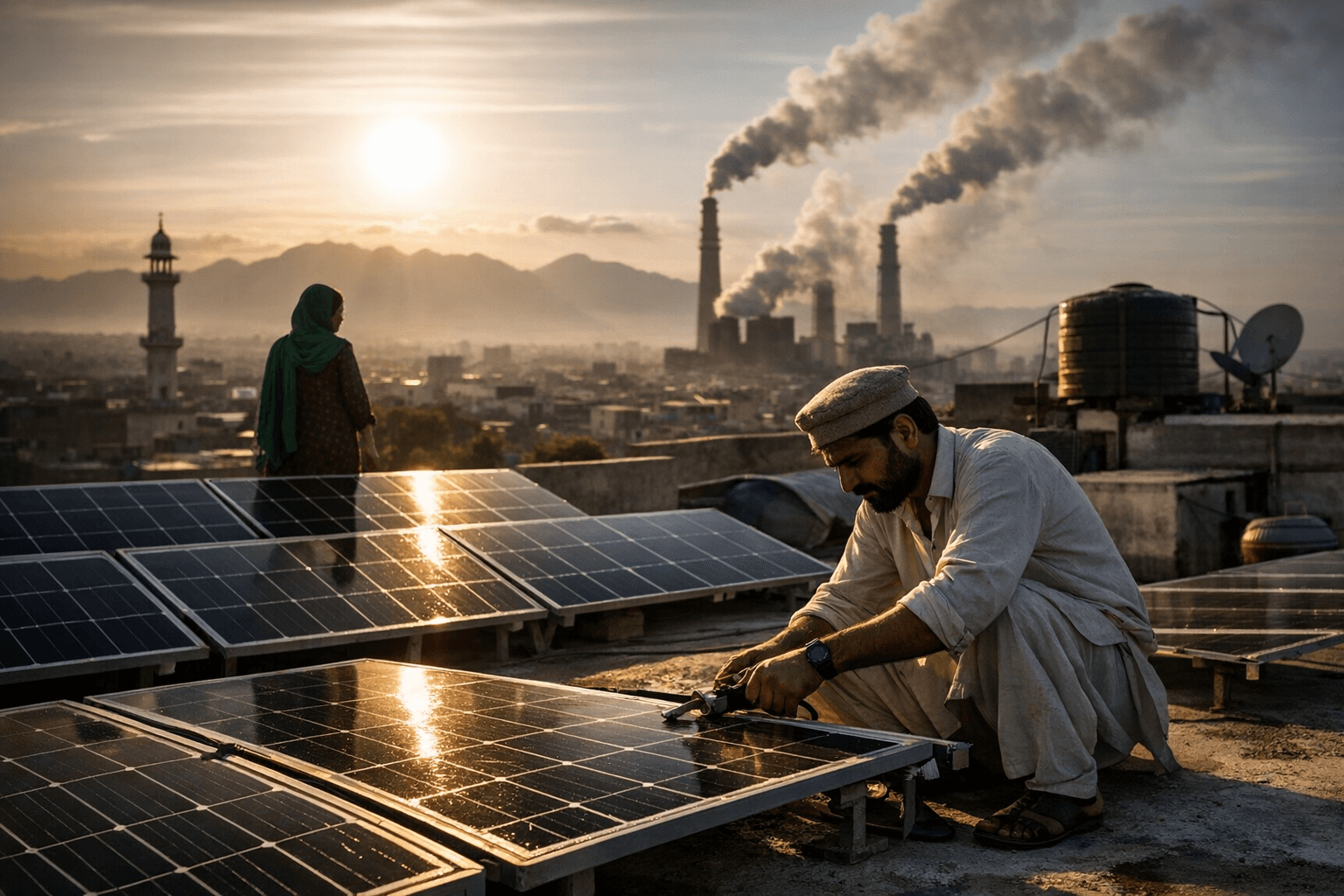
Millions of Pakistani households and businesses made a quiet, individual bet against their own grid, and the cumulative payoff now registers in macroeconomic terms: an estimated $12 billion in avoided LNG and fuel imports since 2020, with the country positioned to save a further $6.3 billion in 2026 alone, according to an analysis by the Centre for Research on Energy and Clean Air.
The numbers behind that figure reveal how fast the shift happened. Solar generation in Pakistan jumped from 7.7 terawatt-hours in 2022 to 36.6 terawatt-hours in 2025, an average annual growth rate of roughly 68 percent, according to the UK-based energy think tank Ember. Solar now ranks alongside hydropower and gas as one of Pakistan's three largest generation sources. Net-metered rooftop capacity alone crossed 5.3 gigawatts by April 2025, nearly a tenfold increase in two years. Panel prices catalyzed much of that uptake: the cost per watt fell to $0.08 by 2025, driven by a fivefold drop in Chinese module prices between 2022 and 2024. Pakistan absorbed roughly 50 gigawatts of imported solar panels in total, making it the third-largest market for Chinese solar hardware globally.
The human calculus behind those terawatt-hours is straightforward. Recurring blackouts, steep tariff hikes and an unreliable grid pushed consumers toward self-generation long before geopolitical risk entered the equation. Vaqar Zakaria, CEO of the Islamabad-based environmental consultancy Hagler Bailly Pakistan, has run rooftop panels for more than five years, cutting his bills to near zero and selling surplus power back through net metering. After adding two electric vehicles and doubling his battery storage, he now runs his home and his cars on sunlight. "I am moving away from their fuel, and I don't need their power," Zakaria said. "I call it the hand of God driving my car."
The geopolitical dimension sharpened that calculus further. As tensions around the Strait of Hormuz roiled global LNG markets, Pakistan's distributed solar base provided a structural hedge that years of centralized energy policy had failed to build. "Its rooftop solar boom has slashed its import bill and is now acting like an insurance policy against the oil and LNG shocks rippling out of the Gulf," said Lauri Myllyvirta, co-founder at the Centre for Research on Energy and Clean Air. Grid electricity demand has meanwhile dropped more than 10 percent in recent years as solar adoption accelerated, and gas generation fell as solar displaced it.
That displacement, however, has fractured along class lines. Rooftop systems cost between 2 and 3 million rupees to install, a threshold that effectively locks out lower- and middle-income households, renters, and residents of dense urban neighborhoods without suitable roof access. When high-consumption customers who can afford panels reduce their grid draw, the grid's fixed costs, including transmission maintenance, capacity payments to independent power producers, and debt servicing for distribution companies, do not shrink. They redistribute onto remaining customers. Losses at distribution companies reportedly exceeded 100 billion rupees in recent years, a figure that policymakers and the National Electric Power Regulatory Authority have cited as unsustainable.
Regulators moved to address that imbalance earlier this year, terminating the existing net-metering regime and replacing it with a net-billing framework. The buyback rate for power exported to the grid was cut from roughly 26 rupees per unit to 11 rupees under the new rules. If the prior regime had been left unchanged, analysis projected regressive cost-shifting could have reached $48.34 billion by 2034. The reform extends payback periods for new solar adopters and has drawn criticism from the prosumer community, but regulators argue it reflects the actual marginal cost of power and reduces the cross-subsidy burden on lower-income grid customers.
Pakistan's solar surge offers a compressed case study in what bottom-up energy transitions can and cannot accomplish. The savings are real, the resilience demonstrated, and the speed of adoption extraordinary. The harder question, whether that resilience is shared broadly or remains concentrated among those who could afford to opt out, is now the central policy problem the country faces as it tries to govern the revolution it did not entirely plan.
Know something we missed? Have a correction or additional information?
Submit a Tip

