Palestinian-American teen laid to rest after settler shooting in Mukhmas
Dozens mourn 19-year-old Palestinian-American Nasrallah Abu Siyam in Mukhmas after he was shot the previous day; U.S. embassy condemned the violence.

Dozens of mourners carried the body of a 19-year-old Palestinian-American through the West Bank village of Mukhmas on Thursday, a day after he was shot and later died, the Palestinian Health Ministry and local witnesses said. The ministry confirmed that Nasrallah Abu Siyam died from critical wounds sustained Wednesday afternoon near the village east of Ramallah.
News organizations and photo agencies used multiple spellings of the youth’s name. The New York Times and an original brief identified him as Nasrallah Abu Siyam; Reuters used the spelling Nasrallah Mohammed Jamal Abu Siam; Associated Press captions published by the Boston Herald labeled him Nasrallah Muhammad Jamal Abu Siyam. All sources say the victim was 19 and held Palestinian-American status.
Witnesses described a confrontation between villagers and settlers. Raed Abu Ali, a resident of Mukhmas, told AP that “a group of settlers came to the village Wednesday afternoon where they attacked a farmer, prompting clashes after residents intervened.” Reuters cited an unnamed relative who said settlers had raided the village to steal sheep and that villagers, including Abu Siam, attempted to stop the theft before the settlers “began firing at them, wounding Abu Siam and others.”
Local health and activist accounts put the immediate toll beyond the fatality. Citing the Palestinian news agency WAFA, Reuters reported that “the attacks injured five people, three of whom suffered bullet wounds including Abu Siam.” The Palestinian Authority’s Wall and Settlement Resistance Commission called Abu Siyam “the first Palestinian killed by settlers in 2026.”
The Israeli military issued a brief statement, reported by The New York Times, saying that “unnamed suspects shot at Palestinians, who were later evacuated for medical treatment. It did not say whether any were arrested.” Reuters also reported that the military “did not immediately respond to a Reuters request for comment,” and the identity of any shooter or any arrests had not been confirmed in the available accounts.
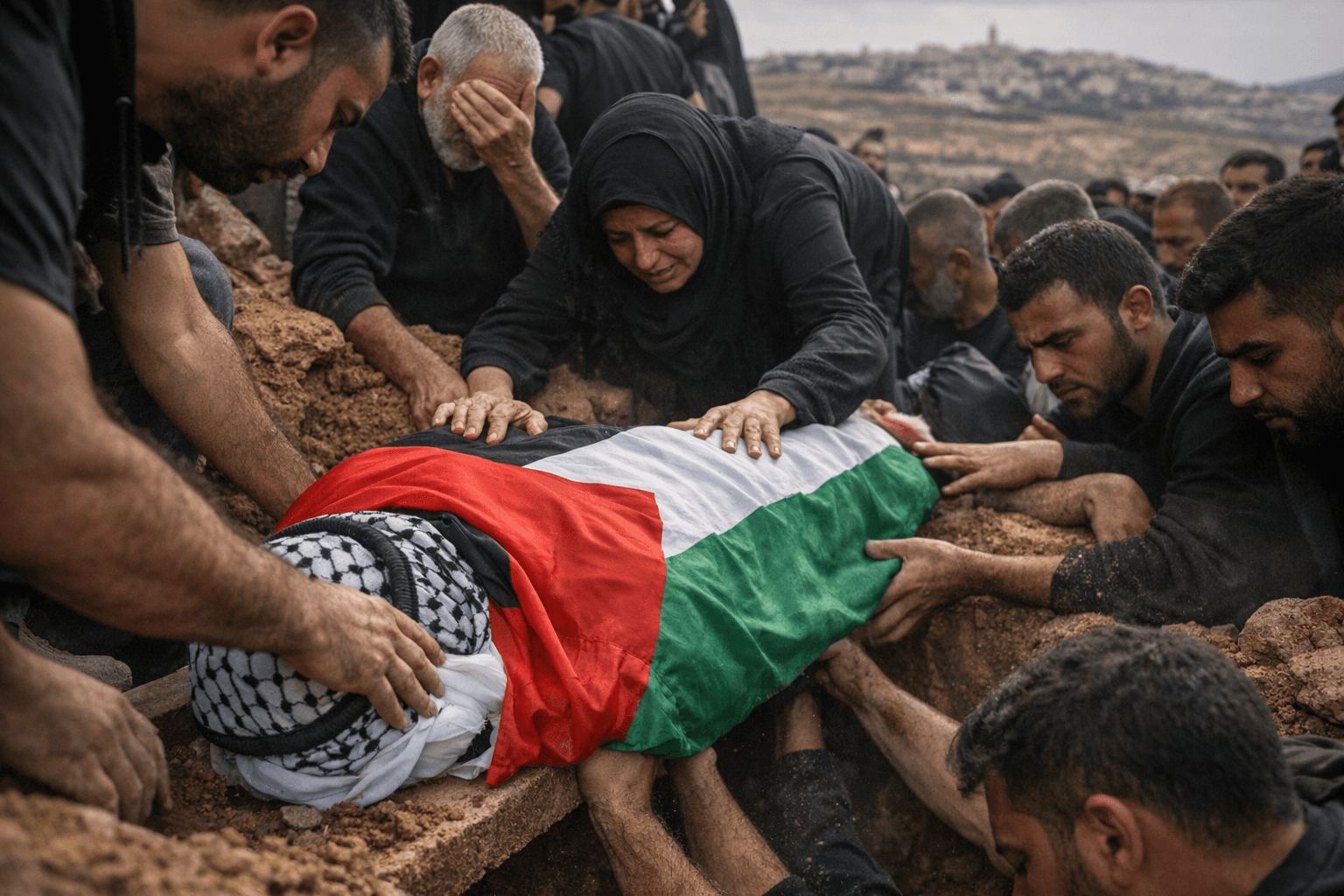
The funeral was marked by images carried and distributed by international agencies: one AFP photo showed a draped body partially covered with red-and-white fabric and a black-and-white-patterned cloth with flowers on top (photo credit John Wessels/Agence France-Presse, Getty Images). AP photos by Nasser Nasser captured mourners offering condolences to Mohammad Abu Siyam, identified as the victim’s father, and posters bearing the victim’s name and picture.
The killing followed a broader surge of violence in the occupied West Bank. The New York Times, citing the United Nations Office for the Coordination of Humanitarian Affairs, said settler violence “killed 240 people last year” and that “seventeen Israelis were killed over the same period.” AP and NPR, also citing UN OCHA, phrased the toll differently, reporting that “Israeli forces and settlers killed 240 Palestinians last year” and that Palestinians killed 17 Israelis, six of whom were soldiers. Reuters noted several U.S. citizens, including the activist Ayşenur Ezgi Eygi, have been killed by Israeli forces or settlers in the West Bank over the past two years.
A U.S. embassy official condemned the violence, telling Reuters: “The U.S. Department of State has no higher priority than the safety and security of U.S. citizen overseas.” Online engagement with The New York Times’s account of the killing showed intense public interest: the paper’s Facebook post drew 298 reactions, 161 comments and 30 shares; one commenter, Basil Abuwarda, wrote, “This is a deeply tragic incident. The loss of life, especially under such violent circumstances, only adds to the ongoing tension and suffering in the region.”
Key questions remain: whether any settlers were detained or charged, where Abu Siyam received treatment, and further Israeli official comment. Journalists and officials cited in these reports recommend verification of UN OCHA’s original casualty language and follow-up with Israeli military and Palestinian health authorities for details the initial accounts did not provide.
This article was produced by Prism’s automated news system from verified source data, official records, and press releases, then run through automated quality and moderation checks before publishing. The system is built and supervised by the people who set the standards it runs under. Read our full AI policy.
Did this article answer your question?