Pentagon shoots down Border Patrol drone with laser near Fort Hancock, Texas
The Defense Department engaged and destroyed a U.S. government drone using a laser near Fort Hancock, prompting an FAA flight restriction and fresh congressional scrutiny.
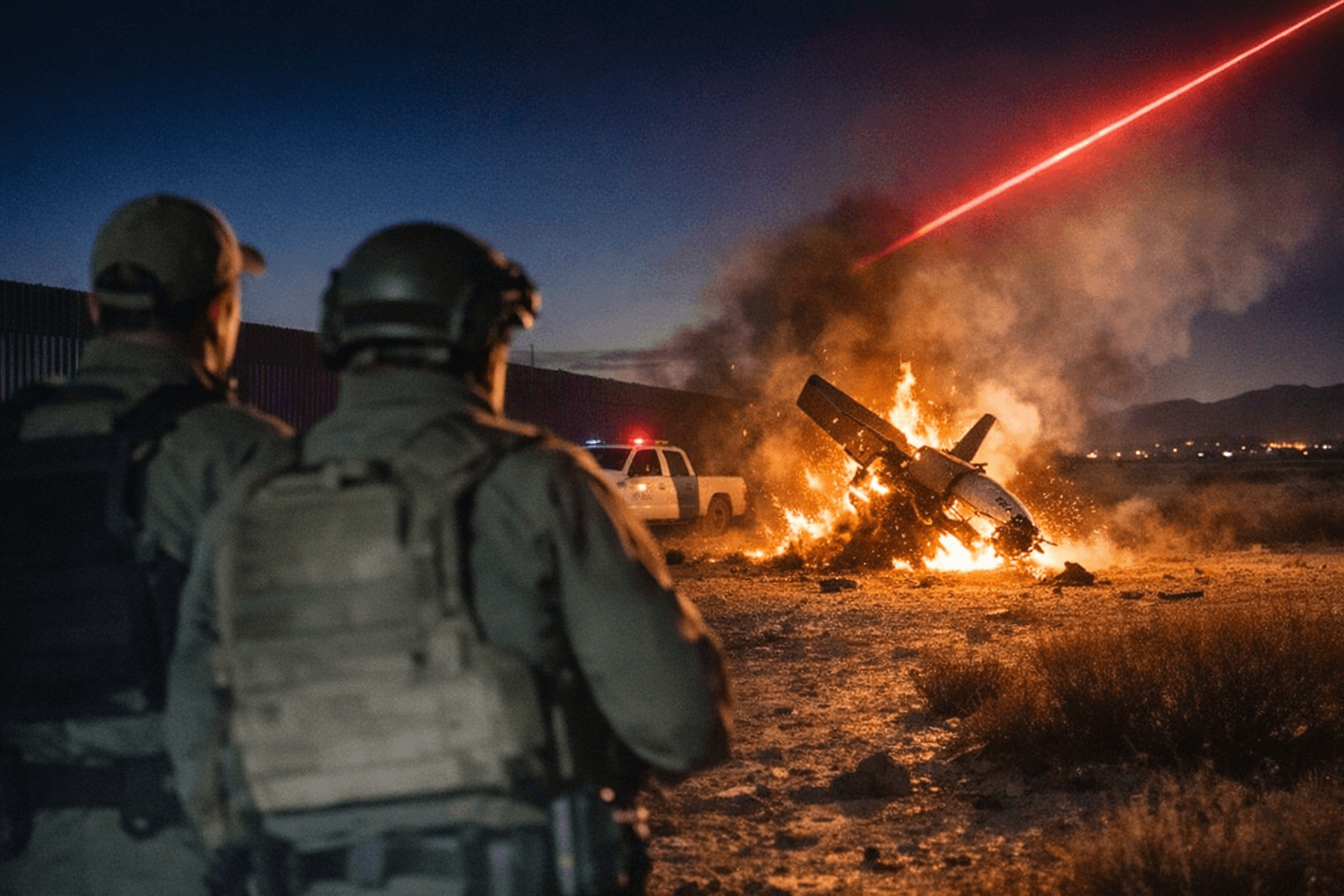
The Defense Department shot down a U.S. Customs and Border Protection drone near Fort Hancock, Texas, using a laser weapon, federal officials said, prompting the Federal Aviation Administration to expand a temporary flight restriction around the small border community.
The Department of Defense, Customs and Border Protection and the FAA issued a joint statement saying an "engagement occurred." The statement, as circulated to reporters, included the line, "This reported engagement occurred when the Department of War employed counter-unmanned aircraft system authorities to mitigate a seemingly threatening unmanned aerial system operating within military airspace." Officials have not yet released a full verbatim joint statement or clarified whether the phrase "Department of War" was an error in the released text.
An unnamed U.S. official said a laser weapon was used to down the drone. The FAA expanded a temporary flight restriction in the Fort Hancock area for "Special Security Reasons" and said the restriction did not affect commercial air service; agencies also said there were no commercial aircraft in the vicinity at the time of the engagement. Public records for the exact NOTAM text, lateral and vertical limits of the TFR, and the incident timestamp have not been released.
Congressional Democrats on the House Transportation and Infrastructure Committee immediately seized on the episode as evidence of hazardous gaps in interagency coordination. Reps. Rick Larsen, André Carson and Bennie Thompson said in a joint statement, "Our heads are exploding over the news that DoD reportedly shot down a Customs and Border Protection drone using a high risk counter-unmanned aircraft system." In a follow-up passage they added, "We said MONTHS ago that the White House’s decision to sidestep a bipartisan, tri-committee bill to appropriately train C-UAS (counter unmanned aerial system) operators and address the lack of coordination between the Pentagon, DHS and the FAA was a short-sighted idea. Now, we’re seeing the result of its incompetence."
The incident intensifies questions about how the federal government deploys counter-unmanned aircraft systems, who retains authority to engage presumed threats, and how agencies notify civilian aviation authorities and Congress. Two weeks earlier military testing of high-energy laser systems near Fort Bliss triggered an abrupt FAA restriction on El Paso airspace that was announced for 10 days then reversed hours later; officials said the earlier closure involved tests with lasers and was linked to concerns about cartel-operated drones. Separately, federal officials acknowledged a CBP laser strike in Texas in recent weeks that later turned out to have targeted party balloons, a sequence that helped spark the earlier airspace dispute.
Key facts remain unresolved. Agencies have not publicly confirmed the precise date and local time of the Fort Hancock engagement, the specific counter-UAS system used, or the drone's operational ownership and asset identification. Some reporting has described the aircraft as a CBP drone; other official accounts have not definitively attributed ownership. Several House members said they had not been briefed before the details were publicly reported.
The episode underscores a policy gap that lawmakers have tried to address legislatively: training and certification for C-UAS operators and formalized protocols for coordination among the Pentagon, Department of Homeland Security components and the FAA. Oversight committees in both chambers are likely to press for after-action reviews, full incident reports and the raw FAA NOTAMs that define the airspace restrictions. Until agencies produce those documents, congressional leaders say accountability and safe integration of military counter-drone operations into civil airspace will remain in question.
This article was produced by Prism’s automated news system from verified source data, official records, and press releases, then run through automated quality and moderation checks before publishing. The system is built and supervised by the people who set the standards it runs under. Read our full AI policy.
Did this article answer your question?

