Peregreen V4 657.59 km/h Guinness Record Spurs Counter‑UAS Alarm
The Peregreen V4 achieved a Guinness-certified top speed of 657.59 km/h, a milestone for drone racing that also raises urgent counter-UAS and air-defense questions.
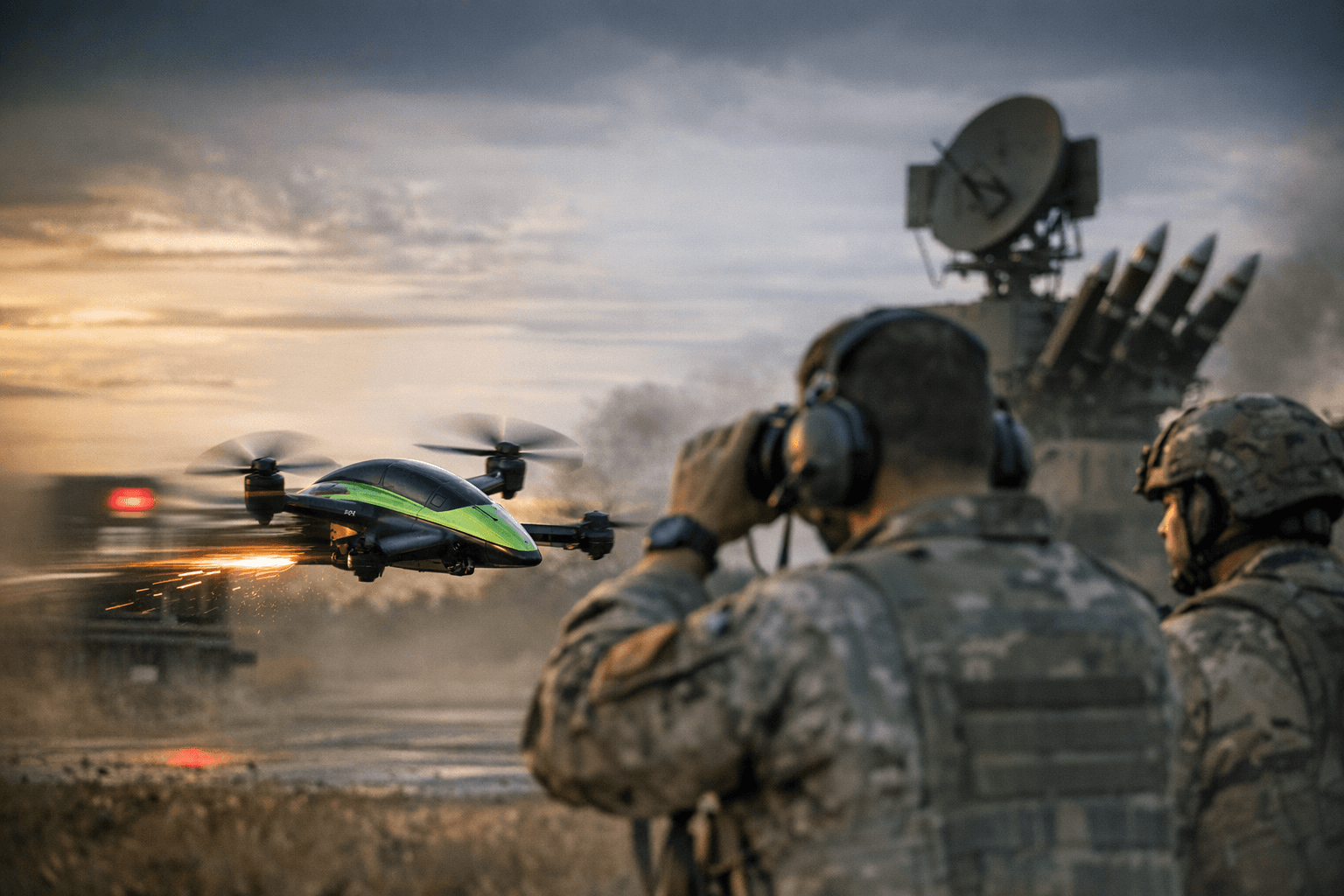
The Peregreen V4 sprinted to a Guinness-certified 657.59 km/h, a raw speed that redefines expectations for civilian quadcopter performance and immediately tightens the focus on counter-UAS readiness. Guinness recorded the certification on Jan 15, and industry attention intensified after the run became public on Jan 21. The platform’s velocity is not just a lap-time brag; it compresses threat envelopes that air defenders and race directors must reckon with.
Performance on the course leaned more on engineering than piloting spectacle: pilot names were not disclosed for the certified run. The achievement belongs to the Peregreen platform and the Bells engineering team, whose iterative approach combined rapid 3D printing, computational fluid dynamics (CFD) modeling, and aggressive motor and propeller tuning. Those technical moves delivered the speed envelope: 657.59 km/h is a departure from traditional multirotor race metrics and a technical leap beyond what most timing rigs and safety nets were designed to handle.
From a sport standpoint, the record reframes competition. Drone-racing organizers now face a split problem: how to adapt courses, timing systems, and safety zones for machines whose ground speed approaches manned light-aircraft thresholds, and how to keep piloting skill relevant when raw hardware optimization can dominate outcomes. The Bells’ process, short feedback loops, printed airframes, and iterative prop tuning, illustrates a larger trend in the pits where hardware cycles once measured in years now turn in weeks or months. That accelerates arms races between builders and between rulesets.
Industry implications extend beyond podiums. High-speed quadcopters change interception math for counter-UAS systems: detection windows shrink, interceptors need faster closure rates, and stealthier signatures at high Mach-equivalent speeds alter sensor requirements. The Peregreen V4’s combination of raw ground speed and small radar cross-section signals a class of threat platform that blurs the line between hobbyist innovation and operationally relevant capability. Defense planners and vendors will need to reassess engagement timelines, sensor fusion, and rules of engagement where detectability and kinetic intercept become marginal.
Culturally, the record is a double-edged prop: it amplifies community pride in engineering creativity and forces an ethical conversation about dual-use advances. The Bells’ use of CFD and rapid prototyping is celebrated in the pits, but those same tools lower barriers for actors seeking high-speed platforms for non-sport ends.
What comes next is predictable escalation: rivals will iterate, race organizers will rewrite safety protocols and timing standards, and counter-UAS programs will push for faster sensors and intercept solutions. For fans, the Peregreen V4 run is a milestone in pure performance; for policymakers and defenders, it is a clarion call to update the rules of the air.
Know something we missed? Have a correction or additional information?
Submit a Tip