Philadelphia artist turns pennies and bills into sculptures, jewelry
Stacey Lee Webber turns pennies and bills into art that tests how labor is valued and why Americans still read money as power.
Money, remade
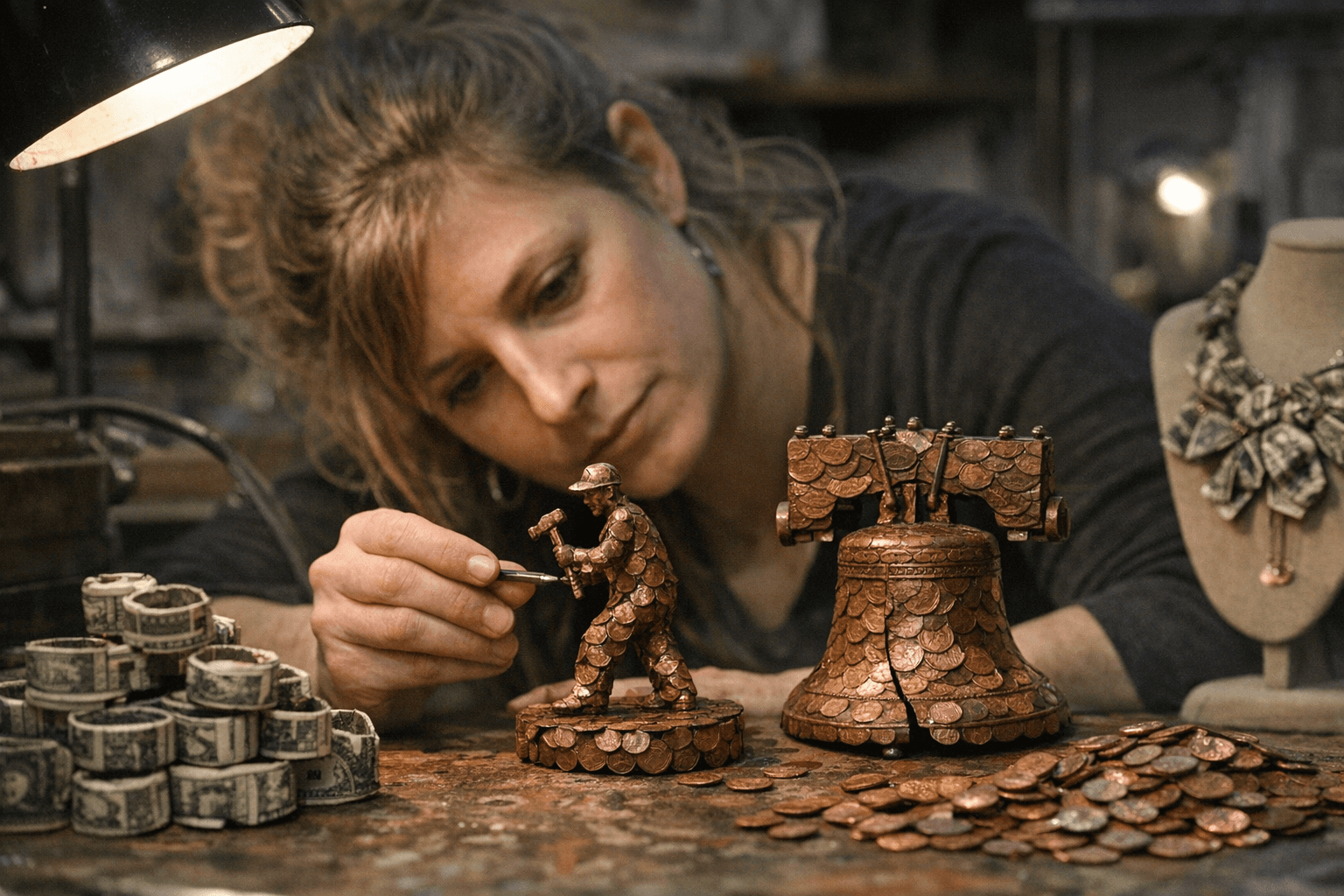
Stacey Lee Webber turns the smallest unit of cash into something that can stop a viewer in place. In her Philadelphia studio, pennies and bills become sculptures, jewelry, and wall pieces that look at once familiar and unsettling, because the material is still money even after it has been transformed into art. Nancy Giles speaks with the artist on CBS News Sunday Morning as part of the program’s April 12, 2026 Money Issue, and Webber says the attention sent demand for her work sharply higher.
That reaction is part of the story. Her practice is built on a simple but pointed reversal: currency is usually a tool for exchange, but in Webber’s hands it becomes a way to ask what society really values, who gets paid, and how labor gets seen. The joke is never just that the art is expensive because it is made from money. The deeper point is that money itself can be both material and message.
Labor cast in copper
The clearest example is The Craftsmen Series, a group of hand-fabricated, life-sized tools made entirely from copper pennies. Webber says the work questions how people measure labor, skill, and time, and that idea runs through the series like a structural beam. A tool made from pennies is still a tool, but it also turns workmanship into a visible archive, each coin standing in for effort, repetition, and the slow accumulation of skill.
That is why so much of her work reads as a tribute to working-class labor and the “invisible hands” that build and repair. Webber does not treat coins as decorative shorthand for wealth. She treats them as evidence of work, especially the kind that is often overlooked even though it keeps homes, machines, and cities functioning. In that sense, her penny tools do more than imitate the objects of manual labor. They elevate the labor itself.
Webber’s broader body of coin-based work extends that same idea into different forms. Her listings include enameled penny cubes, boxes, vessels, and wall pieces, all of which keep the coin visible while changing its purpose. The material stays legible as currency, but the finished object makes the viewer slow down and consider the difference between face value and meaning.
Bills that speak back
If the coin works dwell on labor, her Insurrection Bills series pushes into history and politics. In that body of work, Webber alters U.S. banknotes with stitched imagery and commentary, turning familiar paper currency into something more intimate and more critical. The bills no longer just circulate as symbols of national trust. They become surfaces for interruption, revision, and dissent.
That intervention matters because currency is among the most recognizable objects in American life. People handle it, count it, save it, and worry over it, but rarely look closely at the ideas encoded in it. Webber’s stitched notes make that habit impossible to ignore. The money remains recognizable, yet the alterations suggest that history and power are never as fixed as a banknote wants to seem.
Her ongoing sculpture series God Bless America extends that impulse by transforming familiar symbols of American life into intricate, hollow forms made entirely from hand-soldered circulated coins. The effect is both precise and symbolic: the object looks solid from a distance, but the structure reveals how much of national identity rests on what is assembled, repeated, and believed.
From training to full-time practice
Webber’s path to this work was built over years rather than a single breakthrough. She earned a Master of Fine Arts in 2008 and was an artist in residence at Lillstreet Art Center in Chicago in 2009. In 2011 she moved to Philadelphia to pursue full-time art, and after years of teaching and working as a production jeweler, she became a full-time artist in 2015.
She is now based in Northeast Philadelphia and has exhibited internationally, including in the Republic of Korea, Tokyo, and Belgium. That reach helps explain why the work lands beyond a local gallery context. The objects are rooted in American money, but they speak fluently to a broader audience that understands cash as both a daily tool and a loaded symbol.
The trajectory also clarifies why Webber’s work feels so exacting. Jewelry making, production work, and sculpture all depend on patience, technique, and close control over materials. In her case, that training becomes part of the meaning. When a penny is soldered, stitched, or fabricated into a larger form, the time embedded in the object is not hidden. It is the object.
What the price tags reveal
The most revealing part of Webber’s market may be the numbers attached to the work. Her website lists Penny Scales at $22,000 and Penny Waves 12-inch at $2,600, while smaller items such as penny cubes sit far lower. Those figures sharpen the contrast at the center of her practice: a one-cent coin can become the basis for a work priced like a luxury object, and that leap says as much about art markets as it does about craftsmanship.
That contrast also makes her popularity feel culturally timed. Americans are surrounded by conversations about value, from the cost of everyday goods to the shrinking usefulness of small change. Webber’s work takes that anxiety and makes it visible. By turning pennies and bills into sculpture and jewelry, she turns cash into a critique of cash itself, while reminding viewers that the value of an object is never limited to the amount stamped on its face.
That is what gives her money art its force. It is not novelty, and it is not a gimmick. It is a serious argument, built coin by coin, that labor has dignity, that value is constructed, and that money still carries enough symbolic power to shape the way Americans see art, work, and themselves.
This article was produced by Prism’s automated news system from verified source data, official records, and press releases, then run through automated quality and moderation checks before publishing. The system is built and supervised by the people who set the standards it runs under. Read our full AI policy.
Did this article answer your question?