Photographer reveals story behind iconic shark images, and False Bay decline
Chris Fallows turned a single breach into a conservation icon, then watched False Bay’s white sharks vanish and ripple through the ecosystem.
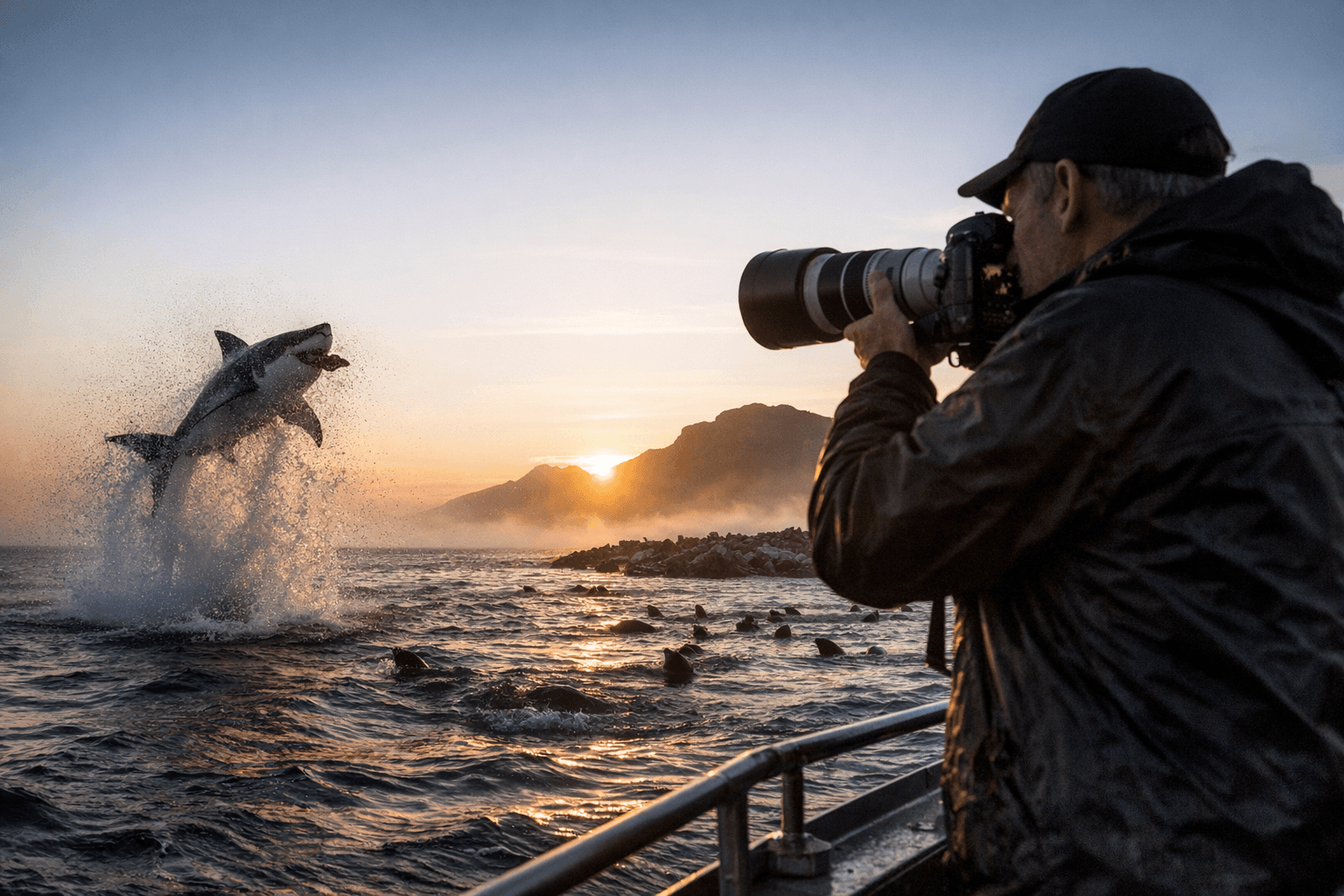
The image that changed the conversation
Chris Fallows built one of the most recognizable wildlife images in the world by staying close to a place that was changing before his eyes. His best-known photograph, “Air Jaws,” captured in June 2001 at Seal Island off Cape Town, turned a split-second shark breach into a global symbol of the power and vulnerability of marine predators.
What gives that image force is not only drama, but context. Seal Island sat at the center of one of the world’s most extraordinary white shark ecosystems, a feeding ground in False Bay shaped by a 65,000-strong Cape fur seal colony and, for years, by repeated predatory bursts from great white sharks. In one account, naturalists recorded about 600 predatory events over a four-month period there, and Fallows and a colleague helped turn that rare behavior into a scientific archive that now contains more than 10,400 catalogued events.
How Fallows got the shot
Fallows first started working with sharks in False Bay in 1998, after beginning with white sharks in 1991. He was also the first person to discover and photograph the now-famous breaching great white shark behavior at Seal Island in 1996, a breakthrough that changed how scientists, photographers, and the public understood the species.
That access did not come from one lucky morning on the water. It came from repeated time in the field, close observation, and a willingness to return to the same animals and the same waters long enough to understand patterns that most viewers never see. CNN described his method as combining innovative techniques with a lifetime of familiarity with his subjects, allowing him to get respectfully and intimately close to lions, elephants, and great white sharks.
That matters because the ethics of wildlife photography shape the public value of the image. Fallows’ work is not simply about getting dramatic proximity. It is about earning enough trust, knowledge, and patience to document animals without reducing them to spectacle. The result is imagery that can change how people talk about endangered wildlife, not just how they look at it.
Seal Island as a laboratory for awe and evidence
Seal Island became famous because it offered both visual theater and scientific abundance. The shark-seal interactions were frequent enough to study systematically, and rare enough to feel extraordinary. The Shark Research Institute says the database built with Apex Shark Expeditions is the largest of its kind for this behavior, and that volume of evidence gave scientists a way to analyze predation at a scale few marine sites can match.
That is why “Air Jaws” became more than a single photograph. It represented a place where wildlife photography and field science reinforced each other. A striking image can draw public attention, but a long-running dataset gives that attention substance, showing that the scene was not an isolated event but part of a repeatable ecological system.
For conservation, that combination is powerful. Images create memory. Data creates credibility. Together they make it harder to dismiss disappearing wildlife as anecdote.
The loss that reshaped False Bay
The story took a darker turn when great white sharks in False Bay were widely reported as gone by mid-2018. The disappearance stunned observers because it involved one of the most visible shark populations on the South African coast, from a place that had once seemed synonymous with white shark abundance.
A 2019 paper in Scientific Reports documented the disappearance from Seal Island and the simultaneous emergence of sevengill sharks in the area. A 2025 study in Frontiers in Marine Science added evidence that the loss of white sharks triggered cascading ecosystem effects, including increases in seals and sevengill sharks. In ecological terms, that is a reminder that apex predators do not merely occupy the top of a food web. They help structure it.
The implications reach beyond False Bay. If the decline of white sharks can alter the balance among seals and other sharks in a system as studied as Seal Island, then the conservation stakes extend to any coastal ecosystem where top predators are under pressure from fishing, habitat disruption, or shifting ocean conditions. Fallows’ photographs make that abstract warning visible.
Why the disappearance changed Fallows’ work
The loss of the sharks affected Fallows personally and professionally. He has said the disappearance deeply affected him and pushed him to use photography as a way to document and protect wildlife. That shift helps explain why his body of work now spans not only marine predators, but also elephants, cheetahs, humpback whales, and lions.
The move from one species to many is not a retreat from shark photography. It is an expansion of the same conservation logic. Whether he is photographing a breaching shark or a lion on land, the underlying task is similar: create images that give the public an emotional and factual reason to care about species at risk. In a national debate over protection for habitats and wildlife, that matters because public support often follows visibility.
Fallows’ 2020 Global Eye Award for “Air Jaws” recognized the power of one image. Yet the larger achievement is the body of work behind it, which turns rare encounters into evidence, and evidence into urgency. In a world where apex predators can vanish from a famous bay in less than a generation, the photographs do more than preserve a moment. They preserve a warning, and a case for action.
This article was produced by Prism’s automated news system from verified source data, official records, and press releases, then run through automated quality and moderation checks before publishing. The system is built and supervised by the people who set the standards it runs under. Read our full AI policy.
Did this article answer your question?