Post Falls Council Unanimously Approves Prairie Medical Zone Change for Bed Tower
Post Falls City Council unanimously rezoned about 30.88 acres at Hwy 41 and West Prairie Avenue to allow a multi-story hospital bed tower and a 14-bed emergency department first phase.
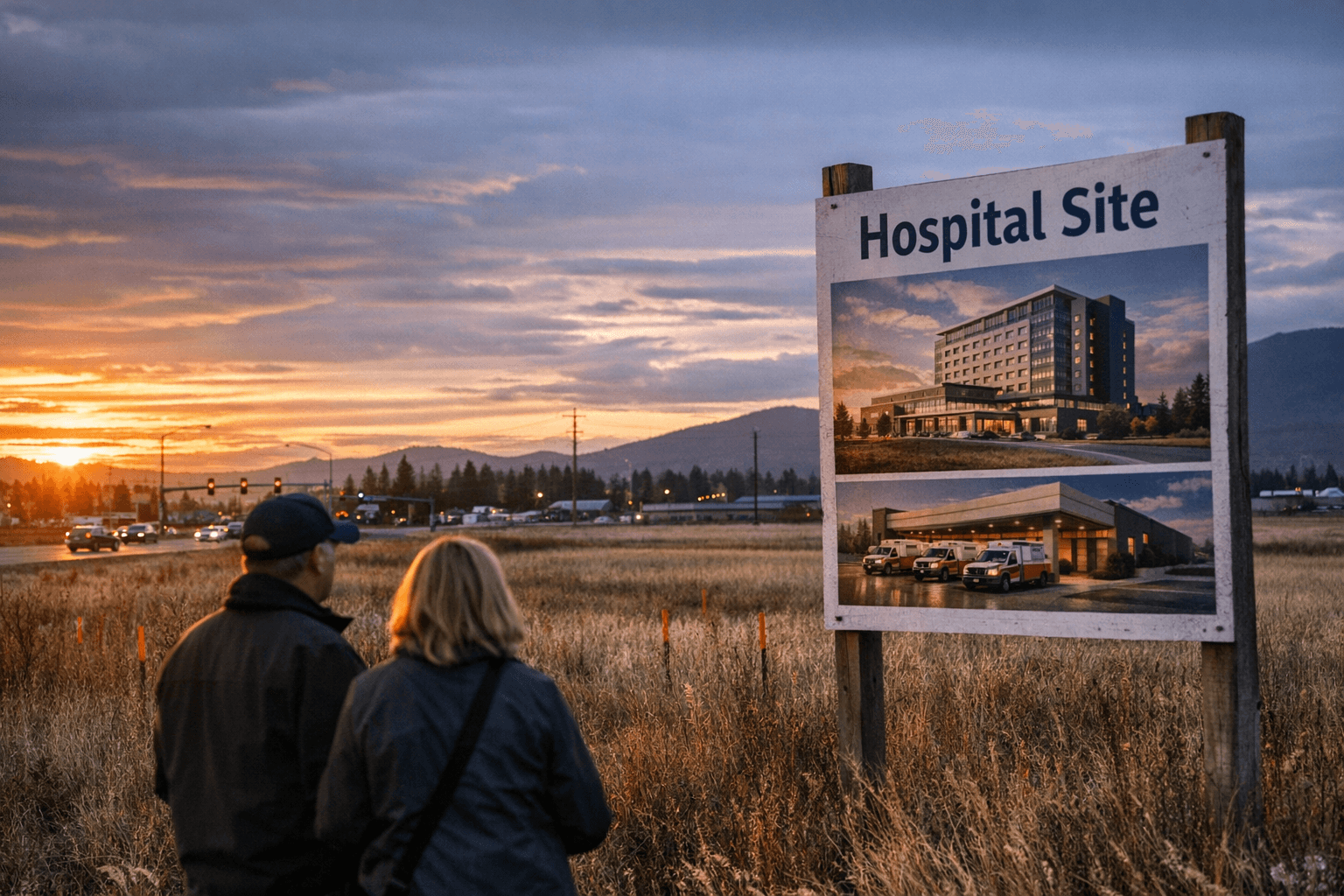
The Post Falls City Council voted unanimously March 3 to reclassify roughly 30.88 acres at the southeast corner of West Prairie Avenue and Highway 41 from Community Commercial Services to Community Commercial Mixed, clearing the way for a vertical hospital bed tower under zoning case ZC25-2. The rezoning raises the site height limit from 45 feet under CCS to as much as 105 feet under CCM, a change proponents say is needed to accommodate a multi-story medical campus owned by North Idaho Healthcare Holdings, LLC, a joint venture of Kootenai Health and MultiCare Health Systems.
Planning staff led the formal review of ZC25-2 and the Post Falls Planning and Zoning Commission voted unanimously Jan. 13 to recommend the rezoning after finding CCM consistent with the City’s Future Land Use Map and the Highway 41 corridor focus. Justin Souder of the Planning Department explained the change was requested primarily to permit increased building height to achieve an efficient campus design, and staff and the applicant agreed a development agreement will accompany the rezoning to prohibit residential development on the parcel.
Project representatives described the buildout and near-term schedule in detailed terms. Ben McGrann, speaking on behalf of North Idaho Healthcare Holdings, said, “Our first phase is an emergency department with 14 beds.” McGrann said the project team envisions later expansion into a 250-bed hospital totaling roughly 500,000 square feet, plus 300,000 square feet of medical office space, and estimated the first phase could be completed by the end of 2027 and the first part of 2028. McGrann also framed the vertical approach operationally: “The reason we want to be able to go vertically up to six stories is, which this would allow, is really just the efficient use of the space.”
City infrastructure planning and financing moved in parallel with the rezoning. The Post Falls Urban Renewal Agency and City Council adopted Ordinance 1547 on Dec. 16, 2025 to amend the Post Falls Technology Urban Renewal District and revise Appendix A - Project Costs so the URA can consider reimbursing eligible public improvements that accelerate construction. The City’s press materials list a 2025 estimated cost of $1,124,919 for public water and sewer improvements and Highway 41 right-in/right-out access and Prairie Avenue entrances tied to the Prairie Medical Campus.
Community development officials tied the URD changes to specific street and utility work. Community Development Director Bob Seale said the goal is to finish connector roads Zorros and Fennecus in one sequence, not incrementally: “What they’re looking to do ultimately is to be able to complete Zorros and Fennecus in one fell swoop as opposed to incrementally.” Councilor Ryan Davis emphasized the partnership with the developer, saying the infrastructure-first approach “makes perfect sense.”
Design and traffic details remain unresolved and subject to study and agreement. Project documents note Ross Point Water District will provide water and the City of Post Falls will provide wastewater service; project planners are weighing underground parking versus parking structures to preserve green space and have said a study will analyze ambulance traffic impacts. The plan also envisions the vertical bed tower reducing site coverage to allow walking trails and gardens for patients and visitors. Reporter Samantha Steigleder’s coverage warned of ownership risk phrased this way: “If something were to happen and you didn’t own this land anymore, they would by right have the ability to build whatever they wanted up to that height as well.”
With unanimous votes at both the Planning Commission and City Council and the URD amendment in place, the project’s next milestones are the development agreement text, final site plans showing parking and tower height, and completion of the ambulance traffic analysis. Those items will determine the timing and phasing of utilities, roadway widening, and construction that supporters say will add hospital capacity to Kootenai County by the late 2020s.
Know something we missed? Have a correction or additional information?
Submit a Tip