Post-Katrina law did not block Noem’s FEMA spending rule, officials say
A statute meant to guard FEMA resources did not prevent a rule requiring Noem’s sign-off on contracts over $100,000; staff say the policy slowed flood response and spurred departures.

Roughly one-third of FEMA’s full-time workforce has departed by some estimates as a chain of policy changes and personnel turmoil exposed limits in a post‑Katrina statute intended to protect agency resources. Less than a month before catastrophic floods hit central Texas in July, Noem enacted a rule requiring her personal sign-off on every contract and grant above $100,000, a shift agency staff say constrained rapid response.
A post‑Katrina law was written to rein in the Homeland Security secretary and guard FEMA resources, but lawyers familiar with the statute say its provisions are difficult to enforce. The practical result, according to internal FEMA communications and personnel accounts, was legal uncertainty inside the agency at a moment when speed mattered most.
When floods inundated communities in central Texas, seasoned FEMA teams “sprang into action” but immediately encountered bureaucratic hurdles that slowed scaling of resources, staff wrote in internal guidance requests. FEMA employees repeatedly sought legal direction and proceeded on the understanding they were following administration orders. The tension between a centralized sign-off requirement and on‑the‑ground urgency produced delays that some senior officials found unacceptable.
“It has instilled a culture of fear,” said Tierney, a former deputy FEMA administrator. “People are afraid to make decisions, and that is going to be a problem when we have a large catastrophic incident, and we need lots of people moving as fast as possible to help people.” The remark underscores a central concern among emergency managers: decision paralysis can translate directly into slower rescues and prolonged hardship for affected communities.
Agency leadership defended its conduct while also describing active intervention. Richardson told lawmakers he was on vacation but “jumped in ‘immediately’ to help lead the response from Washington, ‘kicking down the doors of bureaucracy.’” Department officials say other assets were rapidly deployed across the department, including teams from the U.S. Coast Guard and Border Patrol, and that FEMA resources were tapped when needed. “We’re being responsible with taxpayer dollars, that’s our job,” a department spokesperson said.
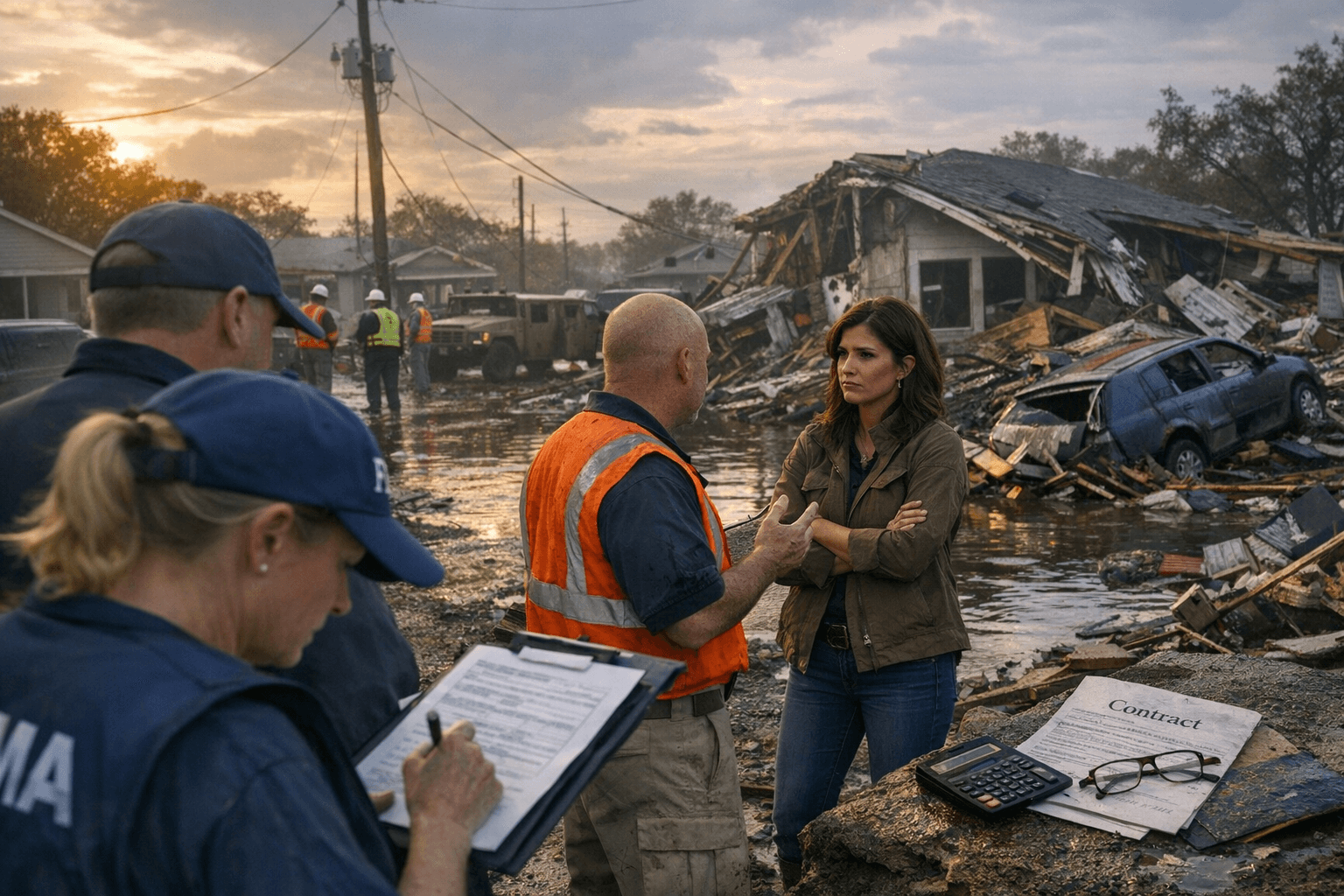
Personnel consequences were swift. The response episode precipitated public criticism, layoffs, hiring freezes and what officials described as numerous departures “many through layoffs and DOGE buyouts.” Weeks after the floods, the head of FEMA’s Urban Search and Rescue branch resigned, citing delays as the breaking point. The exodus included dozens of longtime senior leaders who helped reshape the agency after Katrina.
On the ground, volunteers and responders continued rescue work amid the constraints. A photo from Comfort, Texas is captioned: “A search and rescue volunteer holds a Camp Mystic t-shirt and backpack in Comfort, Texas, on July 6.” That image captures the human scale of operations that were unfolding even as institutional frictions played out in Washington.
The clash raises a core question for lawmakers and courts: why did a statutory guardrail enacted after Katrina not prevent a rule that diminished FEMA’s autonomous contracting authority? Officials point to ambiguous enforcement mechanisms in the statute and the challenge of policing executive direction inside a sprawling department. For communities dependent on rapid federal aid, the stakes are clear, legal ambiguity and centralized approval requirements can reduce agility at the exact moment responders need it most.
This article was produced by Prism’s automated news system from verified source data, official records, and press releases, then run through automated quality and moderation checks before publishing. The system is built and supervised by the people who set the standards it runs under. Read our full AI policy.
Did this article answer your question?