Practical Short-Handed and Offshore Sailing Techniques for Catamarans
A practical primer compiles short-handed and offshore reefing and depowering techniques for catamarans, with MOD/MOD70 performance figures and step-by-step handling advice.
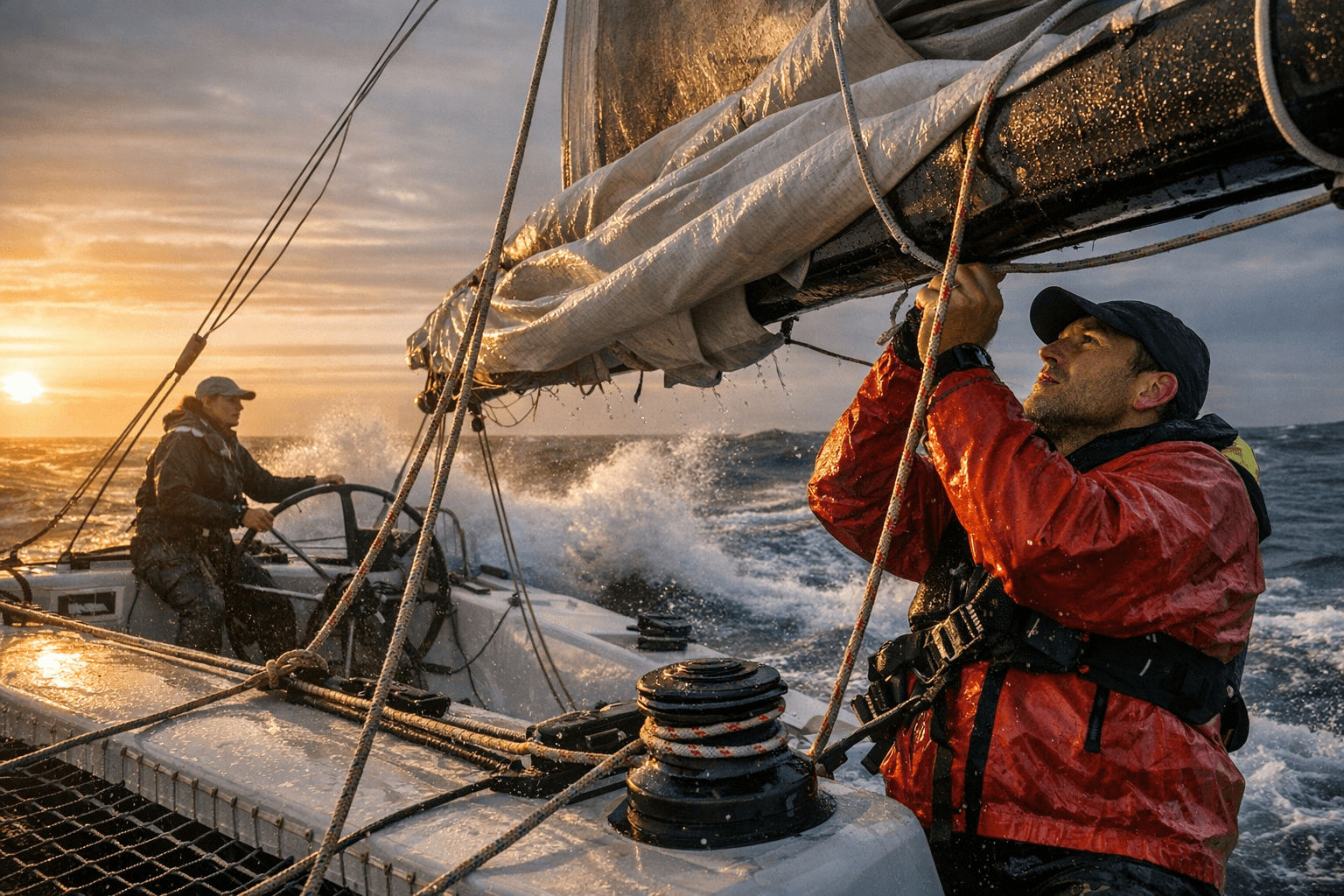
Catamarans handle differently from monohulls: they resist heeling, accelerate quickly, and have different stowage and visibility characteristics. This evergreen primer focuses on practical techniques for short-handed crews and those preparing for offshore passages." That opening captures why the handling playbook matters: multihull momentum and stability change how and when to reduce sail, trim, and redistribute weight.
Safety and conservative decision-making run through the guidance. Doylesails cautions: "If the wind is expected to increase, I’d confidently change down at these minimum wind speeds, but if the wind is oscillating up and down in strength I would make sure the wind was really holding above that minimum wind speed before reefing." For uncertain conditions the counsel tightens: "And if unsure of what is going to happen with the wind – when sailing into squalls, into night time, or into gusty offshore winds near high land and headlands – then I would always aim to err on the side of caution. When cruising, being set up for the higher wind speeds than expected, is an old axiom."
Practical sail-management is given as an ordered sequence for depowering that short-handed crews can rehearse. Doylesails lays out the starting move: "As it gets windier, the first thing I would do is ease just a little mainsheet, to mark 2 or 3 on your scale so that the top of the main opens a little to reduce the power up top, and to reduce all of the loads. All the leech telltales will be flying now." The next steps are simple and repeatable: "After that start easing the traveller down a little to depower further. Then, when you have 20% of the front of the sail luffing, its certainly time to reef, which will provide the same power, with less drag, so will be faster and safer."
Those procedural cues work as a rhythm for short-handed crews: reduce top tension, back off traveller, watch telltales and the luff, then reef before loads spike. The rationale is performance-minded and conservative at once: "When cruising or on delivery, I always like to learn the minimum wind speed that I can reef while maintaining a similar boat speed. That way there is less stress to the boat, rigging and crew. The centre of effort of the sails also goes down, so heel and pitching reduce. Downwind, the bow down trim will reduce and the boat will be safer and lighter on the helm."
Readers will want numbers for planning. Doylesails cites high-performance benchmarks from the MOD program and a contact at Ancasta: Graham Laver "sent me the sailing guide for the Lagoon 52." For the MOD platform the delivery targets are modestly sporty: "upwind we are happy to be doing 16 knots and downwind 25 knots, and we want to achieve those speeds with the minimum of sail. When racing of course we try to go faster with a 20 knots target speed upwind and 30 knots downwind!" For the MOD70 the reefing thresholds quoted are explicit: "As the boat is very powerful, we would go to second reef at 26 knots and third reef at about 33 knots on the MOD70, less on delivery of course."
What this means for catamaran crews is straightforward: practice the depowering sequence until it becomes reflex, learn the minimum-wind reef point that preserves speed, and adopt conservative reef triggers when the wind is variable or you are short-handed. For cruising cats like the Lagoon 52, check vessel-specific guides from your dealer or broker for numbers tailored to displacement and rigging; for high-performance platforms the MOD/MOD70 figures set a higher envelope. Mastering these steps reduces stress on gear, smooths helm feel, and keeps offshore passages safer and faster.
Know something we missed? Have a correction or additional information?
Submit a Tip