Practical Techniques and Professional Notes for Restoring Vintage Analogue Synthesizers
Juno 106 fixes and Roland‑stocked clones change the restoration playbook: expect VCF/VCA and PSU failures, pre-order parts, and lean on community clones where original ICs are unobtainable.

Vintage analogue synth restoration lives where practical diagnosis meets community engineering: expect repeatable faults, plan parts ahead, and accept that some original ICs are effectively gone, but skilled reverse engineering has closed critical gaps.
1. Why restoration matters: tactile play and creative workflow
A lot of professional musicians want the interaction of pushing buttons and twiddling knobs. It's part of the process, the creative aspect of making music,” Kent enthuses. Restoring a unit is not only about electrical reliability; it's about returning the performative interface that changes how players think and interact with sound. Restorations that preserve or restore tactile controls deliver immediate creative value onstage and in the studio, as Kent notes that "changing the sound in real time...is going to change your mind set."
2. Expect repeatable failure patterns (triage by model)
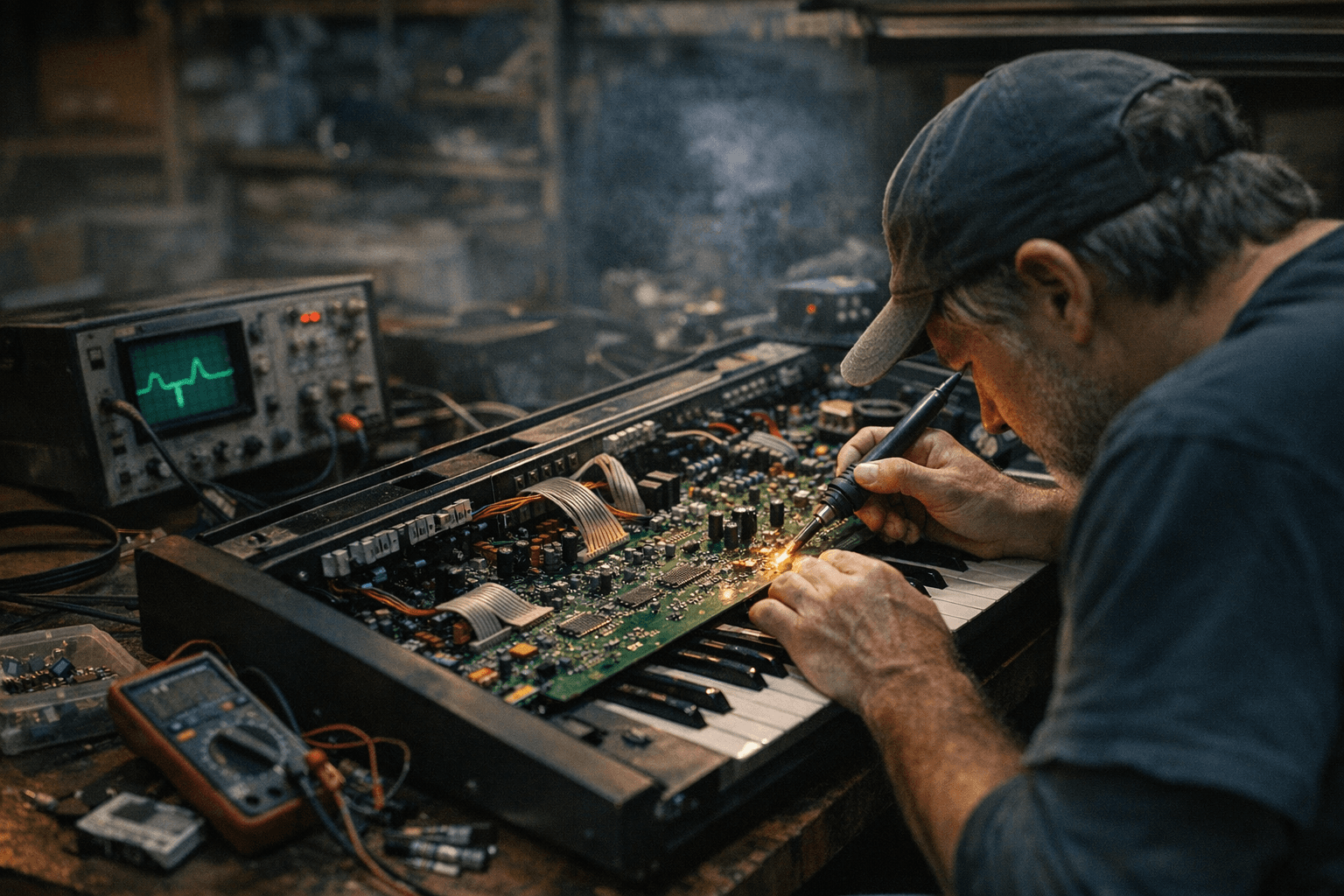
"We generally find a lot of machines tend to fail in the same areas,” Kent says. The most common recurring issues identified in longform repair practice are voice-board VCF/VCA IC failures and power-supply problems. Use model‑specific symptom lists, for example, the classic Juno 106 symptom "one key of every six on their Juno 106 doesn't work" typically points to a failed VCF/VCA on a specific voice board, to shortcut initial diagnostics and reduce shop time.
3. Make parts scarcity central to your plan
A perennial problem for synth restorers is finding components, especially obscure integrated circuits. Obsolescence of certain ICs means that sourcing becomes a restoration strategy in itself: allocate budget and time for rare parts, build networks with specialist suppliers, and track third‑party clone projects that reproduce hard‑to-find controllers. Include stock checks and lead‑time in customer quotes so clients understand that parts availability, not bench time alone, often sets the schedule.
4. Pre‑order critical replacement parts and streamline workflow
"When someone phones me up to say one key of every six on their Juno 106 doesn't work, I'll tell them the VCF/VCA has probably gone on the voice, order the part ahead of time, and when the Juno arrives I'll open it up and lo, that's the IC that's blown." Use that exact approach: anticipate the most likely failure, order the likely replacement before the unit arrives, and book teardown and validation in a single visit. This reduces turnaround and avoids the costly back‑and‑forth of multiple service calls; set up a parts‑ahead checklist per model to standardize the practice.
5. Treat power supplies as first‑class diagnostics
"It's one of the most common faults, alongside power-supply problems." PSUs vary wildly between models: "Some synths have PSUs barely capable of running them, while others are overrated." Use systematic PSU checks (voltage rails under load, ripple, capacitor ESR) as the second step after voice‑board triage. Anecdotes aside, for perspective, "The PSU in a CS80 could power a whole village without trouble,” which underscores how different design philosophies affect both failure modes and repair approaches. Prioritize safe, well‑documented PSU work: measure under operational load and replace aging electrolytics and regulators before they take downstream chips with them.
6. Face the semiconductor reality: remanufacture is rarely an option
"With the silicon wafers of chips of the time fabricated with a six‑micron process, compared to today's wafers measured in nanometers, there is little chance of remanufacturing the ICs today, even if the dies, long since lost, could be found or reverse-engineered." That technical constraint has two immediate implications for restorers: you cannot assume an original-secondhand IC will be replaceable indefinitely, and remanufacturing original dies at modern fabs is effectively infeasible. Plan for substitution strategies (NOS stock, functional drop‑ins) or adopt community clones where available.
7. Leverage community reverse engineering and vetted clones
"Undeterred, electronics sages have tackled that very problem." A high‑profile example: Jeroen Allaert from Ghent in Belgium spent years reverse‑engineering the original Juno 106 VCF/VCA controller PCB to produce a perfect clone that solves the manufacturing defects of the original. That work demonstrates how meticulous reverse engineering can yield improved, reliable drop‑in parts, and manufacturers sometimes accept that reality: "What do Roland think about this? They stock his parts." For restorers, community clones can be a reliable path forward, but treat them like any supplier: verify compatibility, test extensively, and document serial numbers and batch revisions for warranty work.
- Diagnosis flow: cosmetic → power rails → voice boards → control panel electronics → final audio test.
- Parts policy: pre‑order the most likely ICs for common symptoms and keep a small NOS/clone inventory for high‑failure models.
- Safety: always check electrolytic condition and perform isolation testing after PSU repairs; label and photograph wiring before disconnecting.
- Documentation: log part numbers, reasons for substitution, and test voltages; that record saves time on future call‑backs. These steps reflect the pragmatic, repeatable practices recommended by experienced technicians in the field.
8. Practical shop checklist for a restoration job
9. Model case studies you can apply immediately
Juno 106: use the "one key of every six" symptom as a triage flag for VCF/VCA ICs; pre‑order the likely replacement and prioritize voice‑board inspection on arrival. CS80: treat the PSU as a significant subsystem, its overbuilt capacity historically reduces risk of PSU‑caused failures, but age still dictates routine cap and regulator checks. These model‑specific heuristics reduce diagnostic time and set realistic customer expectations.
10. Verification, vendor relations, and next steps
Treat third‑party solutions and manufacturer statements as items to verify in your shop procedures. The existence of clone projects and reported manufacturer stocking arrangements is a game changer, but confirm availability and compatibility before promising turnaround times. Maintain direct lines to trusted clone authors and manufacturer parts teams; when possible, document those communications as part of the job file.
Conclusion Restoring vintage analogue synths is a mix of pattern‑recognition diagnostics, careful parts management, and community‑driven engineering. Expect voice‑board VCF/VCA faults and PSU issues, accept semiconductor limits on remanufacture, and lean on vetted reverse‑engineering projects where originals have vanished, those practices keep restored instruments playable, reliable, and true to the tactile experience that defines why players care.
Know something we missed? Have a correction or additional information?
Submit a Tip