Putin Moves Boldly to Cut Russians Off From the Internet
Russia's internet blackouts left parents of diabetic children unable to monitor blood sugar remotely, part of a sweeping Kremlin crackdown that began in Moscow in March 2025.
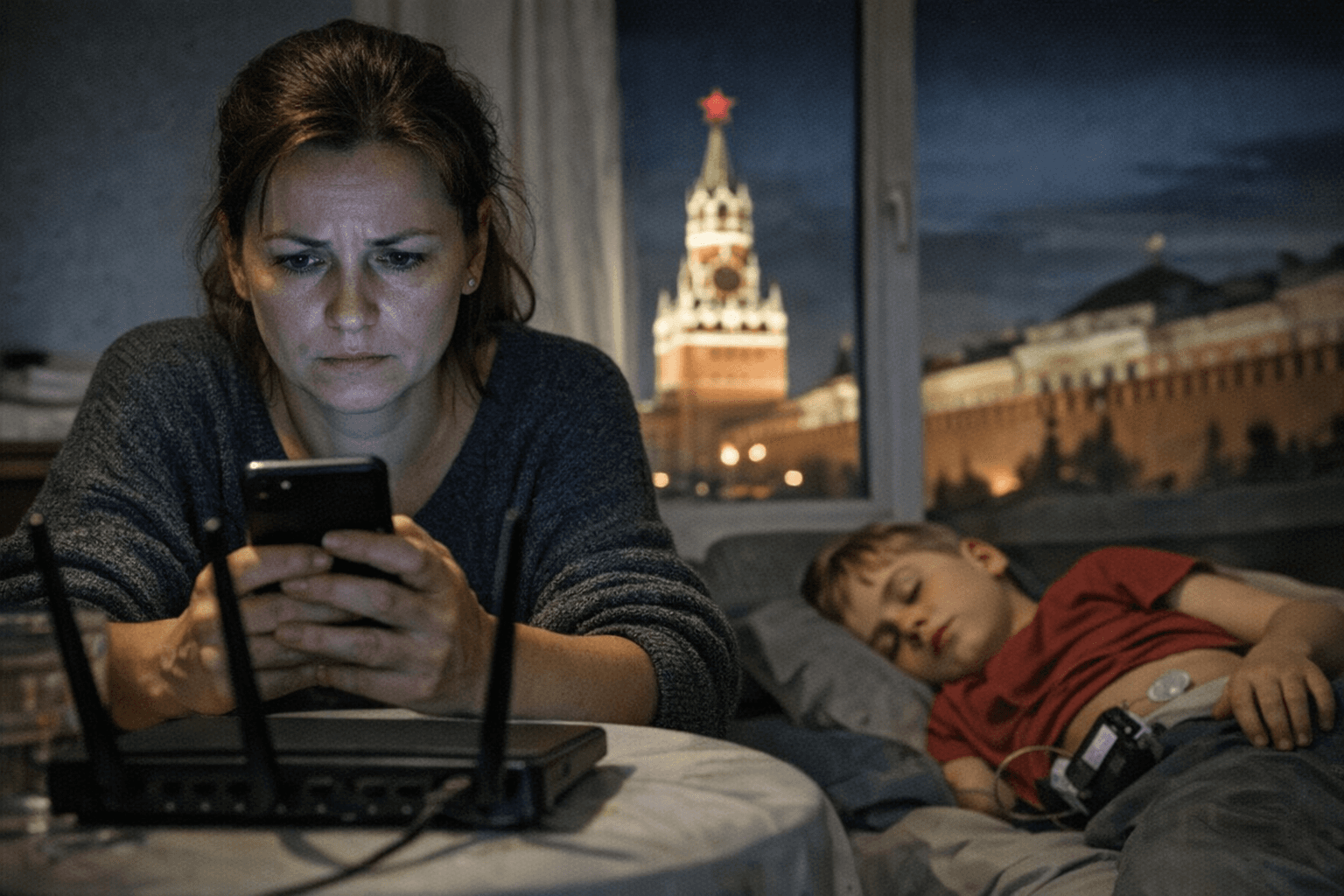
Parents of children with diabetes in Russia resorted to staying home just to maintain a Wi-Fi connection strong enough to monitor their children's blood sugar levels through phone applications. That ground-level consequence captured something broader: a systematic, Kremlin-driven effort to sever ordinary Russians from the open internet.
Since May 2025, Russia experienced frequent fixed-line and mobile internet shutdowns across the country, escalating a campaign that had begun months earlier in the capital. On March 5, 2025, the Russian government cut mobile internet and public Wi-Fi in Moscow. Ten days later, authorities began shutting down mobile internet across Moscow Oblast. The outages continued from there.
The Russian news agency RBC, citing its sources, reported that the blackouts were due to the testing of "white lists," government-approved sites that remain accessible during internet shutdowns. Leonid Iuldashev, from eQualitie, a Canadian company that develops censorship circumvention tools, told the Kyiv Independent the rollout was anything but orderly. "Since the beginning of March, authorities started to implement 'white lists' in Moscow for the first time, but in a very chaotic way," he said. Authorities were testing whether they "can turn them on for a particular house, for a particular district, for a particular street, and what the collateral damage would be."
The official justification offered by Russian authorities held that outages were necessary to prevent Ukrainian drone attacks, some of which use mobile connectivity for navigation. That explanation found few believers. Ukrainian drones continued reaching targets inside Russia even as users in Kamchatka, some 4,350 miles from the Ukrainian border, were told "security concerns" explained their lost connectivity. Russians who spoke to NBC News, independent experts and even the country's hard-line pro-war bloggers questioned the rationale.
Russian columnist Sergei Parkhomenko framed the campaign in starker terms. "It's a general drive to restrict all forms of communication and access to independent information, and to establish control over any communication," he told the Kyiv Independent. "Any communication is dangerous for a totalitarian regime during wartime."
The legal architecture for permanent control was taking shape alongside the technical rollout. The Russian Duma was reviewing a bill that would allow the Federal Security Service to order telecom operators to shut down communication services on request, "to protect against emerging threats to the security of citizens and the state."
The everyday toll was immediate. Ordinary Russians found themselves unable to make calls, order taxis or pay for groceries while away from home. Small businesses absorbed the disruptions repeatedly, and residents began carrying cash or confined themselves to locations with reliable Wi-Fi connections. Darbinyan, cited by NBC News, said the outages were causing "huge discontent" among the Russian public, pressure the analyst warned the Kremlin could not simply ignore.
Russia's trajectory drew direct comparison to Iran, where authorities cut citizens off from the internet for weeks after cracking down on nationwide unrest. According to an analysis from London-based think tank Chatham House, Iran now permits access to the global internet only for those holding security clearance, a model that Russia's house-by-house white-list testing appeared to be approaching methodically, if chaotically.
Russians had already absorbed drone attacks overhead, rising prices and four years of wartime restriction on free speech. The internet crackdown pushed into new territory: the severing of the unremarkable digital infrastructure that modern daily life is built on.
Know something we missed? Have a correction or additional information?
Submit a Tip

