Radiohead Reunion Draws Record Crowds, Topples Hard Rock Attendance Marks
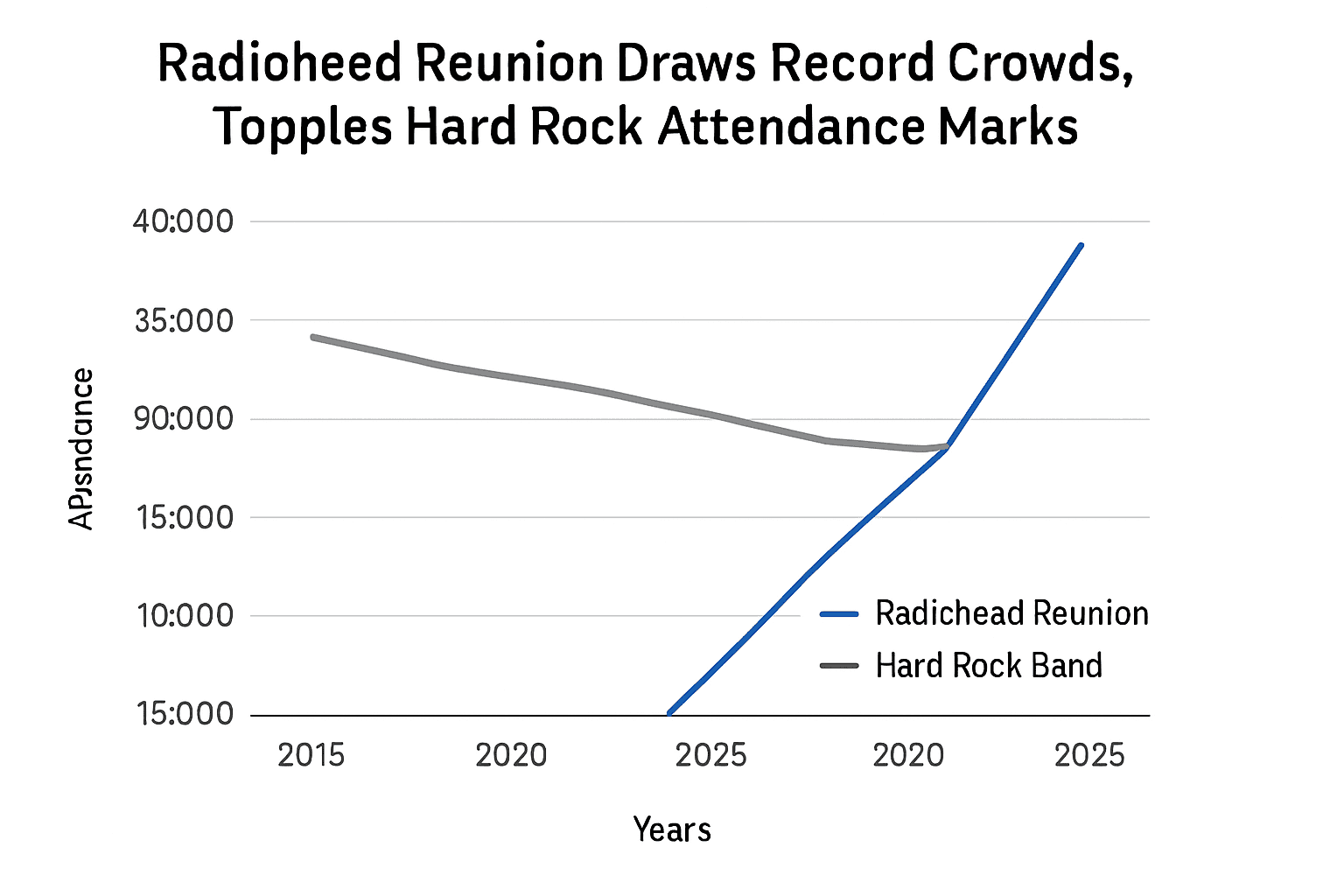
Radiohead’s European reunion shows in late November shattered attendance and engagement records previously held by a noted hard rock band, signaling a seismic moment for legacy acts returning to the road. The band’s surprise setlist choices and palpable fan reaction across Bologna, Copenhagen and Berlin underscore a renewed appetite for communal live music experiences, with broad business and cultural consequences.

Reports published November 30, 2025 and republished by Yahoo from Parade detailed that Radiohead’s recent European reunion dates surpassed attendance and engagement records that had stood for years under a noted hard rock band. The milestone came as the group played arenas and large venues in Bologna, Copenhagen and Berlin, delivering nights that mixed deep catalogue immersion with unexpected rarities and a level of audience intensity that industry observers called notable.
The reunion marked Radiohead’s return to large scale touring after a hiatus from arena level runs. Promoters and local partners in each city reported surges in adjacent economic activity as fans traveled internationally, filled hotels and patronized restaurants ahead of performances. The tour’s momentum across key European stops has already altered conventional wisdom about the commercial power of legacy alternative acts, demonstrating that carefully staged returns can rival the box office draw traditionally associated with arena filling rock bands.
Musically, the shows were notable for setlist surprises. Radiohead pulled out rarely played tracks alongside their most streamed anthems, a programming choice that rewarded long time fans and created viral moments on social platforms. That mix of nostalgia and rarity helped deepen engagement metrics across streaming services and social media, translating to renewed consumption of back catalogues and spikes in related merchandise sales. The balance of familiarity and scarcity has quickly become a model for reunion strategies, highlighting how scarcity of live performances can amplify cultural value.
The significance reaches beyond ticket tallies. Radiohead’s success in reclaiming the spotlight speaks to shifting audience desires toward immersive, thoughtful performances that blur the line between spectacle and intimacy. Where a hard rock model often emphasizes volume and mass spectacle, Radiohead’s approach fused sonic intricacy with visual design, offering an experience that appealed to both long time devotees and younger listeners discovering the band online. This cross generational appeal is increasingly valuable in an industry where streaming algorithms and social virality can rapidly reframe an act’s relevance.
There are also business lessons for promoters, labels and artists. The ability of a reunion to outdraw a competitor’s long standing record highlights the premium placed on first run reunions and curated setlists. It raises questions about ticket allocation, dynamic pricing and secondary market activity, as well as the sustainability of tours that leverage scarcity to drive demand. Meanwhile, local economies benefit from influxes of cultural tourism, reinforcing the role of major concerts as economic multipliers for host cities.
Socially, the shows offered a reminder of the communal power of live music after years of digitally mediated experiences. Fans converged not only to hear songs, but to participate in a shared cultural moment that reaffirmed music’s capacity to create collective memory. As Radiohead’s European leg concludes, the broader industry will be watching whether this model can be replicated by other legacy artists seeking both commercial success and deeper cultural resonance.
This article was produced by Prism’s automated news system from verified source data, official records, and press releases, then run through automated quality and moderation checks before publishing. The system is built and supervised by the people who set the standards it runs under. Read our full AI policy.
Did this article answer your question?