Raqqa, Ancient Euphrates City, Hopes for Change After Years of Ruin
Raqqa’s ruined streets show how a city can survive one ruler after another yet still struggle to recover the basics of life. Its latest political turn has not erased the physical and psychological damage left behind.
A city where history and ruin sit on the same ground
Raqqa stands on a layer cake of civilizations, and that history is part of what makes its present so stark. The city sits on the Euphrates River just west of its meeting point with the Balikh River, on land once home to the ancient Greek city Nicephorium and later the Roman fortress and market town Callinicum. In early Arab times, it flourished again when Abbasid caliph Harun al-Rashid made it a headquarters against the Byzantines and built palatial residences there.
That long arc matters because Raqqa has never been only a wartime headline. It has been a river city, a trading point, a military outpost, a seat of power, and then, over and over, a place reshaped by outside force. The city’s modern story is not just one of destruction, but of repeated interruption, where each new ruler leaves its mark and each collapse resets daily life.
Modern growth, then collapse
Raqqa’s modern expansion accelerated after construction began on the Tabqa Dam in 1968. The dam helped spur growth and tied the city more closely to the larger economy of the Euphrates valley. That development, however, did not shield Raqqa from the next wave of upheaval.
From 2014 until 2017, the Islamic State controlled the city and turned it into the de facto capital of its self-declared caliphate. The group’s hold on Raqqa transformed the city into a symbol of terror and centralized rule, but the period that followed was no clean liberation from damage. It was a transition from one form of domination to another kind of emergency: a shattered urban landscape, weakened institutions, and a population left to navigate what remained.
What the battle left behind
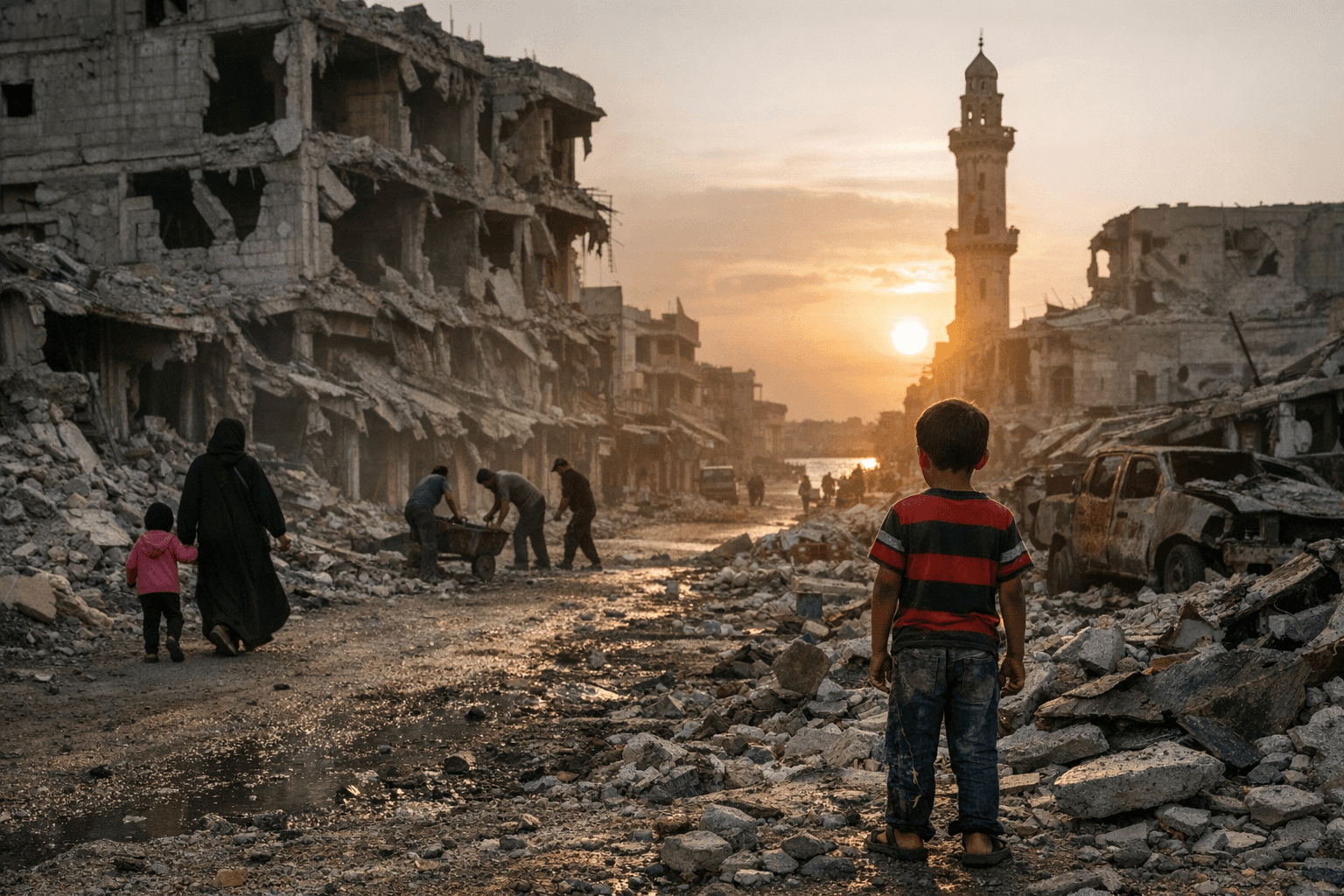
The Syrian Democratic Forces announced Raqqa’s liberation in October 2017 after a four-month battle that devastated much of the city. Assessments cited by the United Nations and later referenced by RAND estimated that about 11,000 buildings were damaged or destroyed between February and October 2017. The destruction reached far beyond private homes. Eight hospitals, 29 mosques, more than 40 schools, five universities, and the city’s irrigation system were among the damaged structures.
RAND said Raqqa was left largely uninhabitable after the battle, and its estimates suggest the scale of damage was not symbolic or isolated. It was civic in the deepest sense: hospitals, classrooms, places of worship, and the water network were all hit, meaning recovery was never only a matter of clearing rubble. It required rebuilding the systems that make urban life possible in the first place.
By RAND’s account, as many as 80 percent of buildings were uninhabitable after the fighting. That figure captures the core reality of Raqqa’s recovery: when the built environment is damaged at that scale, return is slow, expensive, and uneven. Families can come back to neighborhoods that still lack safe shelter, functioning services, and the confidence that what they rebuild will remain intact.
Reconstruction that never matched the need
Years later, the distance between the language of recovery and the reality on the ground remained wide. Local reporting in 2024 described the city as still about 50 percent in ruins, with reconstruction moving slowly. Residents and local contractors continued to complain that Raqqa remained heavily damaged and under-served, a sign that rebuilding had not kept pace with the magnitude of the destruction.
That gap is central to understanding post-ISIS recovery. Removing a militant organization is not the same as restoring governance, services, or trust. In Raqqa, the physical damage became a political problem and a social wound. Broken roads, ruined schools, and damaged water infrastructure are not just engineering challenges; they shape whether people believe the state, any state, can protect them or meet basic needs.
The Associated Press reported that six months after the group’s ouster, residents felt abandoned as they tried to rebuild amid rubble and unexploded dangers. That early sense of neglect helps explain why recovery in Raqqa has often been described in terms of absence. The city was liberated militarily in 2017, but the everyday experience for many residents remained one of waiting, patching, improvising, and living with uncertainty.
Another abrupt change in rule
Raqqa’s latest political shift arrived in January 2026, when Syrian government forces retook the city from the Syrian Democratic Forces during a broader northeastern Syria offensive. The move added yet another abrupt transfer of power to a city already shaped by repeated conquest and instability.
The change in control matters because Raqqa’s reconstruction has always been tied to who governs it, who funds it, and whose institutions are allowed to function there. The city has lived under shifting authorities that have brought competing agendas, uneven service delivery, and uncertain long-term planning. Each transition raises the same practical questions for residents: who repairs the water lines, who secures the schools, who clears the ruins, and who is accountable when those tasks are delayed?
Why Raqqa remains a test case
Raqqa is more than a damaged Syrian city. It is a measure of what post-ISIS recovery really means when a place has already survived ancient rise and fall, medieval power, modern development, extremist rule, and war. Its history makes it resilient; its recent past makes that resilience costly.
The city’s central problem is not only the scale of destruction, though that scale is enormous. It is the mismatch between a political story of change and a lived reality of ruin. Buildings can be counted, roads can be cleared, and institutions can be renamed, but the deeper damage in Raqqa is also psychological. People are asked to treat each new authority as the beginning of a better chapter, even as the scars of the last one remain visible in the streets, the schools, the hospitals, and the empty spaces where homes once stood.
Raqqa’s future will depend on more than who controls the city at any given moment. It will depend on whether governance can outlast the cycle of conquest, and whether rebuilding can finally match the scale of what was destroyed. Until then, the Euphrates city remains what history has made it: a place where power passes through quickly, but the ruins stay much longer.
This article was produced by Prism’s automated news system from verified source data, official records, and press releases, then run through automated quality and moderation checks before publishing. The system is built and supervised by the people who set the standards it runs under. Read our full AI policy.
Did this article answer your question?