Rare ant species appears to run a carwash for harvester ants
A tiny desert ant has been seen licking and nipping a much larger harvester ant, a pattern that may mark the first cleaner-ant partnership known to science.
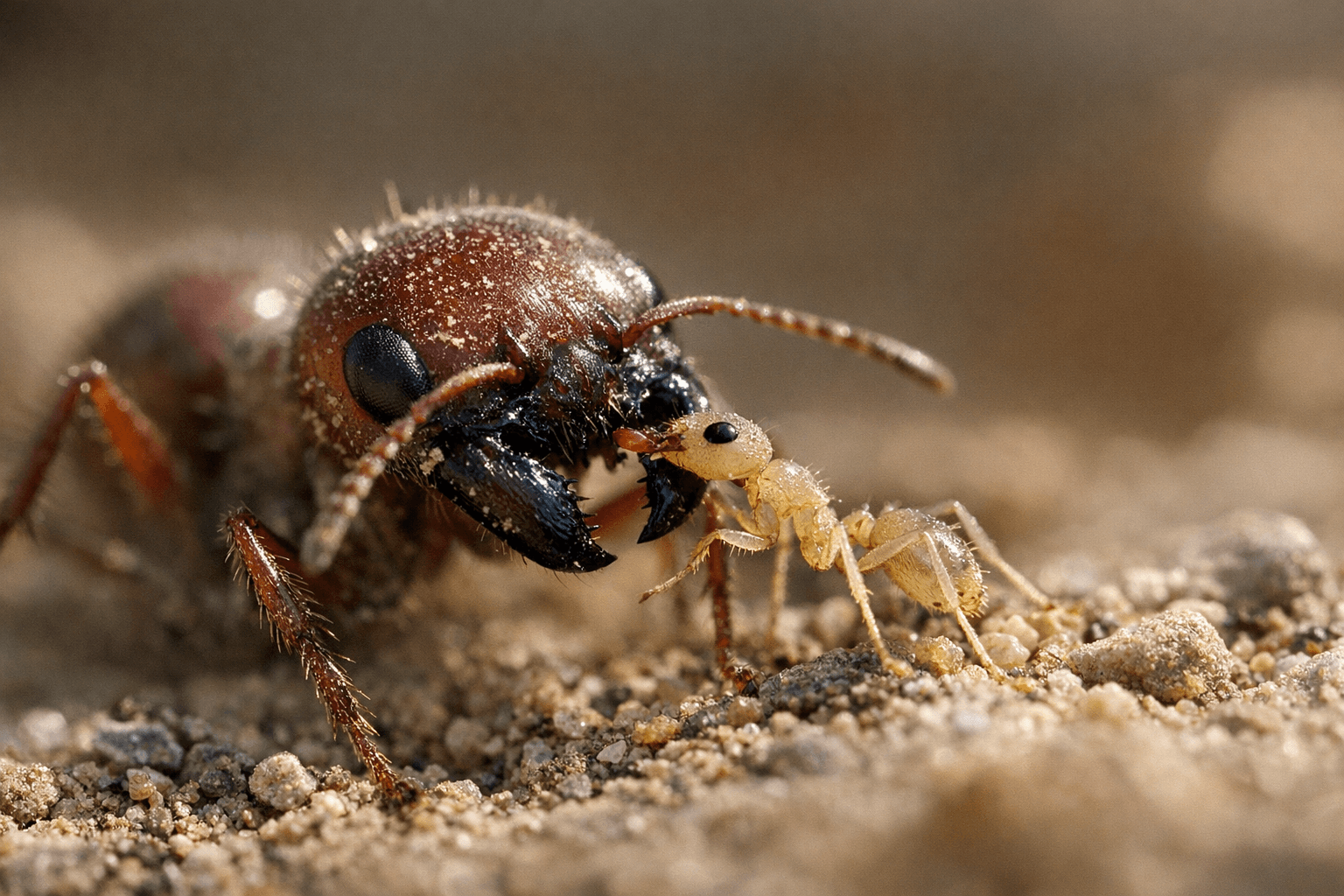
A tiny, undescribed Dorymyrmex ant in Arizona may be doing more than scavenging around a harvester colony. Mark Moett of the Smithsonian National Museum of Natural History described a repeated cleaning routine in which the smaller ants lick and nibble on workers of the much larger Pogonomyrmex barbatus, behavior he says closely parallels the way cleaner fish service larger fish.
The interaction, laid out in a March 12, 2026 preprint titled The First Cleaner Ant? A Novel Partnership in the Arizona Desert, stands out because it was not framed as a random encounter. Moett reported that Pogonomyrmex workers often stationed themselves near Dorymyrmex nest entrances and even allowed the smaller ants to inspect the space between their open mandibles. That sequence of actions suggests a stable cross-species arrangement, not a one-off curiosity.
The biological stakes are significant. If the pattern holds up, it would be the first known example of one ant species cleaning another in a manner parallel to cleaner fish. Yet Moett’s paper also stops well short of proving the exchange works like a true mutualism. The fitness payoffs for both species have not been established, leaving open the question of whether the harvester ants are gaining hygiene, parasite removal or some other benefit, and whether the Dorymyrmex are getting food, protection or access to resources in return.
The setting matters as much as the behavior. Harvester ants in the genus Pogonomyrmex are widespread across the deserts of North, Central and South America, and researchers have described their ecological roles as well-supported and often keystone in natural and managed systems. In deserts such as the Mojave and Sonoran, ants are also classic model organisms because they live in colonies, excavate deep nests and store food for seasons when the landscape turns unforgiving.
That harshness helps explain why desert ants have drawn so much scientific attention. Some species, including desert ants in the genus Cataglyphis, can tolerate surface temperatures of 60 C, 140 F, or higher for short periods. Against that backdrop, a possible cleaning partnership between two very different ants adds a new layer to the study of desert adaptation, showing how cooperation and specialization can evolve even where heat and aridity set the terms of survival.
This article was produced by Prism’s automated news system from verified source data, official records, and press releases, then run through automated quality and moderation checks before publishing. The system is built and supervised by the people who set the standards it runs under. Read our full AI policy.
Did this article answer your question?