Rare corpse flower blooms again at Mount Holyoke, drawing crowds
Pangy, Mount Holyoke's corpse flower, drew crowds back to Talcott Greenhouse as its rare bloom opened and its rotten-flesh odor filled the air.
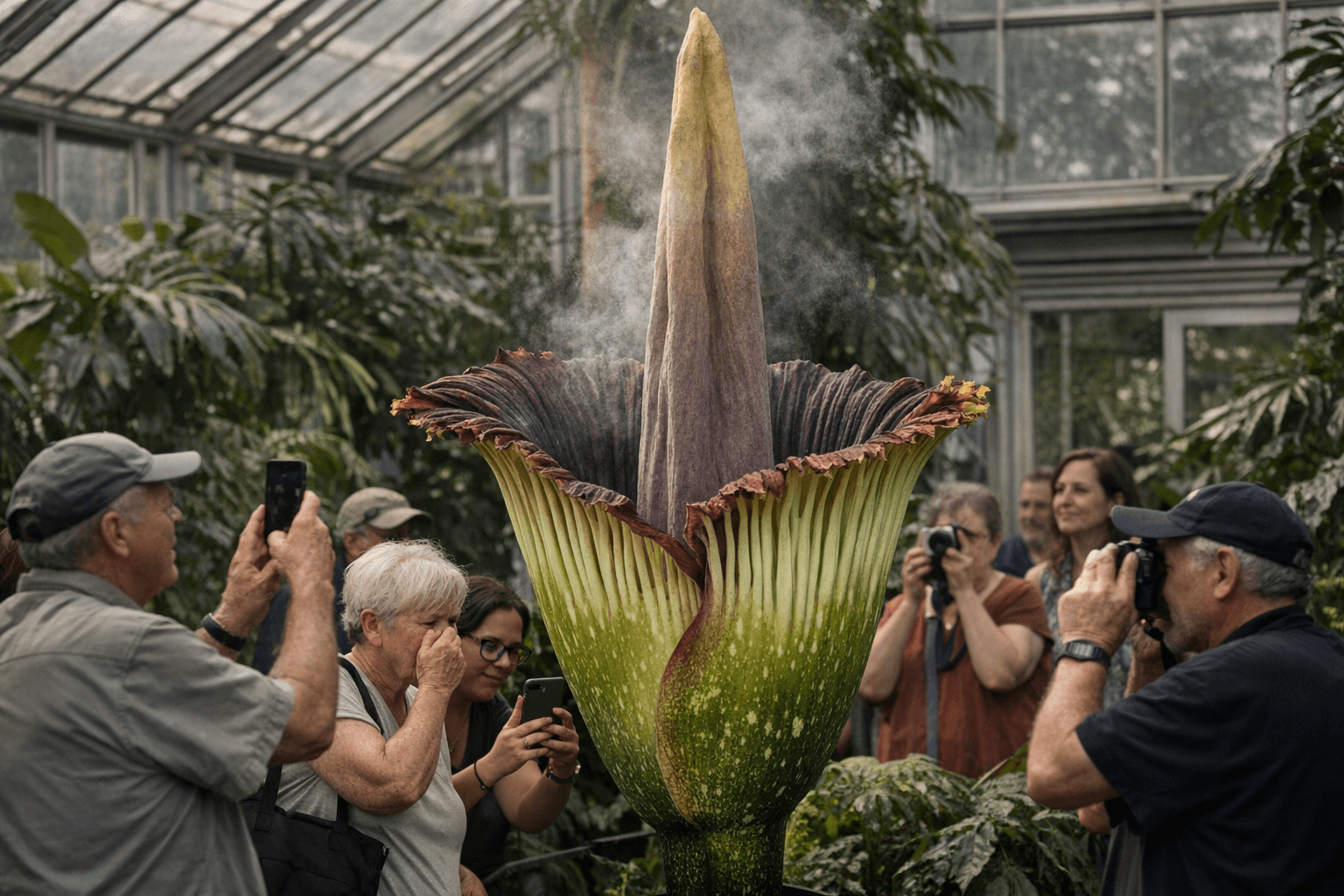
Crowds gathered at Mount Holyoke College’s Talcott Greenhouse in South Hadley, Massachusetts, for a rare plant spectacle that lasted only a few days at most. The corpse flower nicknamed Pangy opened again, sending visitors toward the greenhouse for the chance to see, and smell, one of botany’s most elusive events.
The attraction was more than novelty. Mount Holyoke’s Botanic Garden includes the Talcott Greenhouse and surrounding gardens, a Victorian-era complex that houses more than 2,000 plant types from six continents. That setting has turned each bloom into both a campus event and a public science lesson, with the garden’s mission centered on education, research, conservation and engagement.
Pangy is Amorphophallus titanum, a species native to the rainforests of Sumatra and known for blooming infrequently after long stretches of dormancy. What appears to be a single giant blossom is actually an inflorescence, a cluster of many tiny flowers arranged around a central spadix and wrapped by a purple, velvety spathe. Its infamous odor mimics decaying organic matter and helps lure flies and beetles that carry pollen from one plant to another.
Mount Holyoke staff said Pangy had grown quickly in the weeks before opening, sometimes several inches a day. In 2023, the plant measured 41 inches on April 28, reached 60.5 inches the next week and hit 66 inches before it opened the following morning. Tom Clark, the botanic garden’s director and curator, said at the time that flies were being duped into acting as pollinators.
The college received the specimen in 2020 from Dartmouth College as a young, dormant corm. Mount Holyoke says the plant is one of three corpse flowers in its collection, and this one is the largest and most active. That makes each bloom a high-stakes moment for the greenhouse staff, who can notice the smell as soon as they arrive the next day.
The species’ rarity gives the crowds their urgency. The International Union for Conservation of Nature lists the corpse flower as Endangered, with fewer than 1,000 mature individuals left in the wild. Habitat loss in Sumatra remains a major threat, adding conservation weight to a bloom that can otherwise seem like a curiosity. At Mount Holyoke, it also serves as a reminder that unusual plants can build public interest in the science and protection of threatened species.
This article was produced by Prism’s automated news system from verified source data, official records, and press releases, then run through automated quality and moderation checks before publishing. The system is built and supervised by the people who set the standards it runs under. Read our full AI policy.
Did this article answer your question?


