Rare Jefferson draft of Declaration of Independence goes on display at Library of Congress
Jefferson’s June 1776 draft, marked up by Franklin and Adams, opened at the Library of Congress as a view into how the Declaration was negotiated.
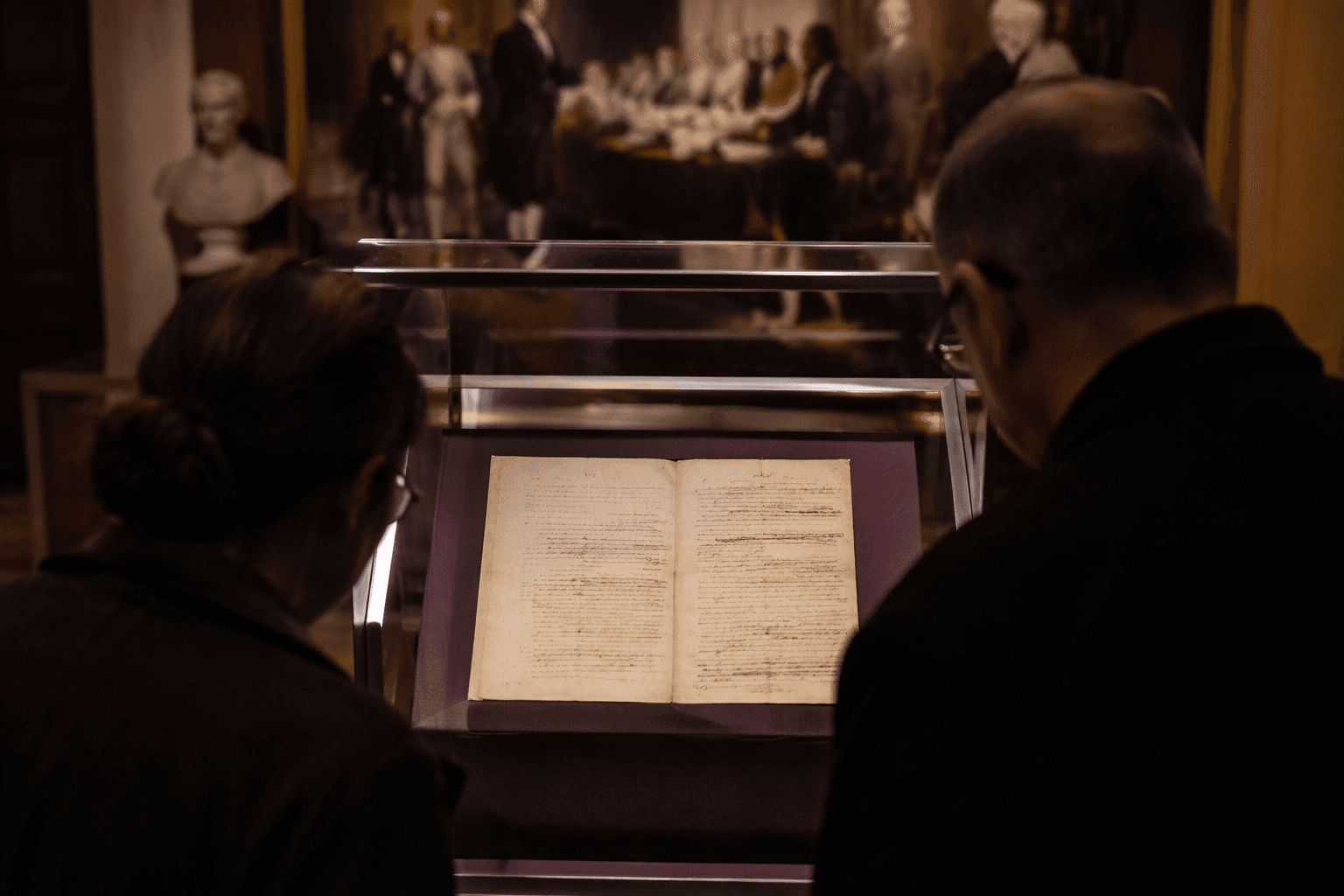
The Library of Congress put Thomas Jefferson’s handwritten “original Rough draught” of the Declaration of Independence on display, exposing the edits that helped turn a private composition into a public statement of revolt. The draft carries changes from Benjamin Franklin and John Adams, making the page itself a record of how the founding language was argued over, sharpened, and strategically framed before Congress adopted the Declaration on the morning of July 4, 1776.
The new exhibition, The Declaration’s Promise: A Revolutionary Idea, opened July 3 in the David M. Rubenstein Treasures Gallery and will remain on view through July 3, 2027. Part of America 250 programming, the exhibition brings together more than 120 treasures from the Library’s collections and begins with the Revolutionary moment before organizing other materials around the Declaration’s best-known phrases and ideas.
Jefferson wrote the draft in June 1776 after Congress appointed the five-member Declaration Committee on June 11: Jefferson of Virginia, John Adams of Massachusetts, Benjamin Franklin of Pennsylvania, Roger Sherman of Connecticut, and Robert R. Livingston of New York. The Library says Jefferson borrowed ideas and phrases from the Virginia Declaration of Rights, including the concept that people should have the pursuit of happiness, showing that the document was built from earlier political arguments as much as from one man’s pen.
The draft has long counted among the Library’s signature treasures, and the institution previously displayed it with the desk on which Jefferson wrote it in an earlier exhibition. The Library said the draft and the desk were rejoined for the first time in nearly 60 years during that show, adding another layer to the object’s history as both a working artifact and a symbol of national origin.
The manuscript is also part of a separate America’s 250th birthday effort: a molecularly stored version of Jefferson’s rough draft is being placed in a time capsule in Philadelphia to be reopened in 2276. That project, together with the gallery exhibition in Washington, keeps the focus on the Declaration as a living political text whose promises of equality, liberty, and happiness have been revisited for more than 250 years.
This article was produced by Prism’s automated news system from verified source data, official records, and press releases, then run through automated quality and moderation checks before publishing. The system is built and supervised by the people who set the standards it runs under. Read our full AI policy.
Did this article answer your question?