Record heat gives way to freeze warning across New York region
Central Park hit 90 degrees, then the region faced freeze warnings days later, exposing crops, plumbing and spring-budding plants to sudden cold.
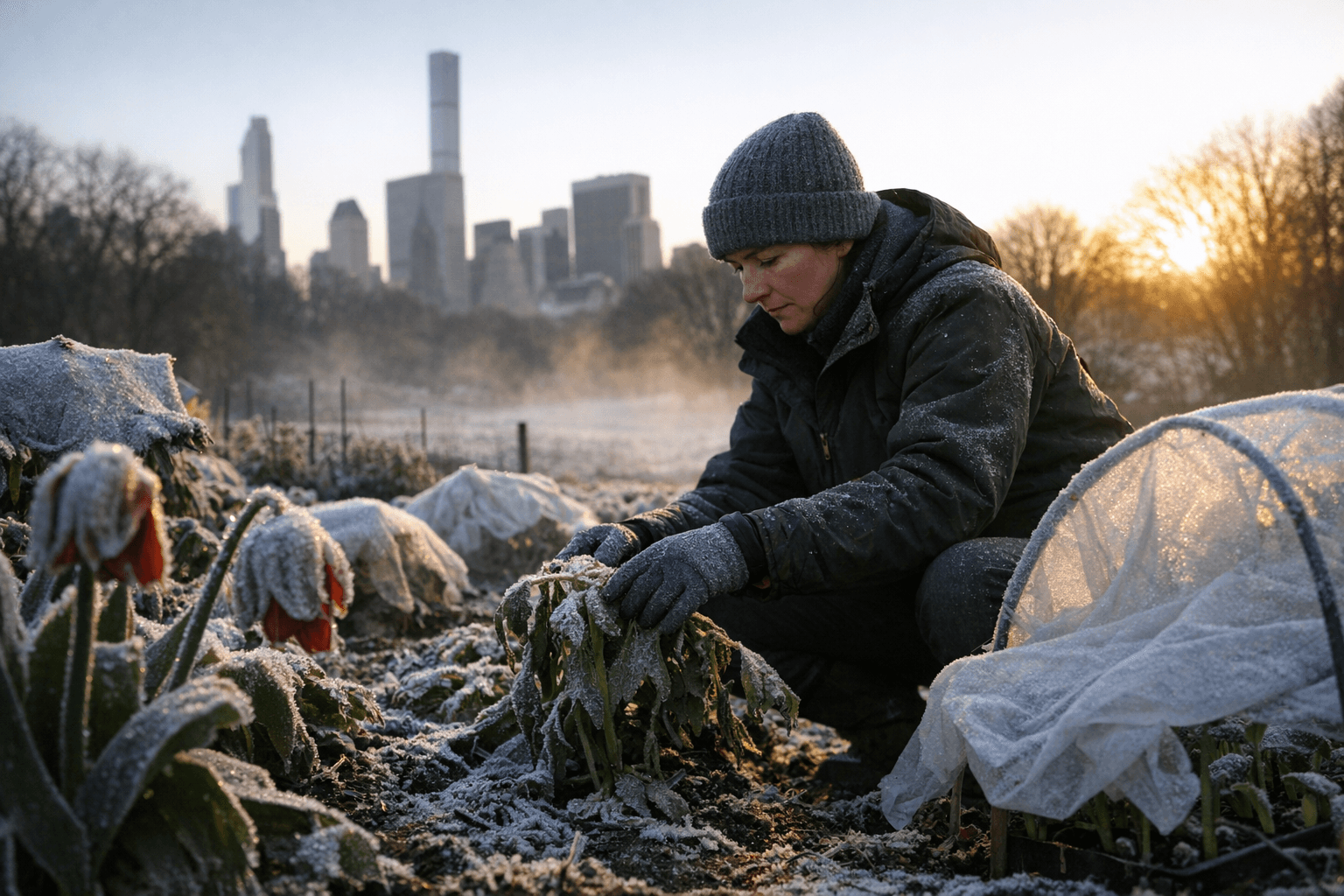
Central Park went from 90 degrees on April 15 to a freeze warning just days later, as a strong cold front pushed a much colder air mass into the New York region and raised the risk of damage to crops, gardens and outdoor plumbing.
The National Weather Service in New York said most of the earlier freeze watch had been upgraded to a freeze warning on April 19, with frost advisories also in place for parts of coastal Connecticut and outlying New York and New Jersey suburbs. The agency said the coldest temperatures were expected Monday night into Tuesday morning, with lows ranging from the mid-20s to the lower 30s across most of the area, while some locations in New York City and on Long Island could stay just above freezing.
That abrupt turn followed an unusually hot stretch in Manhattan. Preliminary climatological data for Central Park showed a high of 90 degrees on April 15, 89 on April 16 and 80 on April 17, after 87 degrees on April 14. For spring growers, the swing mattered as much as the numbers themselves: the weather service warned that frost and freeze conditions could kill crops and other sensitive vegetation, and could damage unprotected outdoor plumbing.
Forecasters said the threat was especially serious because the growing season had already started in some interior valleys, one reason some places were upgraded from watch to warning. A freeze watch remained in effect outside the New York City metro area for Monday night into Tuesday morning, the weather service said, while most of the region moved into a higher-alert freeze warning.
The cold snap was not limited to New York. NWS Boston/Norton had a freeze warning or freeze watch in effect on April 20, underscoring how late-season cold still reached southern New England even after the region’s recent warmth. The broader pattern fit a familiar spring problem in the Northeast: warm spells can push buds, blooms and early planting ahead of schedule, then a fast-moving cold front can erase the margin of safety in a single night.
Longer-range climate guidance pointed in a different direction, but not soon enough to blunt the immediate chill. NOAA’s Climate Prediction Center said ENSO-neutral conditions were favored through April-June 2026, with a shift toward El Niño later in the year, and its May outlook favored above-normal temperatures in the Northeast. For now, though, the region was bracing for a hard freeze after record heat, a reminder that spring in the Northeast can still turn from summerlike to wintry in less than a week.
This article was produced by Prism’s automated news system from verified source data, official records, and press releases, then run through automated quality and moderation checks before publishing. The system is built and supervised by the people who set the standards it runs under. Read our full AI policy.
Did this article answer your question?

