Rehabilitated cold-stunned 50-pound green sea turtle released at Islamorada's Founders Park
A nearly 50-pound green sea turtle nicknamed "Groundhog" was rescued Feb. 3 after cold-stunning, treated at the Turtle Hospital, and released Feb. 19 into Florida Bay off Founders Park Beach in Islamorada.
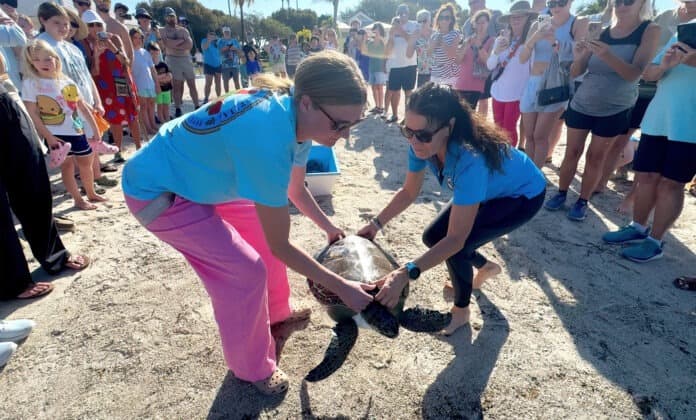
A nearly 50-pound female green sea turtle nicknamed "Groundhog," rescued Feb. 3 after suffering cold-stunning, was rehabilitated at the Turtle Hospital and released Feb. 19 into Florida Bay off Founders Park Beach in Islamorada, hospital staff said. Spectators cheered as Groundhog crawled into shallow water and swam away following the release led by Turtle Hospital staff and volunteers.
Groundhog was found floating and lethargic, classic symptoms of the hypothermic reaction called cold-stunning that occurs when sea turtles are exposed to cold water for prolonged periods, the hospital said. National Aquarium material notes cold-stunning typically occurs when water temperatures drop below 50 degrees Fahrenheit and leaves turtles weak, disoriented and unable to regulate buoyancy. Turtle Hospital manager Bette Zirkelbach said Groundhog was one of the first sea turtles rescued in the Florida Keys during the recent cold-spell event.
Zirkelbach described Groundhog’s care in detail: "We warmed her up, we treated her with fluids (and) a broad-spectrum antibiotic." Zirkelbach added, "Groundhog was a quick recovery," and said, "She was probably in good health when she was cold-stunned, good body weight and she was good to go home today." Zirkelbach was identified in the original account as manager of the world's first state-licensed veterinary center dedicated solely to treating sea turtles.
The Turtle Hospital’s approach in Groundhog’s case focused on warming and supportive care. Clinical accounts from other rehabilitation centers illustrate why gradual warming is standard practice: "When Radish arrived, she was alarmingly cold. The first step was taking a core body temperature, which revealed that the turtle was only 53 degrees Fahrenheit!" Karen Beasley Sea Turtle Rescue staff described placing severely cold turtles in a protected unheated space before moving them slowly into warmer tubs and then into a 75 degree hospital environment while administering fluids and removing barnacles as needed.
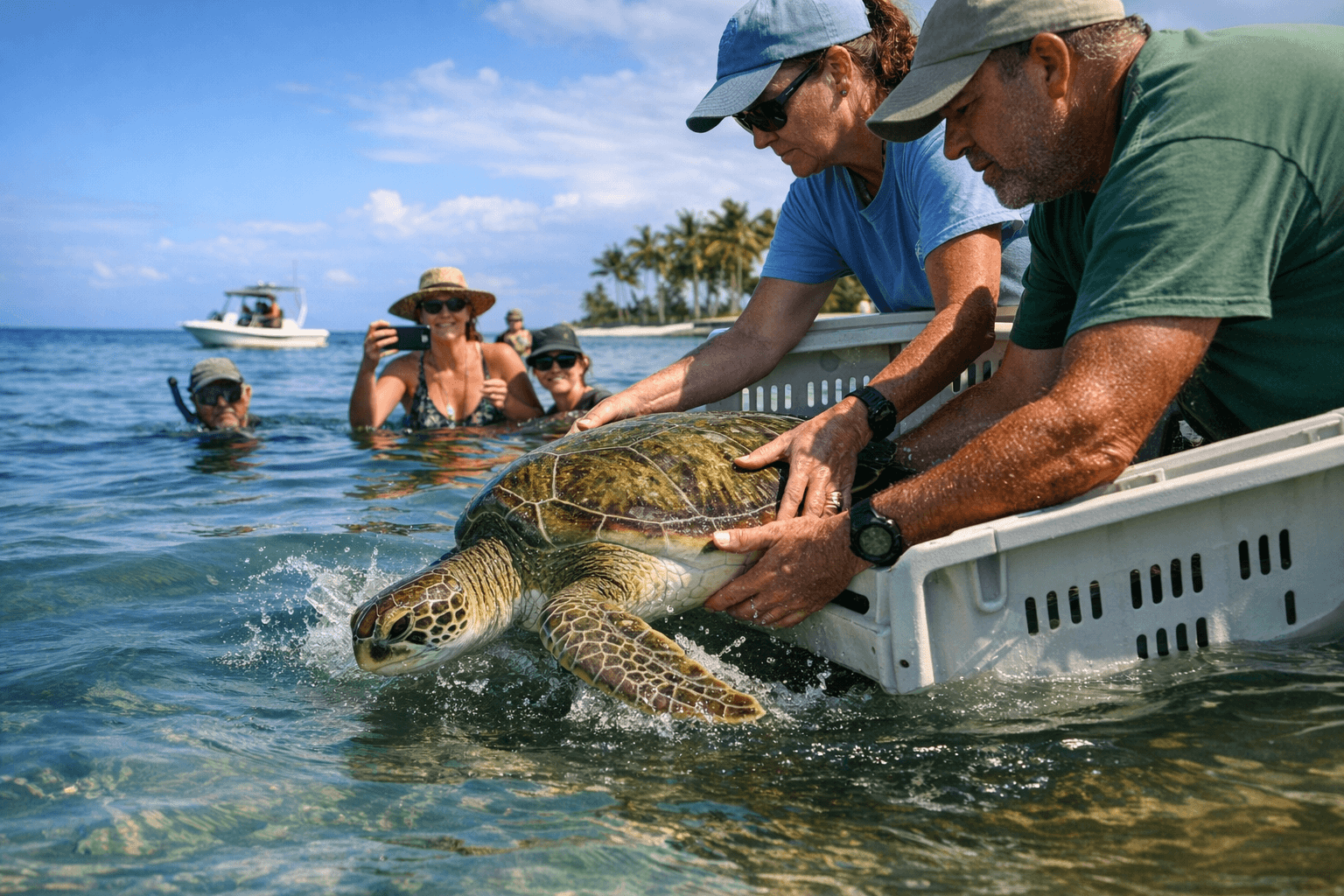
The Islamorada release comes amid larger cold-stunning operations elsewhere. As cold weather swept through Texas in early January, Texas State Aquarium reported that over 2,000 green sea turtles were found statewide. The Aquarium took in 755 turtles between January 1 and January 6 and said that between January 5 and January 9 a total of 716 rehabilitated turtles were returned to the water, including nearly 200 released offshore with U.S. Coast Guard assistance on January 5, 343 released at Padre Island National Seashore on January 6, and 130 released at a January 7 event that drew more than 1,000 members of the public.
NOAA noted that cold-stunning events occur annually in several U.S. regions and highlighted past large-scale responses, including more than 3,500 rescued in Texas during December 2017 and January 2018. The Turtle Hospital reported seven other cold-stunned turtles rescued in the Florida Keys during the same weather event; some of those patients have boat-strike wounds or fibropapillomatosis and remain under treatment at the hospital as staff and partners continue rehabilitation and monitoring.
Sources:
Know something we missed? Have a correction or additional information?
Submit a Tip